Click above Insightful Perspectives ☞ Click the top right corner…☞ Mark as favorite⭐
Insightful Knowledge | Proposing Insights
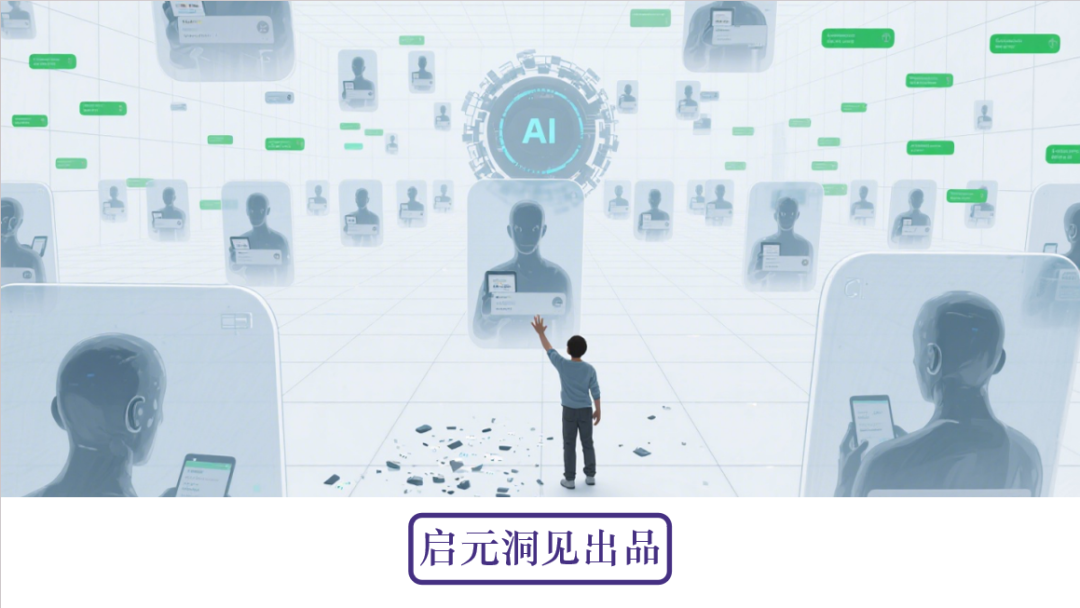
Introduction: On July 2, 2025, the Brookings Institution (Brookings) published an article “What Happens When AI Chatbots Replace Real Human Connection” (What happens when AI chatbots replace real human connection), which profoundly reveals a core paradox of our time: while technology connects us more than ever, the sense of social isolation among humans has reached an all-time high, with more and more people turning to AI for emotional solace. The article systematically analyzes the social background of the rise of AI companions, their potential risks to personal development, especially in the cognitive and emotional development of children and adolescents, and calls for society to resist the trend of “emotional outsourcing” and instead invest in building a “relational infrastructure” that supports real human relationships. Insightful Perspectives has compiled the core content for readers’ reference.
Click “Read the original” at the end for the full text
1. The Paradox of Our Time:
Embracing Machines in Loneliness
We are in a paradox that may define our era. Humans are inherently social beings, yet at the same time, increasingly sophisticated AI is becoming more talkative, communicative, and emotionally perceptive. Perhaps because of this, we are increasingly turning to machines for what we cannot obtain from each other: companionship.
A recent article in the Harvard Business Review (Harvard Business Review) pointed out that today in the U.S. and other similar social contexts, the primary application of AI is no longer automation or productivity enhancement, but companionship and psychological therapy. People are seeking comfort, conversation, and emotional support from chatbots, virtual avatars, and digital assistants.
AI companions such as Replika.ai, Character.ai and China’s “Xiaoice” have attracted hundreds of millions of users who invest genuine emotions—some estimates suggest that the total user count may exceed 1 billion. Data shows that in 2024, users of the companionship app Character.ai spend an average of 93 minutes daily interacting with user-generated chatbots. In addition to dedicated AI companions, general chatbots are increasingly being used to establish emotional connections.
Why is this happening? Because we are lonely.
Despite living in the most technologically connected era in history, the rate of social isolation in the U.S., especially among young people, is at a record high. Today, only 13% of American adults have 10 or more close friends, down from 33% in 1990. By 2021, the proportion of people with no close friends surged from 3% to 12%. This occurs at a time when 40% of Americans desire deeper connections with friends. The U.S. Surgeon General has declared loneliness a public health epidemic, equating its health risks to smoking 15 cigarettes a day.
This issue is not unique to the U.S., but a global phenomenon. The UK appointed a “Minister for Loneliness” in 2018; Japan and Canada have launched national programs to combat social isolation; South Korea has even begun providing subsidies for young people to go out. These reflect significant changes in how we live, work, and interact, exacerbating the global isolation problem.
The situation is even more severe among children and adolescents. A 2023 survey by the Centers for Disease Control and Prevention (CDC) found that nearly half of American high school students report feeling persistently sad or hopeless, and 45% of students feel no closeness to others at school. In Ireland, 53% of 13-year-olds report having three or fewer close friends, up from 41% a decade ago, highlighting a significant decline in peer intimacy. Even the frequency of “conversational turn-taking” between infants and primary caregivers is decreasing. Loneliness is no longer a private pain but a pervasive developmental risk.
We are inherently craving connection, but in the absence of it, many begin to form bonds with machines. Thus, an urgent question arises that concerns both individuals and society: Is artificial love better than no love at all?
2. Relationships Are Not a Luxury,
But a Physiological Necessity
What we need most now is not machine connections, but human relationships.
Decades of research in developmental neuroscience, psychology, and public health have clearly indicated: Humans are inherently social beings. In infancy, warm, harmonious, and responsive relationships shape the structure of the brain. According to research from Harvard University’s Center on the Developing Child, early relational experiences are the strongest predictors of lifelong health, learning ability, and adaptability.
However, people often overlook that learning itself is relational. Children do not learn merely from content; they learn through connections. Relationships provide emotional security that allows children to explore, make mistakes, and grow. As learning scientist Mary Helen Immordino-Yang (Mary Helen Immordino-Yang) points out, cognitive processes such as reasoning, attention, and memory are deeply influenced by emotional and social experiences. A lack of belonging can weaken the brain’s learning capacity. This is evidenced by heartbreaking studies on Romanian orphans: in the 1970s and 1980s, children raised in environments of extreme neglect, despite having their basic needs met, lacked nurturing relationships filled with love. The result was significant brain atrophy and long-term developmental delays, profoundly demonstrating that interpersonal connections are crucial for brain development.
3. The True Cost of Machine Companions
Joint research by the MIT Media Lab and OpenAI found that users who engaged in the most emotionally expressive conversations with chatbots also reported higher levels of loneliness—though it remains unclear whether chatbots exacerbate loneliness or simply attract individuals already seeking emotional connection. The study also found that female participants were slightly less likely than their male counterparts to socialize with others after using chatbots for a while.
Researchers at Stanford University found that young users of the AI chatbot Replika reported high levels of loneliness, but many also felt emotional support from it, with 3% of users even believing that the bot temporarily prevented their suicidal thoughts. These findings suggest that AI chatbots may provide beneficial social support, but they also raise complex issues regarding emotional dependency and how users perceive AI. Previous studies, such as a 2023 study by the MIT Media Lab, showed that chatbots often mimic the emotional tone of users’ messages—responding with happier messages when users are happy and sadder messages when users are sad. Another recent study led by Stanford researchers warned against using chatbots like ChatGPT as substitutes for therapists, pointing out risks such as reinforcing stigma, fostering delusions, and mishandling critical moments.
We may feel attended to, but we are not shaped, challenged, or bound in interactions that define real relationships and promote mutual growth.
Silicon Valley giants are racing to commercialize this emotional vacuum. Meta CEO Mark Zuckerberg (Mark Elliot Zuckerberg) recently announced plans to create AI “friends” intended to “fill the emotional void in people’s lives.” But this raises a deeper concern: What happens when our relational architecture is designed by profit-driven companies rather than those driven by accountability or well-being?
After several high-profile incidents related to interactions with chatbots (including suicides and criminal behavior), advocates have raised serious concerns about AI companion applications, warning that these tools may exploit users’ emotional vulnerabilities without adequate safeguards. Stanford University’s “Brainstorm Lab for Mental Health Innovation” (Brainstorm Lab for Mental Health Innovation) collaborated with the nonprofit organization “Common Sense Media” (Common Sense Media) to create simulated accounts of 14-year-olds to assess how AI companions from three chatbot developers interact with young users. Their research found that with minimal prompts, chatbots from Character.AI, Nomi, and Replika could engage users in harmful mental health conversations. Based on these results, “Common Sense Media” has recommended that no one under 18 use AI companions, citing serious safety concerns.
Children’s brains form up to a million neural connections per second in early life, most of which are shaped through responsive interactions with people. These are not only emotional patterns but also the foundation of cognition. If we replace eye contact with virtual avatars and bedtime screens with bedtime stories, we not only weaken children’s social skills but also impair their ability to learn, regulate emotions, and create.
4. What We Need: Relational Infrastructure
We must resist the notion that AI companions are inevitable or neutral. We should not normalize emotionally immersive AI but rather build platforms that educate users to establish healthy social connections and actively encourage real-world relationships—prompting people to step out of AI rather than sink deeper into it. We should reflect on what it would look like to invest in “relational infrastructure” that nurtures real human connections.
This means placing relationships at the center of our public systems starting from education; it means training teachers to master relational wisdom, redesigning technology to support rather than replace interpersonal connections, and creating environments where a sense of belonging is a design principle rather than an afterthought. What if the design intent of every school was not only academic preparation but also to become a “relationship hub”? What if we measured the strength of connections in classrooms alongside academic performance? This also means that policies and investments must reflect scientific conclusions.
Relational intelligence (Relational intelligence) should be as central to education, health, and AI development as academic content or technical skills. It is not marginal; it is foundational.
Ironically, we turn to machines not because we have changed, but because we are more like ourselves than ever—craving connection, meaning, and care. But machines cannot reciprocate our love. They were never designed to nurture our children, comfort our sorrows, or replace our existence.
So, is artificial love better than no love at all? In moments of deep isolation, the answer may seem affirmative. But our future does not depend on simulation; it depends on the restoration of genuine human connections.
The age of AI should not be the age of emotional outsourcing; let us remember what it means to be whole people and choose to create a world that reflects this essence.
(This article is an original translation by “Insightful Perspectives”. Please be sure to indicate the source and author when reprinting.)
References: Brookings Institution
Reference Title: What happens when AI chatbots replace real human connection
Reference Link: https://www.brookings.edu/articles/what-happens-when-ai-chatbots-replace-real-human-connection/
Related Reading
1. Calling for Interdisciplinary Trust Research in the Age of AI
2. The Impact of AI on Cybersecurity and National Security
Disclaimer: The content of the article represents the author’s personal views. If there are any objections, please feel free to contact us! Images are sourced from the internet; please contact us for removal if there is any infringement.
Editor | Sunny
Proofreader | Sanny

END
About Us
Insightful Knowledge, Proposing Insights. Focusing on strategic issues in the technology field that concern long-term overall and future development, conducting interdisciplinary and cross-field systematic research, and nurturing a batch of objective, fair, and in-depth high-quality results and independent insights that can withstand the test of history and practice.

Click the card to follow us