Watching short videos without lag, taking clear night photos with your phone, and completing AI writing tasks in seconds… all these “efficient experiences” are actually thanks to one thing:
👉 Digital Chips, which are the core components that make devices “run smoothly”, “operate quickly”, and “calculate accurately”.
But ultimately, what are digital chips? What are CPU, GPU, and NPU? What are the differences between them? Which chip supports your phone, computer, or smart appliance?
Today, we will clarify everything.
1
What Are Digital Chips?
Digital chips are chips that only process 0s and 1s, like employees dedicated to arithmetic and logical judgment, responsible for processing various “yes/no, on/off” signals, ultimately controlling the behavior of devices.
Unlike analog chips that “perceive temperature, sound, and current strength”,
they onlyfocus on “decision-making and control”.
2
The Three Main Types of Digital Chips: CPU, GPU, NPU
We will list the most representative members of the digital chip family and see what they do👇
[1] CPU (Central Processing Unit)
Common Understanding:The brain of the device
Main Responsibilities:General computing tasks, logical control, system scheduling
Common Uses:Running apps, managing the operating system, processing files, controlling hardware
Used In:Phones, computers, smartwatches, TVs, routers…
Its Characteristics:Knowledgeable and detail-oriented, but with average speed and parallel processing capability
Like a meticulous liberal arts student who can only handle a few tasks at a time
[2] GPU (Graphics Processing Unit)
Common Understanding:A math expert who can draw
Main Responsibilities:Image rendering, graphics processing, parallel computing
Common Uses:Game graphics, video rendering, AI training, modeling and simulation
Used In:Mobile games, computer graphics cards, AI servers, autonomous driving platforms
Its Characteristics:Strong computational power, especially good at “calculating many things simultaneously”
Like a science student with fast calculation speed, suitable for “intensive problem-solving” tasks
[3] NPU (Neural Processing Unit)
Common Understanding:AI-specific chip, a new role in the “AI era”
Main Responsibilities:AI-related tasks, such as speech recognition, image recognition, and machine learning inference
Common Uses:Scene recognition in photography, facial unlocking, voice assistants, machine translation, autonomous driving
Used In:AI phone chips, smart speakers, robots, in-car systems
Its Characteristics:Specialized in AI tasks, with efficiency far exceeding that of CPU/GPU
Like a specially trained “AI expert”, who performs specific tasks faster than anyone else
3
Where Are They Used in Products?
📱 Phones: One Chip Supports Multiple Departments
Most modernphone chips are integrated SoCs, which combine CPU, GPU, and NPU into a single main chip.
CPU: Handles your basic operations, like opening WeChat, writing memos, and playing music
GPU: Responsible for rendering images while you watch videos or play games
NPU: Powers AI beautification, night photo optimization, and voice recognition input methods
For example: Huawei Kirin chips / Apple A series / Qualcomm Snapdragon all integrate these three core modules.
💻 Computers: Each Professional Task Has Its Own “Chip”
Office computers: Mainly rely on CPU
Gaming computers: Require strong GPU
AI development computers: CPU + high-end GPU (or NPU module)
Common Configuration:
Intel i7 CPU + NVIDIA RTX 4070 GPU (dual tasks for graphics + AI)
Apple M series chips: CPU + GPU + neural engine all in one
🚗 Smart Cars: Countless Chips
A car uses hundreds of chips, many of which are digital chips.
Central entertainment: CPU + GPU (running the car system, maps, voice interaction)
Autonomous driving domain controller: NPU/GPU, real-time analysis of radar + camera data
Battery management system: Uses MCU to judge and control voltage and current (also a digital chip)
🤖 Smart Devices: AI Chips Are the New Favorite
Smart speakers: NPU recognizes commands, CPU controls playback
Robot vacuums: CPU + visual GPU + NPU for route planning
Smart cameras: GPU performs image recognition, NPU does facial detection
Summary
CPU, GPU, and NPU form the “iron triangle” of digital chips: general tasks rely on CPU, graphics calculations rely on GPU, and AI judgments rely on NPU.
You can remember it this way👇
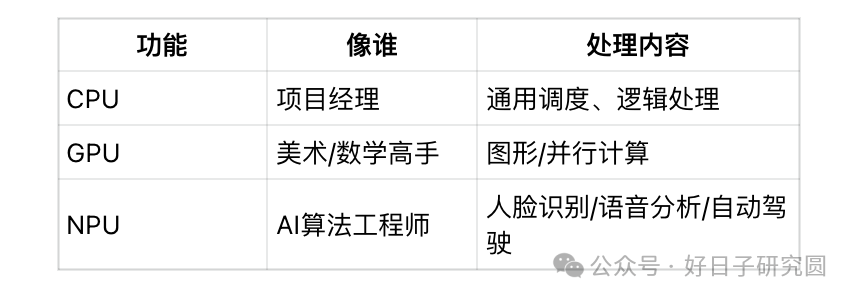
The electronic devices you interact with daily are actually calling different chips simultaneously, but the core experience that determines your “satisfaction” often depends on whether the chips are “good enough”.