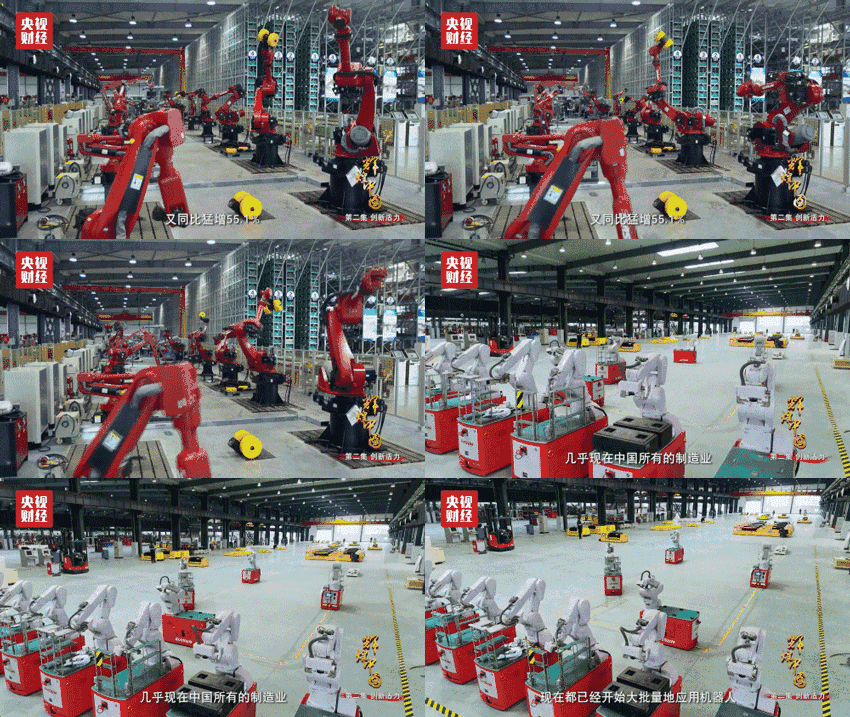
Industrial Robots are widely used in industrial manufacturing, including automotive, electrical appliances, and food industries. They can replace repetitive manual tasks and are machines that perform various functions through their own power and control capabilities. They can be operated by human commands or run according to pre-programmed instructions. Today, we will discuss the basic main components of industrial robots.
Main Body
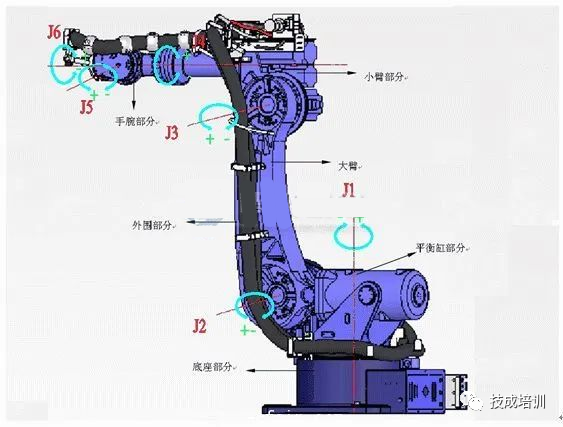
The main mechanical structure consists of the base and actuators, including the upper arm, lower arm, wrist, and hand, forming a multi-degree-of-freedom mechanical system. Some robots also have locomotion mechanisms. Industrial robots typically have six degrees of freedom or more, with the wrist commonly having 1 to 3 degrees of movement.
Drive System
The drive system of industrial robots is classified into three main types based on the power source: hydraulic, pneumatic, and electric.
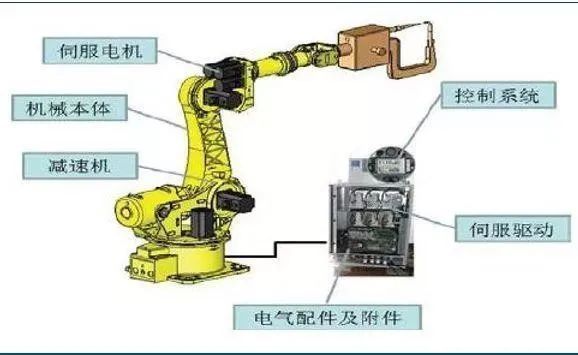
Depending on requirements, these three types can also be combined into a hybrid drive system. Alternatively, they can be indirectly driven through mechanical transmission mechanisms such as synchronous belts, gear systems, and gears. The drive system consists of power devices and transmission mechanisms that enable the actuators to perform corresponding actions. Each of these three basic drive systems has its own characteristics, with electric drive systems being the mainstream choice.
Due to low inertia and high torque, AC and DC servo motors and their associated servo drives (inverters, DC pulse width modulators) are widely adopted. These systems do not require energy conversion, are easy to use, and have responsive control.
Most motors need precise transmission mechanisms installed behind them: gear reducers. These gears act as speed converters, reducing the motor’s rotation speed to the desired level while achieving greater torque. This reduces speed and increases torque. When the load is large, merely increasing the power of the servo motor is not cost-effective; instead, the output torque can be enhanced within an appropriate speed range through gear reducers.
Servo motors can easily overheat and experience low-frequency vibrations during low-frequency operations, making long-term repetitive work detrimental to their accuracy and reliable operation. The existence of precision gear motors allows servo motors to operate at appropriate speeds while enhancing the rigidity of the machine body and outputting greater torque. Currently, the mainstream gear reducers are of two types: harmonic reducers and RV reducers.
Control System
The robot control system is the brain of the robot and is a key factor in determining its functionality and performance.The control system issues command signals to the drive system and actuators based on the input programs. The main task of industrial robot control technology is to control the robot’s range of motion, posture, trajectory, and timing of movements in the workspace. It features simple programming, software menu operation, a user-friendly human-machine interface, online operation prompts, and ease of use.
The controller system is the core of the robot, with foreign companies conducting strict experiments on it in China. In recent years, with the development of microelectronics technology, the functionality of microprocessors has increased while prices have decreased. Currently, 32-bit microprocessors are available on the market for 1-2 USD. The high cost-performance ratio of microprocessors provides new development opportunities for robot controllers, making the development of low-cost, high-performance robot controllers possible. To ensure sufficient computing and storage capacity, most robot controllers now use powerful ARM series, DSP series, POWERPC series, and Intel series chips.
Since existing general-purpose chips cannot fully meet the requirements of some robot systems in terms of cost, functionality, integration, and interfaces, there is a growing demand for SoC (System on Chip) technology in robot systems. This integrates specific processors with the required interfaces, simplifying the design of peripheral circuits, reducing system size, and lowering costs.
For example, Actel integrates NEOS or ARM7 processor cores into its FPGA products, forming a complete SoC system. In the field of robotic technology controllers, research is mainly concentrated in the USA and Japan, where mature products exist, such as those from DELTATAU in the USA and PONLIT in Japan. Their motion controllers are based on DSP technology and adopt a PC-based open structure.
Perception System
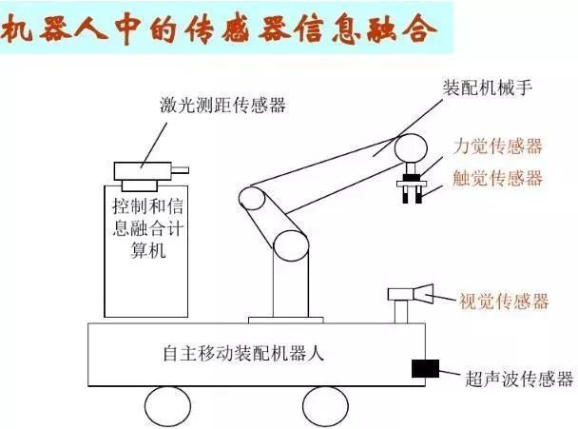
It consists of internal sensor modules and external sensor modules, which obtain meaningful information about the internal and external environmental states.
Internal Sensors: These sensors detect the robot’s own state (e.g., angles between arms) and are primarily used to measure position and angle. Specific types include position sensors, angle sensors, etc.
External Sensors: These sensors detect the environment in which the robot operates (e.g., detecting objects, measuring distances to objects) and conditions (e.g., checking whether an object being grasped has slipped). Specific types include distance sensors, vision sensors, tactile sensors, etc.
The use of intelligent sensor systems enhances the robot’s mobility, practicality, and intelligence standards. The human perception system provides information about the external world, while for some specific information, sensors can be more effective than human systems.
End Effector
The end effector is the component connected to the last joint of the robotic arm. It is generally used for grasping objects and connecting with other mechanisms to perform required tasks.
In robot manufacturing, end effectors are typically not designed or sold; in most cases, they only provide a simple gripper. Usually, the end effector is mounted on the flange of the robot’s six axes to complete tasks in a given environment, such as welding, painting, gluing, and handling parts, which are tasks that robots are needed to perform.
Disclaimer: This article is reprinted from the internet, and the copyright belongs to the original author. If there are any copyright issues, please contact us in time for deletion. Thank you!
2022 Electrical Engineering Primary Exam Question Bank Complete (Includes Answers)
Three Must-Have Tools for Electricians, Easily Accessible with WeChat!
Collection The “Path” of a Veteran Electrician, Secrets to Earning Over 10,000 a Month!
Five Major Electrical Drawing Software (CAD, Eplan, CADe_simu…), Which One Do You Pick?
Latest Electrical Version CAD Drawing Software with Detailed Installation Tutorial!
Latest Electrical Drawing Software EPLAN with Detailed Installation Tutorial!
Common Issues for Beginners Using S7-200 SMART Programming Software (Includes Download Links)
Comprehensive Electrical Calculation EXCEL Sheets, Automatically Generated! No Need to Ask for Electrical Calculations!
Bluetooth Headphones, Books for Electricians/PLC Entry, Get Your Electrical Gifts!
Basic Skills in PLC Programming: Ladder Diagrams and Control Circuits (Includes 1164 Practical Mitsubishi PLC Cases)
Still Can’t Understand Electrical Diagrams? Basic Electrical Drawing Skills, Simulation Software Available, Quickly Get Started with Theory and Practice!
12 Free Electrical Video Courses, 10GB Software/Ebook Resources, 30 Days of Free Live Electrical Courses!