
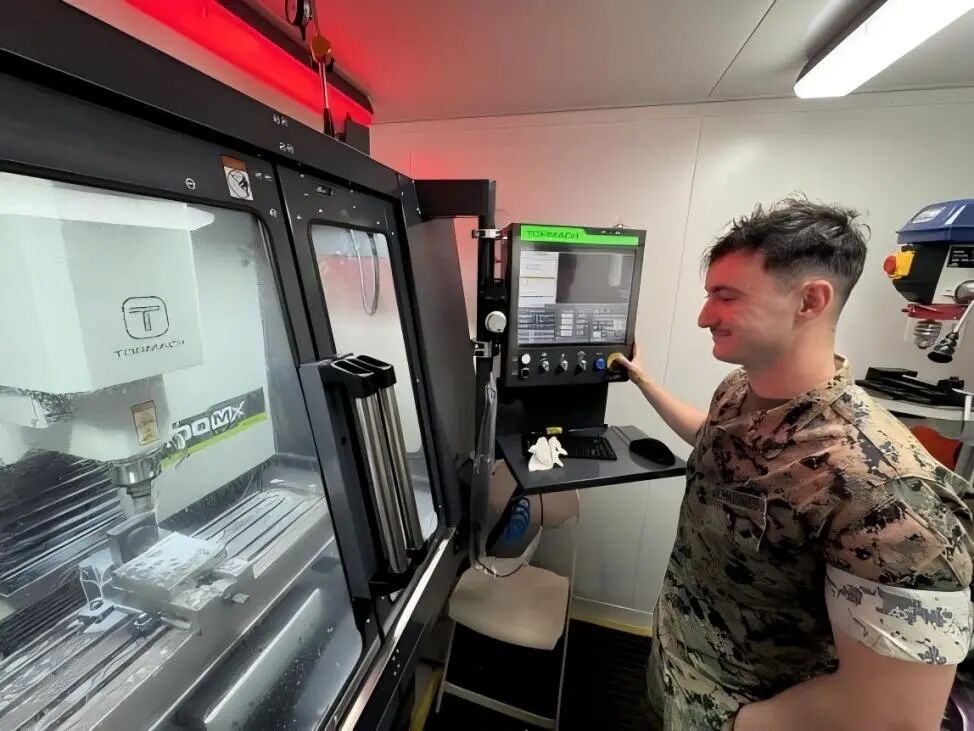
According to foreign media reports, the US Navy recently showcased the practical application of 3D printing technology during the annual exercise “Poseidon Warrior.” By producing critical components on-demand in combat zones or remote areas, they significantly reduced repair waiting times and transformed traditional battlefield logistics. This exercise was jointly conducted by the US Navy and the Marine Corps, focusing on validating the operational effectiveness of industrial-grade 3D printing solutions, including printing equipment deployed in containerized mobile laboratories that can be flexibly configured on ships or at forward bases.
These 3D printing systems can manufacture a variety of parts on-demand, ranging from simple hinges to load-bearing titanium components, and achieve rapid delivery via drones or unmanned vessels. Michael Lattigan, a Colonel and manager of consulting and strategic engagement in the Navy’s innovation department, likened it to “Uber for manufacturing,” completing part production at the speed of Amazon’s global delivery of nuclear propulsion components. He emphasized that this technology enables record-fast repairs for joint forces’ aircraft and vessels, particularly valuable in contested environments.
Specific cases show that a part traditionally requiring 6 to 9 months for delivery and costing $30,000 can be produced in just 3 days through 3D printing. Jacob Lopez, the chief manufacturing technology expert at the Navy’s Surface Warfare Center, pointed out that bringing 3D printing equipment to the battlefield is crucial, as ships cannot carry all spare parts, and advanced technology can directly ensure the safety of soldiers. Additionally, the exercise demonstrated cold spray technology, which can quickly repair damaged helicopter beams in-flight, a process that traditionally takes months and hundreds of man-hours, significantly saving resources. Military planners also suggested that 3D printing could expand to emergency medical needs in the future, further enhancing the operational resilience and coverage of frontline troops.