People often imagine living on the Moon, such as building habitats and rovers, but the real bottleneck lies in infrastructure: without reliable power and communication, any outpost cannot survive the lunar night. As the Artemis program prepares to send astronauts back to the Moon’s South Pole, the question of how to power and connect the base has shifted from theory to reality.
To address this challenge, British architectural giant Foster + Partners is developing a spiral-shaped lunar tower (Tall Lunar Tower) designed to provide both energy and communication functions through a self-deployable structure. I spoke with Irene Gallou, a senior partner at the firm and head of the expert modeling team, to learn how this design is being shaped through additive manufacturing, robotics, and early environmental testing.
The tower concept was announced in April this year, stemming from NASA’s Small Business Innovation Research (SBIR) Phase I program, which explores new methods for lunar infrastructure in collaboration with American Branch Technology.
She explained, “The focus of the first phase of the project is on the design and manufacturing of the tower, assuming a foundation exists (which is being researched by another consortium funded by NASA in the ecosystem).” The goal is to demonstrate how a self-deployable structure can overcome the scarcity of equipment and materials on the Moon while also proving that additive manufacturing technology can create lightweight and resilient geometries.
This work ultimately completed several demonstrations, including a full-size tower section standing 5 meters tall, produced by Branch Technology’s U.S. facility using its cellular fabrication (C-Fab) process. This prototype showcased the design’s suitability for mass production and will be exhibited at the “Earth to Space” exhibition at the Kennedy Space Center in Washington, D.C. in Spring 2025, marking the first tangible validation of this concept.
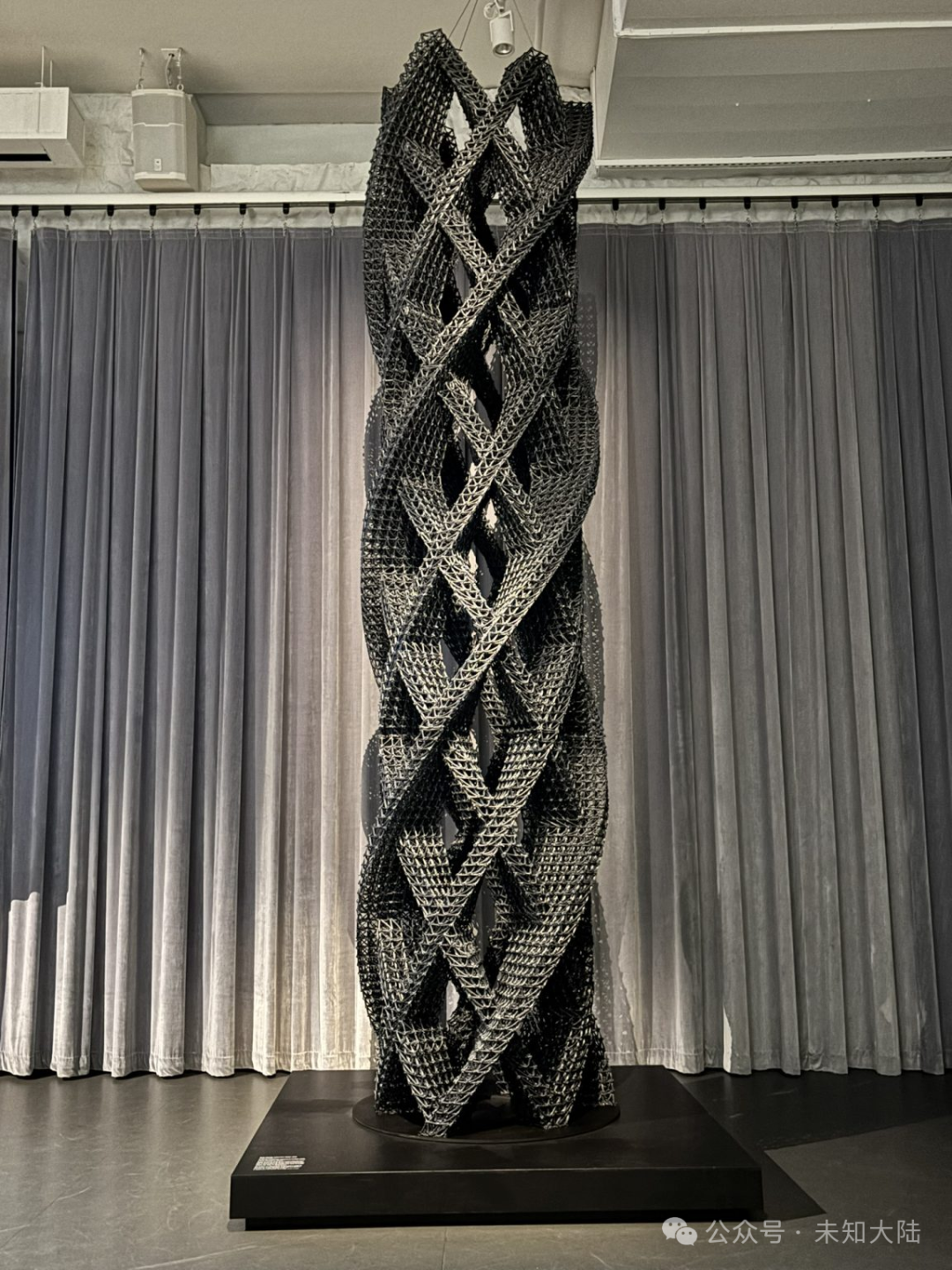
A scale model of the lunar tower, which can be produced using freeform 3D printing and cellular fabrication technology. Image courtesy of Foster + Partners
The next step is to test how this design responds to the actual conditions of the lunar environment, starting with structural responses.
Designing for Lunar Conditions
On the Moon, even the simplest structures must withstand unfamiliar forces, and the spiral tower addresses this challenge through its geometry.
According to Gallou, “The tower’s diagonal grid geometry provides clear load paths for vertical and lateral loads generated by solar arrays and natural disasters such as moonquakes.”
She stated, “The team calculated these loads based on lunar gravity and then optimized and evaluated the structure using finite element analysis in a parametric geometry CAD platform.” These simulations provided confidence in the structure’s performance in a low-gravity environment before physical testing.
However, proving the software’s stability is just the first step; the greater challenge lies in how to actually construct this tower on the Moon.
Building the tower is as important as ensuring its stability, and the team considered how to achieve this without using heavy machinery that cannot be transported from the ground. As the senior partner noted, “We explored autonomous robotic systems at the conceptual level to build this tower from scratch.”
This idea relies on climbing robots, “envisioned to move along an integrated spiral track while 3D printing the structure,” which can later be reused for deploying and maintaining solar arrays. This dual-purpose approach aims to conserve resources while meeting the demands of lunar construction.
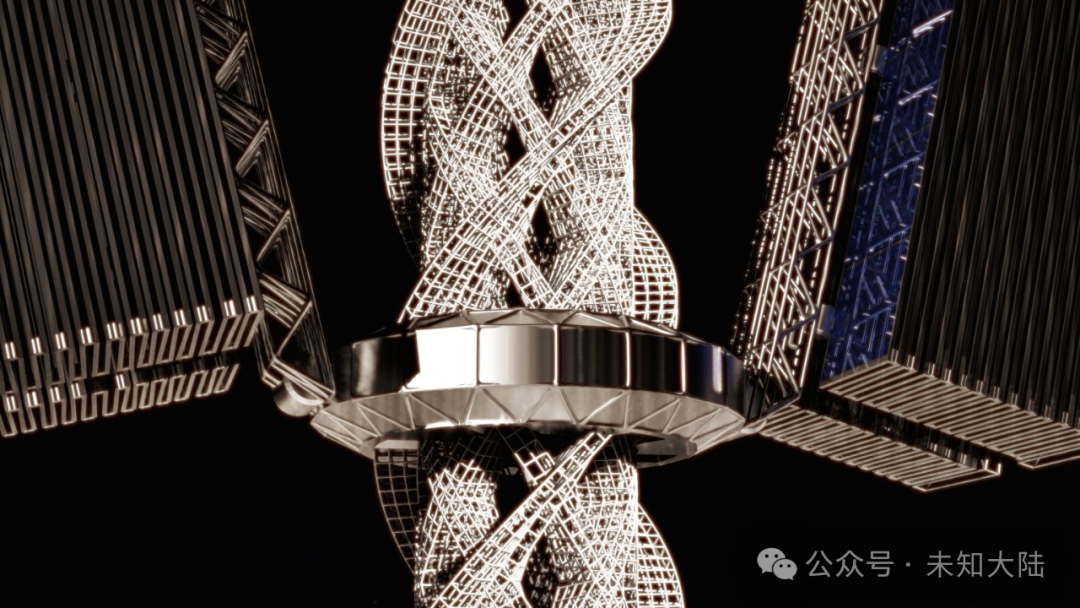
The lunar tower integrates a spiral track to enable simultaneous manufacturing and deployment of solar arrays. Image courtesy of Foster + Partners
Material development is being conducted in phases, with the first demonstrators “constructed using terrestrial materials and [Branch Technology’s] freeform 3D printing cellular fabrication technology.”
Advancing to higher Technology Readiness Levels (TRL) will require local resources such as lunar aluminum, and this transition will depend on addressing “compatibility with atmospheric vacuum,” which affects material processing and technology development.
This phased approach allows for the verification of geometries and processes using readily available materials while preparing for the harsher conditions of the lunar environment. The design is also customized based on site-specific parameters and optimized for conditions near Shackleton Crater at the lunar South Pole, where lighting and terrain will directly impact material processing and construction methods.
Branch Technology’s C-Fab process uses large six-axis arms to directly extrude open lattice structures from digital geometries, eliminating the need for traditional cutting or assembly to form complex shapes.
Practically, this method has proven to reduce material usage by twenty times compared to traditional methods, with a fivefold increase in production speed. This combination produces components that are both lightweight and structurally efficient.
This balance is particularly crucial for lunar construction, as every kilogram of material transported from Earth incurs significant costs. For broader application, the C-Fab process has undergone bending, compressive, and panel strength testing according to ASTM (C78, C140, E72) standards and meets NFPA (285) fire safety requirements.
After outlining its design and manufacturing process, Gallou also highlighted why this infrastructure is vital for the survival and development of lunar outposts.
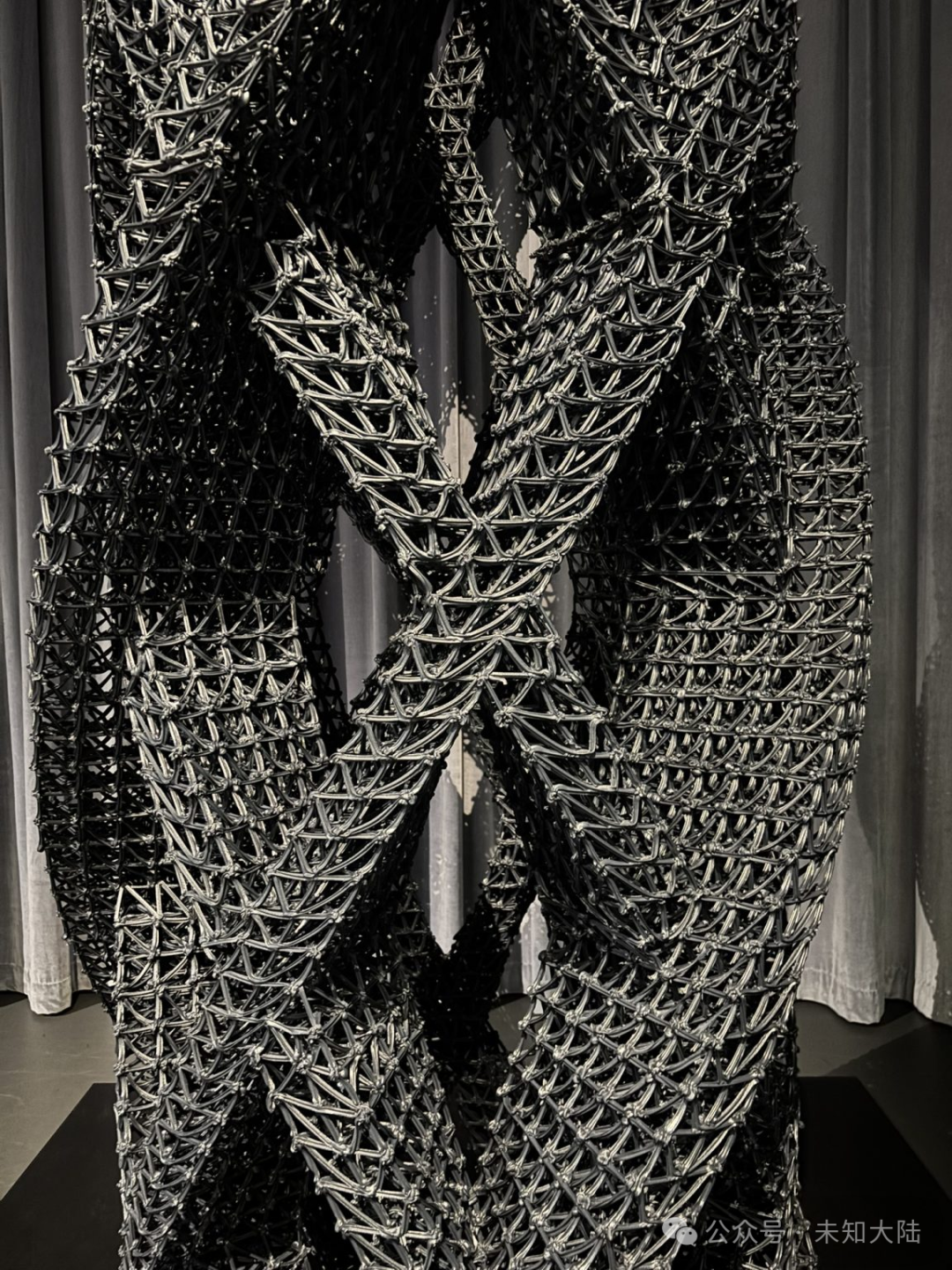
A close-up of the structural scale model of the lunar tower, featuring a diagonal grid geometry. Image courtesy of Foster + Partners
Moving Towards Sustainable Lunar Operations
The spiral tower is designed to serve multiple functions, meeting the needs for power generation and communication within a single structure. The senior partner stated that combining the two “minimizes the materials required compared to building two separate systems.” Even so, it is expected that the second phase of the project will explore the trade-offs between power and communication equipment in more detail.
Its design envisions a sail-like solar array that unfolds after the tower is deployed, creating an energy capture platform while supporting communication. The tower rises 50 meters above the ground, improving line-of-sight communication while reducing shadows cast on the solar array by surrounding terrain.
However, even with such advantages, the tower must prove its capability to operate during the harshest periods of the lunar cycle: the two-week night.
Providing power during the two-week lunar night remains one of the most daunting challenges, as generating power alone cannot ensure continuity without reliable storage. Concepts under review include insulated rechargeable batteries and regenerative fuel cells with cryogenic storage, with the senior partner stating that “these options will be explored in more detail in the second phase.”
Additionally, “planned environmental simulations include thermal load testing to consider extreme temperature gradients, structural analysis of natural disasters (such as moonquakes), and experimental testing of materials and processes in vacuum chambers,” she noted.
These tests aim to demonstrate whether the design can withstand the harshest aspects of the lunar environment, and the success of this phase does not depend on deployment but on survival under lunar-like pressures.
Looking ahead, Gallou believes this tower is a significant driver for the existence of life beyond Earth. “The successful development of lunar infrastructure like the ‘Tall Lunar Tower’ is an important step towards expanding lunar surface exploration, settlement, and industrial activities, as well as their long-term viability,” she stated.