
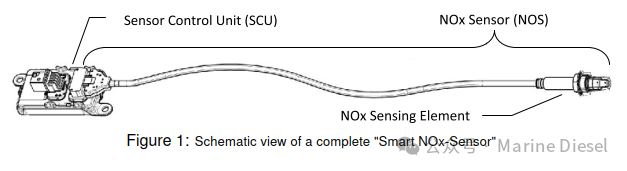
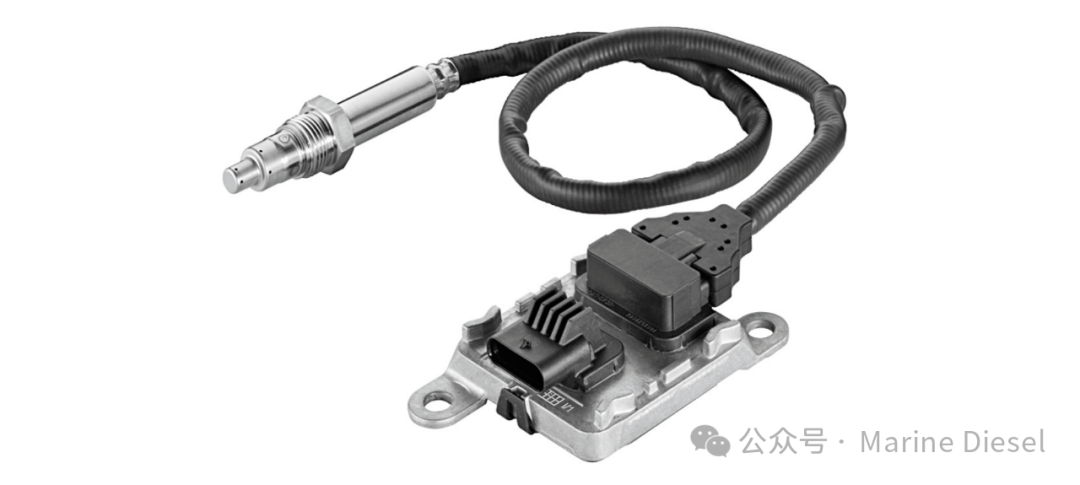
With the widespread application of Tier III compliant engines, it is essential to have devices for monitoring NOx on the engine.The nitrogen oxide sensor measures the concentration of nitrogen oxides after the SCR reactor and turbocharger to ensure that urea injection does not occur in excess or insufficient doses.
Operating Principle:
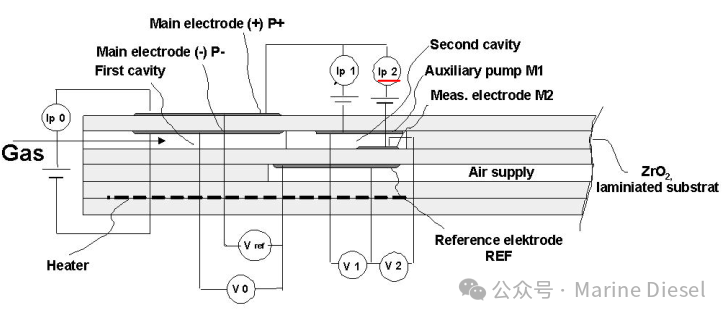
The ceramic sensor element made of zirconium electrolyte measures the concentration of oxygen in the exhaust gas entering the first chamber through a diffusion barrier. The oxygen concentration in the chamber is controlled to a constant concentration of a few ppm. Other components in the exhaust gas, such as HC, CO, and H2, also enter the chamber and are oxidized at the first pump electrode made of platinum (Pt).
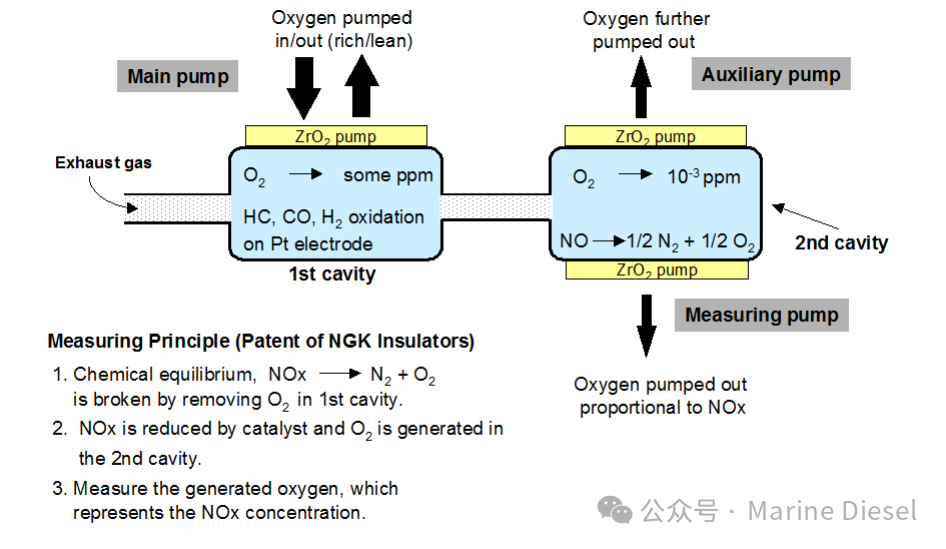
Test gases containing small amounts of ppm oxygen and NOx enter the second chamber from the first chamber. In the second chamber, gaseous oxygen is completely removed by the auxiliary pump. At the measuring electrode, NO is removed by the reaction 2NO=N2+O2, reducing the generated oxygen.
The ammeter measures the value IP2, which corresponds to the NOx concentration in the exhaust gas.
The core component is a porous ZrO2 zirconia ceramic tube, which is a solid electrolyte with porous platinum (Pt) electrodes sintered on both sides.
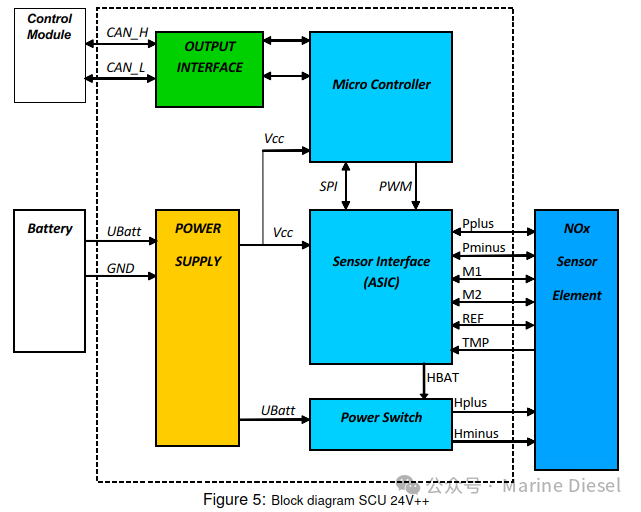
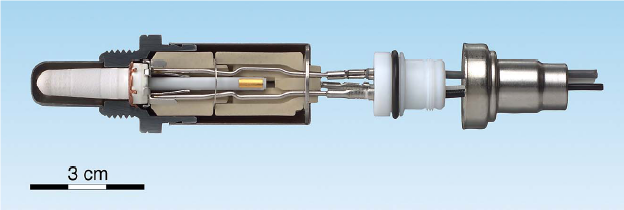 When heated to a certain temperature, due to the different oxygen concentrations on both sides, zirconia undergoes a chemical reaction, resulting in charge movement across the electrodes, generating current that reflects the varying concentrations of nitrogen oxides.The following images show the exploded view of the control module (SCU=Sensor Control Unit) model and the program flowchart.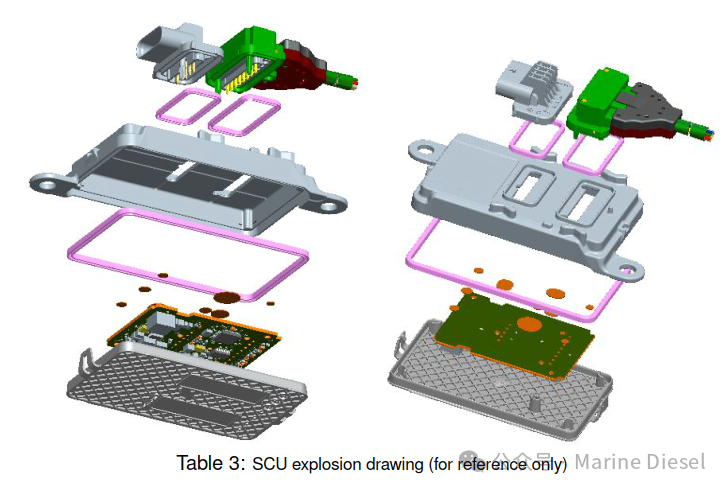
For several common questions of concern to everyday users, the patent company provided a TWL, summarized as follows:
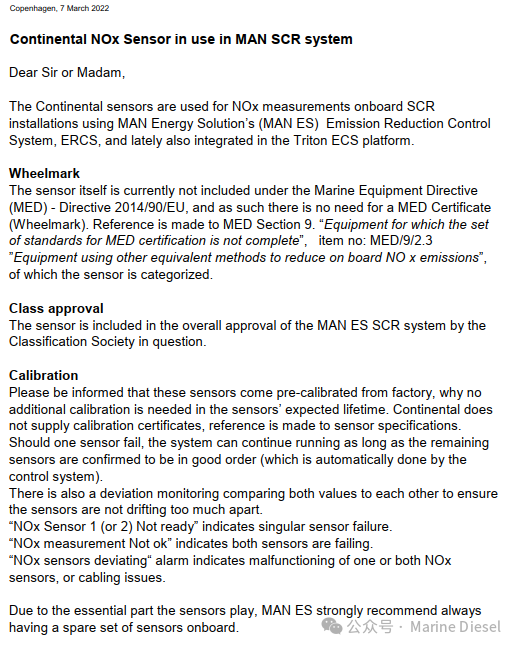
1. Is Wheelmark (MED certificate) required?
Answer: The sensor is currently not included in the Marine Equipment Directive (MED) – Directive 2014/90/EU requirements, so no MED certificate (Wheelmark) is required.
2. Is classification society approval required?
Answer: The sensor has been included in the overall certification of the MAN ES SCR system by the classification society. This means there is no separate classification society certificate.
3. Is a calibration certificate provided?
Answer: Please note that these sensors are pre-calibrated at the factory, and no additional calibration is required during the expected lifespan of the sensor. Continental Group does not provide calibration certificates; please refer to the sensor specifications.
Design considerations include:
If one sensor fails, as long as the status of the remaining sensors is good (automatically confirmed by the control system), the system can continue to operate.
There is also a deviation monitoring that compares the two values to ensure that the sensors do not deviate too much.
“NOx sensor 1 (or 2) not ready” indicates a single sensor failure.
“NOx measurement abnormal” indicates that both sensors have failed.
“NOx sensor deviation” alarm indicates that one or both NOx sensors have failed, or there is a wiring issue.
For everyone’s reference and learning!

-
Learning about Hydraulic Power Supply (HPS)
-
Learning about High Position Lubrication
-
Introduction to the Hydac Filter RF9
-
Boll Filter 6.49
-
Dynamic Limiter Function (DLF)
-
Introduction to MAN B&W two-stroke engine operating on ammonia
-
Learning about Piston Ring Markings
-
Learning about Exhaust Gas Recirculation (EGR)
-
Learning about Load Dependent Cylinder Liner Cooling Water System (LDCL)
-
Learning about the SCR system of the main engine
-
Learning about EEC Function
-
Learning about Air Cooler
-
EEDI Introduction
-
Adaptive Cylinder Control (ACCo) MAN Asset+ Solutions
-
Learning about Fuel Valve Testing Rig
-
Full-Scale Ammonia Engine Runs at 100% Load
17. Learning about Hydraulic Cylinder Unit (HCU)

If you like this article, please share it with your friends. For more information, please follow me. The information is sourced from the internet, and I would like to thank you for that. This is for everyone’s learning, considering that technology is evolving, some parameters may change with development, and specific adjustments need to be provided by the designer. If there is any infringement, please contact me for resolution.
Long press the QR code to follow me