For a wealth of sensor knowledge and industry reports, please reply with the keyword 【Data Download】 in the public account dialog box to obtain some materials for viewing《Over 100 Professional Knowledge Materials on Sensors, There’s Always One Suitable for You~》Here👇Follow me, and remember to click the menu bar in the upper right corner•••👉Set as a Star⭐
Source: Henan Intelligent Sensor Industry Association
Sensors, as a cutting-edge technology of modern science, are considered one of the three pillars of modern information technology and are recognized as a high-tech industry with great development prospects both domestically and internationally. Experts in automation in China point out that sensor technology is directly related to the development of the automation industry in our country, stating that “if sensor technology is strong, then the automation industry is strong.” This highlights the importance of sensor technology to the automation industry and even to the entire national industrial construction.
However, while sensors are experiencing a springtime, the Chinese public still seems to see a feast dominated by foreign semiconductor giants.Industry insiders believe that although the sensor market in China is developing rapidly, there is still a significant gap between domestic sensor technology and the world level.
This gap is manifested on one hand by the lag in sensors’ ability to perceive information, and on the other hand, by the technological lag in the intelligence and networking of sensors themselves. Due to the lack of sufficient large-scale applications, domestic sensors are not only low in technology but also high in price, making it difficult to be competitive in the market.
- Development Status of Sensors in Various Countries
Currently, the global sensor market is mainly dominated by a few leading companies from the United States, Japan, and Germany. The combined market share of the United States, Japan, Germany, and China accounts for 72% of the global sensor market, with China accounting for about 11%.Compared to the more than 20,000 types of products produced worldwide, China can only produce about one-third of them, and the overall technical content is also relatively low, which is a state that urgently needs to change.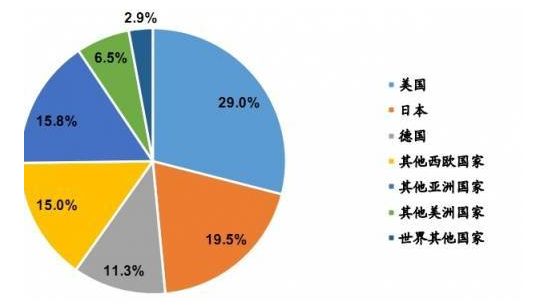 United StatesThe United States claimed as early as the 1980s that the world had entered the sensor era, and established a National Technology Group (BGT) in the early 1980s to help the government organize and lead major companies and national enterprises in sensor technology development. Six of the 22 technologies deemed crucial for the long-term security and economic prosperity of the United States are directly related to sensor information processing technology. Among the eight key technologies critical for maintaining the quality advantage of U.S. weapon systems, six are passive sensors. In 2000, the U.S. Air Force listed 15 key technologies that would enhance the capabilities of the 21st-century Air Force, with sensor technology ranking second.The U.S. development model follows a path of prioritizing military applications before civilian use, and enhancing before popularizing, characterized by:(1) A strong emphasis on research into functional materials for sensors;(2) A significant focus on sensor technology development: For example, Honeywell’s solid-state sensor development center invests $50 million annually in equipment, currently possessing the most advanced equipment and production lines, including computer-aided design, single crystal growth, processing, graphic generation, automatic coating and photolithography, plasma etching, sputtering, diffusion, epitaxy, vapor deposition, ion implantation, chemical vapor deposition, scanning electron microscopy, packaging, and dynamic testing, and updates most of its instruments approximately every three years, claiming that only in this way can it ensure its technological leadership. (3) A focus on process research: The principles of sensors are not difficult and are not kept secret, but the most confidential aspect is the process. Many evaluations state that “sensors” are not just ordinary industrial products, but rather masterpieces of perfect craftsmanship. In terms of R&D, there are about 1,300 manufacturers producing and developing sensors in the U.S., along with over 100 research institutes and universities.GermanyGermany prioritizes military sensors as a key development technology, and German sensors fully leverage the inherent advantages of an established industrial power, further integrating the reputation of German manufacturers with their advantages in technology R&D and quality management, significantly enhancing the market competitiveness of their products.On one hand, they pay more attention to saving raw material costs; on the other hand, they invest heavily in human capital to maintain technological leadership and thus a high market share!JapanJapan ranks sensor technology as the top among the ten key technologies. Japanese business leaders claim that “whoever controls sensor technology can control the new era.” Japan places great importance on the development and utilization of sensor technology, listing it as one of the six core technologies for national key development.The Ministry of Science and Technology of Japan set 70 key research projects in the 1990s, of which 18 were closely related to sensor technology.Japan emphasizes practicality and commercialization, following a path from introduction, digestion, imitation to self-improvement and design innovation.The former costs more, while the latter is cheaper and faster.In terms of R&D, Japan has about 800 manufacturers producing and developing sensors.ChinaChina began to engage in the sensor manufacturing industry as early as the 1960s. In 1972, the first batch of piezoresistive sensor development and production units was established; in 1974, the first practical piezoresistive pressure sensor was successfully developed; in 1978, the first solid-state piezoresistive accelerometer was born; and in 1982, the earliest silicon micromachining (MEMS) processing technology and SOI (Silicon on Insulator) technology research began. After entering the 1990s, various products such as absolute pressure sensors, micro-pressure sensors, ventilator pressure sensors, polysilicon pressure sensors, and low-cost TO-8 packaged pressure sensors were successively developed and produced.Over the past 30 years of reform and opening up, China’s sensor technology and industry have made significant progress, mainly reflected in: the establishment of national key laboratories for sensor technology, micron/nano national key laboratories, national engineering centers for sensor technology, and other research and development bases; research projects such as MEMS and MOEMS (Micro-Opto-Electro-Mechanical Systems) have been included in the national high-tech development priorities; in the “Ninth Five-Year Plan” national key science and technology projects, sensor technology research achieved results of 51 varieties and 86 specifications of new products, initially establishing the sensitive element and sensor industry.Currently, China’s sensor industry is at a critical stage of transitioning from traditional to new sensors, reflecting the overall trend of new sensors towards miniaturization, multifunctionality, digitization, intelligence, systematization, and networking.
- Current Status of the Domestic Sensor Industry
Domestically, the sensor industry is lagging in information perception on one hand, and in the intelligence and networking technology of sensors themselves on the other hand.Due to the lack of sufficient large-scale applications, domestic sensors are not only low in technology but also high in price, making it difficult to be competitive in the market.China began to pay attention to sensor technology research around 1980. After years of effort, the development level in sensor research is relatively good. However, the technological progress in productization is still not ideal; many sensor technologies have decent research levels in domestic laboratories, but unfortunately, they have not been fully utilized and have not been transformed into mature products entering the market.Research in sensor technology requires a long-term investment; the development of a sensor can take 6-8 years to mature, which is generally too long for Chinese companies to bear. Chinese companies find it even harder to endure failures, and the risk of failure in sensor research is high.In contrast, Japanese companies support R&D, where many do not form products, but companies can afford it; if 2-3 out of 10 can become products, that’s sufficient. In comparison, many of our companies are prepared to take existing products from others. This mindset is problematic, including our constant hope to introduce ready-made foreign products and talents with their own projects. We are not prepared to fish but rather to catch a fish.Compared to larger instruments and equipment, the investment required for sensors in the productization process is generally not large, making it more suitable for small enterprises to invest. In this regard, China should have an advantage. However, from another perspective, this is also a shortcoming.A characteristic of the sensor industry is that while sensors themselves have high technical content, the price of a single sensor is generally not high.This characteristic leads to the result that, despite the high technological added value of sensors, it is difficult to form a considerable output value solely relying on sensors.Generally speaking, sensors are somewhat like the “medicinal guide” in traditional Chinese medicine; their functions are important, but to truly scale, they need to rely on the entire medicinal formulation. Many foreign sensor companies quickly develop related measuring instruments once they have breakthroughs in certain sensors.Additionally, under China’s patent protection mechanism, the key technologies painstakingly developed in sensors often present a “know-how” nature, which, once copied, is hard to clarify, and companies cannot afford lawsuits. Although there are MEMS sensor companies in China, they are mostly contract manufacturers, and if not careful, the processing companies may take them for themselves; currently, the innovation system of enterprises has significant issues.
- Differences in Sensor Development Between China and Foreign Countries
Domestic sensor manufacturers occupy the mid-to-low-end market. From the development trend, there are three situations for domestic sensor manufacturers:1. Products from private or joint ventures occupy the mid-to-low-end market, where traditional technologies and equipment can meet the manufacturing requirements of the vast majority of products, and the market development status is good.Except for a few manufacturers who take foreign-produced chips and package related products in China to occupy a larger market share, other high-end products are monopolized by foreign manufacturers.2. With the rise of emerging industries such as the Internet of Things, the sensor industry has become an important field for countries around the world to compete in high-tech development.In recent years, China’s sensor industry has grown rapidly, and application models have matured. However, due to the low level of the industry, poor technological innovation capabilities, the domestic sensor industry presents a market pattern of low-end surplus and high-to-mid-end monopolized by foreign countries. The lag in sensor technology development has hindered the smooth advancement of domestic strategic emerging industries.Currently, China has formed a relatively complete sensor industry chain from materials, devices, systems to networks. Significant progress has been made in network interfaces, sensor and network communication integration, and Internet of Things architecture. However, the industry level is low, enterprise scale is small, and technological innovation capabilities are poor; many enterprises merely introduce foreign components for processing, leading to severe homogenization. Outdated production equipment and unstable processes have resulted in scattered product indicators and poor stability. Imitated products are also lacking in agility. In relatively R&D-prominent fields, the foundational industrial development has been overlooked, and commercialization development is severely lagging.Currently, there are about 6,000 types of sensor products in China, while abroad there are over 20,000, far from meeting domestic market demand. The import ratio of mid-to-high-end sensors reaches 80%, and the import ratio of sensor chips even reaches 90%, indicating a huge gap in domestic production. There is a severe shortage of high-tech products such as digital, intelligent, and miniaturized sensors. High-end products required for major national equipment rely mainly on imports. Moreover, for sensors and intelligent instruments required for national security and major projects, foreign countries often impose restrictions on China. Foreign-funded enterprises occupy the vast majority of the domestic high-end market share and will continue to dominate the high-end market for a long time to come; this trend will not fundamentally change in the short term.3. State-owned enterprises are experiencing stable growth, but overall, they are unable to keep pace with the latest technological developments abroad, and except for a few manufacturers, the overall gap is widening.This is due to the rapid development of sensor technology, fast updates of processes and manufacturing equipment, and many new devices that domestic manufacturers cannot produce. Additionally, the price of a single piece of equipment ranges from tens of thousands to millions of dollars, making it difficult for most manufacturers to purchase new equipment based on their own accumulation, resulting in an inability to keep up with the rapid development of foreign enterprises in many new technologies and processes.
- Main Reasons for the Development Gap in China’s Sensors
1. Core manufacturing technologies are severely lagging behind foreign countries, resulting in unsatisfactory domestic products.New technologies, products, processes, and materials for sensors are constantly emerging abroad, with trends towards digitization, intelligence, and miniaturization becoming a reality, and continuously improving and upgrading. In contrast, while the research and development fields of China’s sensors are basically comparable to those abroad, there is still a significant lag in certain core manufacturing process technologies, leading to considerable differences in depth and breadth, mainly manifested as:1. Incomplete product varieties and specifications, with a lack of new products.Currently, the number of sensor product varieties in China is about 3,000, while abroad it exceeds 20,000, with a product variety satisfaction rate of only 60%-70%, far from meeting domestic sensor market demand. From the perspective of industry product structure, over 60% of products are old, with insufficient new products, and high-tech products are even scarcer. Overall, there is a lack of matching varieties, incomplete series, a high proportion of low-end products, and a scarcity of high-end products, resulting in a lack of market competitiveness.2. Poor technological innovation, with few products having independent intellectual property rights.Enterprises’ independent development and technological innovation capabilities are weak. Due to various factors, domestic enterprises still produce low-tech products or products that have been discontinued abroad using manual methods. Many new companies are merely sales agents for foreign products, and while many universities and research institutes can track high technologies and develop high-value-added products, their results are mostly samples, far from industrialization, with few independent developments and research results with independent intellectual property rights.3. Outdated process equipment, resulting in poor product quality.After years of development, although a batch of processes and products has been developed, the stability and reliability of batch production processes have not been fundamentally resolved, limiting their application fields and industrial development. Some high-performance products are not guaranteed by processes but rather by selection and grading.From a technical perspective, due to the relatively backward production processes and equipment for domestic sensors, the micro-mechanical processing technology and packaging technology are not advanced enough, with a lot of manual operations and non-standard detection methods, resulting in major performance indicators being 1-2 orders of magnitude worse than those abroad, and service life being 2-3 grades lower.Therefore, in major projects in fields such as chemicals, power plants, metallurgy, petroleum, environmental protection, and machinery, many high-performance sensors still rely on imports.4. A shortage of talent resources, leading to insufficient industrial development.One characteristic of sensors and their industry is that they are technology-intensive, which naturally requires a dense talent pool. Currently, in China, there is a relative lack of high-level research teams and young and middle-aged technology experts, technical managers, and academic leaders who can meet the current development needs of sensor technology, resulting in a slow pace of technological updates in the industry and insufficient momentum for industrial development.5. Insufficient overall planning and inadequate investment.Current issues include repeated and scattered efforts, insufficient overall planning, low intensity of research investment, outdated research equipment, and a disconnect between research and production, which affects the transformation of research results, leading to a low overall strength of China’s sensor products. Additionally, due to insufficient government attention, the recognition of the importance of sensor technology in the development of information technology has lagged behind that of computer technology and communication technology, resulting in a small scale and intensity of resource investment for development needs, which has slowed the development speed of sensor technology and constrained the rapid advancement of information technology.
Content marked as a star = content you care about. According to the recommendation principles of WeChat public accounts, if you do not set the Sensor Expert Network public account homepage 【as a star】, you will not be able to receive the latest information in the sensor industry in a timely manner!
Disclaimer: The reproduction of this article is for the purpose of conveying more information. If there are any errors in source attribution or infringement of your legal rights, please contact us, and we will promptly correct or delete it. Thank you.
If you have submission, exposure, or interview needs, please email:[email protected].