
Scientific DevelopmentsDomesticRewriting Textbooks! Scientists Discover Mitochondrial Gene Encodes 14th Protein for the First Time
On May 3, the journal Cell Metabolism published the latest research results from Liu Xingguo’s team at the Guangzhou Institute of Biomedicine and Health, Chinese Academy of Sciences. They have rewritten the assertion in textbooks that “the mitochondrial genome encodes 13 proteins” by discovering a new model of mitochondrial convention that encodes the 14th protein for the first time.
China Completes 7 Manned Deep-Sea Dives with the “Fendouzhe” Submersible, Reaching Depths of 7735.9 Meters
The research vessel “Tansuo 2” from the Institute of Deep-Sea Science and Engineering, Chinese Academy of Sciences, completed 7 manned deep-sea dives with the “Fendouzhe” submersible during a recent 14-day voyage, with two dives exceeding 7700 meters and a maximum depth of 7735.9 meters. The team also successfully recovered a deep-sea lander used for observing whale fall system evolution at depths greater than 7700 meters.
“Bio 3D Printing +” Achieves Treatment for Hard-to-Heal Bone Defects
The research team led by researcher Ruan Changshun at the Shenzhen Institute of Advanced Technology, Chinese Academy of Sciences, proposed a new strategy called “Bio 3D Printing +” that is mechanically assisted. They combined 3D printing technology to construct hollow fiber hydrogel scaffolds with mechanical responsiveness and large, complex structures, then utilized the mechanical response properties of the scaffolds to achieve rapid, uniform, precise, and friendly cell loading. The cell-loaded scaffolds obtained based on this strategy can effectively promote the repair and functional reconstruction of hard-to-heal bone defects. Relevant results were recently published in Nature Communications.
Chinese Scientists Develop Ultra-Tough 3D Printed Elastic Material
The research team from Zhejiang University designed a new type of photosensitive resin and used it to 3D print a “super rubber band” that can stretch over 9 times its original length and lift a 10-kilogram object with a diameter of just 1 millimeter. Relevant results were recently published in Nature.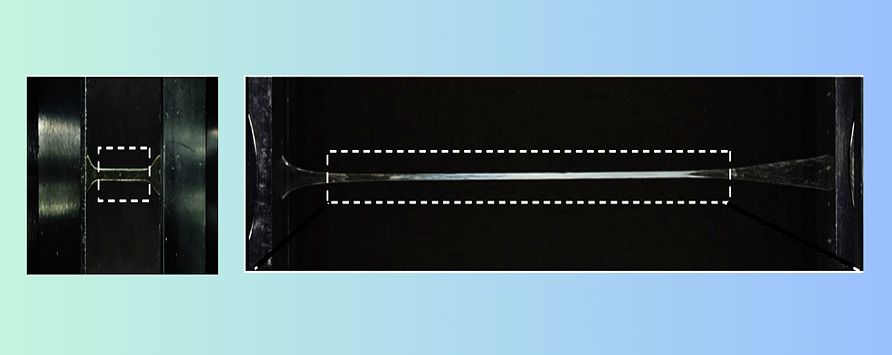
Comparison of the “super rubber band” before and after stretching (left image is before stretching, right image is after stretching). Image source: Zhejiang University
International
Salt and Fluid Loss May Stimulate Kidney Regeneration
The latest research from the University of Southern California shows that the loss of salt and fluids can stimulate kidney regeneration and repair in mice. This method of kidney repair and regeneration may open new avenues for kidney disease therapies. The relevant paper was published in the latest issue of Clinical Research.
Recommendations
-
“High-Temperature Assassin,” with a Mortality Rate of Up to 70%!
-
What?! The Earth’s Rotation Has Slowed Down?
-
Exploring the Cave Sites of the Old Stone Age in Xinjiang

 Scan to Get More Information
Content Source
Today’s Science Association