Skip to content
The functionality of Artificial Intelligence (AI) has become crucial in various mobile devices. Especially in 2024, AI PCs are being launched into the market, marking it as the ‘Edge Device AI Year’. In this article, we will review the main AI PCs and processors released in the second half of 2024.
The semiconductor industry in 2024 is expected to be fully led by AI technology. Chips with AI processing capabilities, high-capacity dynamic random access memory that is compatible with AI technology (including high bandwidth memory and low power double data rate 5X types), and power integrated circuits capable of executing segmented power management are being integrated into the mobile device sector on an unprecedented scale.
With the rapid development of generative AI technology, AI functionality has become standard in devices such as personal computers, smartphones, augmented reality/virtual reality devices, drones, and in-vehicle systems. Some AI systems are integrated with cameras and sensors, while others operate in the background to optimize wireless communication environments.
Given the multitude of processors and products set to launch, 2024 can undoubtedly be seen as the ‘Year of AI Applications for Edge Devices’. Therefore, this article will focus specifically on personal computers and processors equipped with AI technology that will be released in the second half of 2024.
Three Major Changes Brought by Mobile AI
Mobile AI devices are leading three significant transformations.
First, processors are integrating a dedicated hardware computing unit called NPU (Neural Processing Unit) responsible for executing specific integer operations, floating-point operations, and multiply-accumulate operations, resulting in a corresponding increase in chip area.
Second, the installation height of parallel high-capacity DRAM matching the computing unit has been enhanced, with major companies increasing DRAM capacity in their 2023 models. For example, the ‘Google Pixel 8’ is equipped with 12GB of DRAM (similar examples include the 2024 ‘Google Pixel 9’, which has a capacity of 16GB).
Third, processors are paired with a large number of power ICs to achieve precise control of power consumption. As the number of NPU cores in processors increases and DRAM capacity expands, power ICs have also been subdivided and increased. Mobile AI devices are gradually enhancing semiconductor usage. In the PC sector, models compatible with ‘Copilot+ PC’ (NPU over 40TOPS) will be launched as AI PCs starting in June 2024.
ASUS AI PC Equipped with Qualcomm Snapdragon X
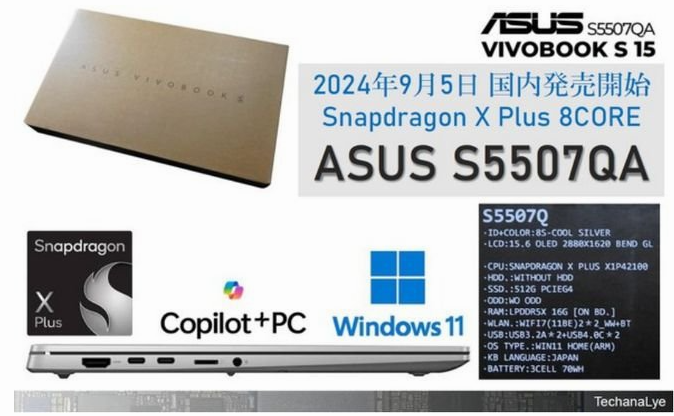
Figure 1 shows the ‘Vivobook S 15 S5507QA’, which will be launched in September 2024, compatible with ASUS Copilot+ PC. The processor it features is the Qualcomm ‘Snapdragon X Plus 8-CORE’, which serves as a budget alternative to the ‘Snapdragon X Elite’, with performance being a compromise.
This device is equipped with 16GB of DRAM. Given that the market price for high-end laptops typically exceeds 200,000 yen, this product is priced at about 100,000 yen, although it supports Copilot+ PC, its CPU and GPU performance has been scaled down.
Figure 1: ASUS ‘Vivobook S 15 S5507QA’ released in September 2024
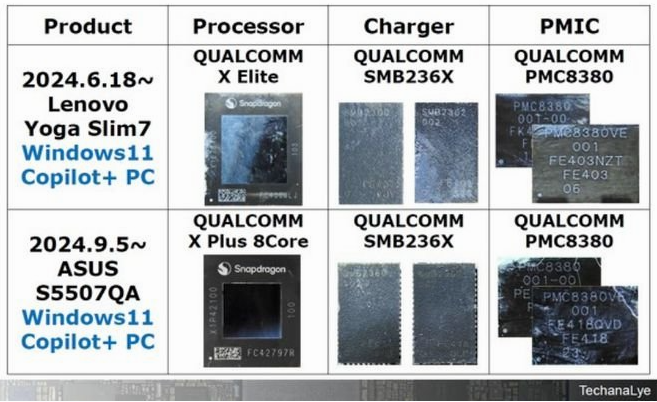
Table 1 reveals the configurations of the Qualcomm Snapdragon X Elite (top row) launched in June 2024 and the Snapdragon X Plus 8-CORE (bottom row) launched in September in terms of power systems and processors. Qualcomm provides not only chipsets for smartphones’ power and communication systems but also a diverse range of battery charging, battery management, and power IC products for the personal computer market.
Among these products, a total of 8 power ICs and 4 battery ICs are equipped. Whether it is the high-end Snapdragon X Elite or the more budget-friendly X Plus 8-CORE, they both utilize the same power IC and battery IC. This standardized power supply system is also widely used in the smartphone sector.
Table 1: Qualcomm ‘Snapdragon X’ Series Internal Configuration
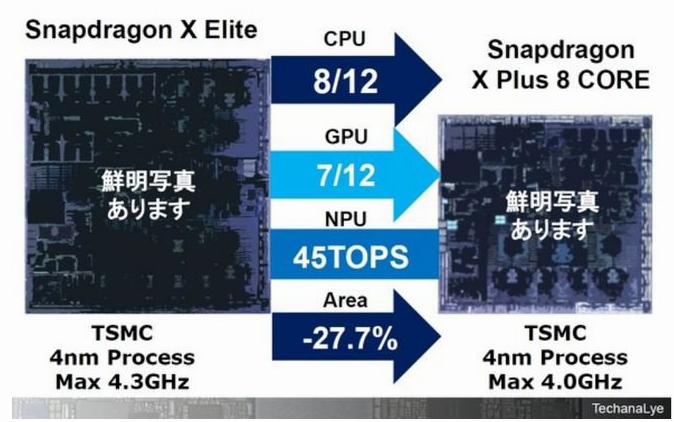
Figure 2 illustrates the Qualcomm Snapdragon X Elite (left) and Snapdragon X Plus 8-CORE (right) chips produced using TSMC’s 4nm process technology. The left X Elite, as a high-end model, features a 12-core ORYON CPU and a 12-core Qualcomm self-developed GPU Adreno, with a maximum operating frequency of up to 4.3GHz.
Figure 2: Snapdragon X Series Chips
The right X Plus 8-CORE’s budget central processing unit (CPU) configuration consists of eight cores, which reduces four cores compared to the standard version, while the graphics processing unit (GPU) consists of seven cores, reducing five cores. By streamlining functionalities, the chip’s die area has been reduced by approximately 28%, while the maximum operating frequency has been adjusted to 4.0GHz.
To meet the performance requirements of Copilot+ PC, the budget version of the neural network processing unit (NPU) maintains the same performance as the high-end version, at 45TOPS. By reducing the die area by about 30%, not only is the amount of data obtained from the wafer increased, but the reuse of multiple test patterns significantly lowers production costs while ensuring compatibility with AI PC processors priced in the 100,000 yen range.
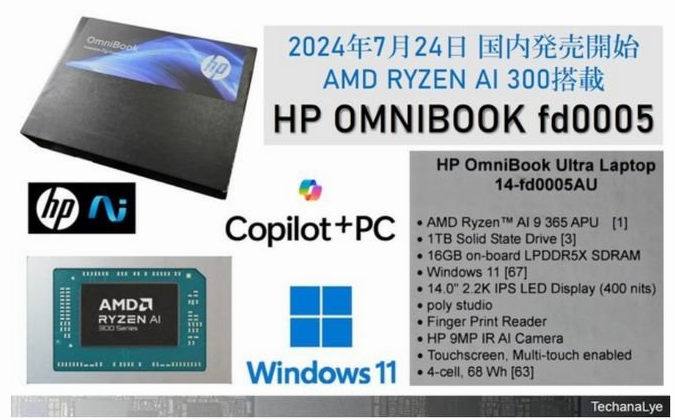
Figure 3 shows the ‘HP OmniBook Ultra 14-fd0005AU’, which will be launched in July 2024, a device compatible with Copilot+ PC. It is equipped with AMD’s APU (Accelerated Processing Unit, a combination of CPU and GPU) – the ‘Ryzen AI 300’ series designed specifically for Copilot+ PC compatibility.
Compared to the 2023 ‘Ryzen 8000’ series APU, which has integrated AI functionality but only 16TOPS of performance, the Ryzen AI 300 series processors are equipped with up to 50TOPS of performance, with NPU performance more than tripled compared to the previous generation, starting to be integrated into AI personal computers from July 2024.
Figure 3: ‘HP OmniBook Ultra 14-fd0005AU’
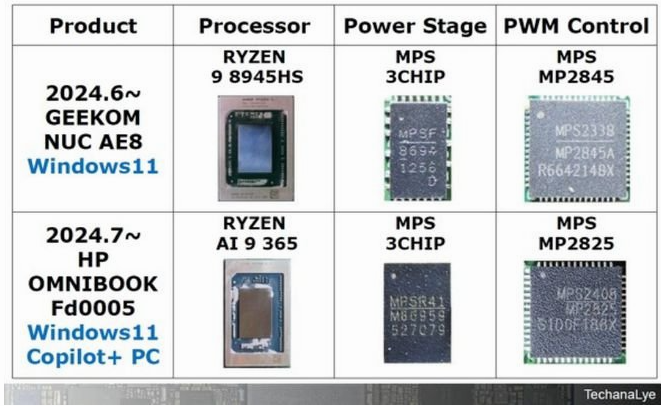
Table 2 presents a comparative analysis of the ‘Ryzen 9 8945HS’ processor from the AMD Ryzen APU 8000 series and the ‘Ryzen AI 9 365’ processor from the Ryzen AI 300 series. It should be noted that AMD has not provided chipset support, and both processors are equipped with MPS (Monolithic Power Systems) power system integrated circuits.
Table 2: Comparison of ‘Ryzen 9 8945HS’ and ‘Ryzen AI 9 365’
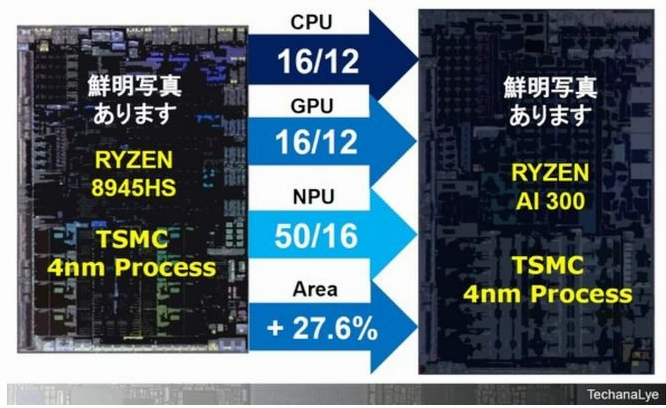
Figure 4 illustrates the comparison between the Ryzen 9 8945HS and the Ryzen AI 300 chips. Both chips include CPU, GPU, and NPU, and both utilize TSMC’s 4nm process technology. The CPU and GPU architectures of both chips have been upgraded to the latest, with the CPU architecture upgraded from Zen 4 to Zen 5, and the GPU architecture from RDNA3 to RDNA3.5, with the core count increased from 12 cores to 16 cores.
In terms of CPU configuration, a 4-core Zen 5 architecture and an 8-core Zen 5C (compact) architecture have been adopted, with performance streamlined. Due to the use of the same TSMC 4nm process technology, the chip’s functionality has been enhanced, resulting in an approximate 28% increase in die area.
It is certain that the next generation of products after 2025 will adopt 3nm process technology; thus, the 4nm process technology may be the last time it is used, and its size has expanded.
Figure 4: Chip Comparison between Ryzen 9 8945HS and Ryzen AI 300
ASUS AI PC with Intel Ultra
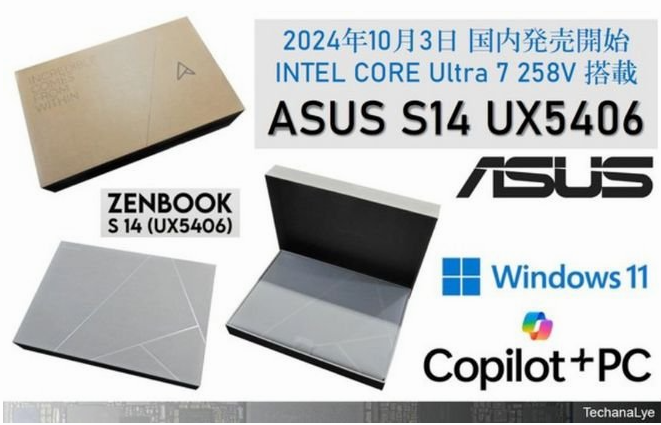
Figure 5 shows the ‘Zenbook S 14’ (model UX5406) from ASUS’s Copilot+ PC series, launched in October 2024. This device is equipped with Intel’s 200V Lunar Lake processor, the second generation of the ‘CORE Ultra’ series. In contrast, the Meteor Lake launched in January 2024, as the inaugural product of the CORE Ultra series, had an NPU performance of 36TOPS but did not meet the performance requirements of Copilot+ PC. The second generation Lunar Lake processor further enhances NPU performance to 48TOPS, compatible with the performance requirements of Copilot+ PC.
Figure 5: ASUS Copilot+ PC ‘Zenbook S 14’ (UX5406)
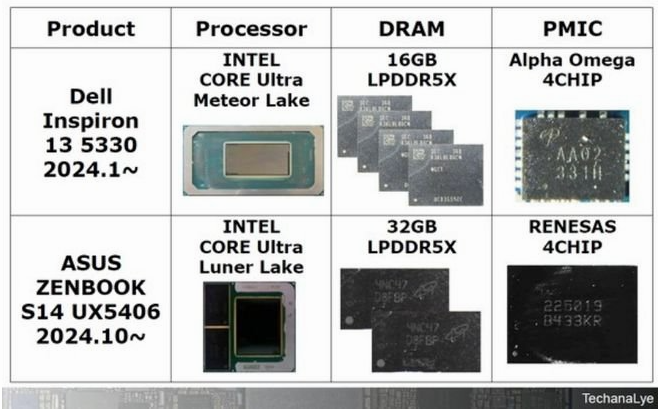
Table 3 reveals the chip configurations of personal computers equipped with the first generation Meteor Lake (top row) and the second generation Lunar Lake (bottom row). Lunar Lake minimizes chip area and shortens signal transmission distance by integrating DRAM within the package.
This technology application has been used since Apple introduced its ‘M1’ chip in 2020, and Apple has effectively adopted this technology since its ‘A12X’ chip in 2018. As for Meteor Lake, its combined power IC is provided by Alpha & Omega from the USA, while Lunar Lake’s combined power IC is provided by Japan’s Renesas Electronics, totaling four chips.
Table 3: PC Chip Configuration with Meteor Lake and Lunar Lake
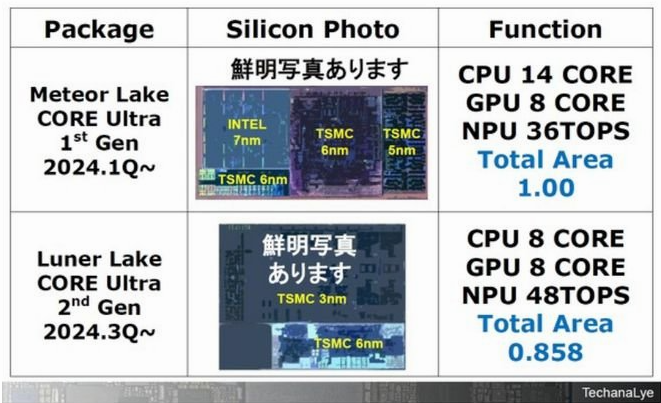
Table 4 shows the die structure of the first generation Meteor Lake and the second generation Lunar Lake in the CORE Ultra series. Both consist of multiple small chips. Meteor Lake is made up of five different organic silicon materials, including a silicon interlayer that connects the various chips and provides power.
In contrast, Lunar Lake consists of four organic silicon materials. The CPU of Meteor Lake is manufactured using Intel’s 7nm process (codenamed INTEL 4), while its GPU and NPU are fabricated by TSMC. In Lunar Lake, the CPU, GPU, and NPU are all manufactured using TSMC’s 3nm process.
Almost simultaneously, Intel began to launch Arrow Lake processors for desktops, which also use TSMC’s 3nm process and feature a small chip architecture. It is expected that in the second half of 2024, Copilot+ processors compatible with PCs will be launched, but it is noteworthy that companies differ in the power ICs used in manufacturing their chips.
Table 4: Die Status of Meteor Lake and Lunar Lake
By 2025, the alliance between MediaTek and NVIDIA is expected to further expand into the Copilot+ PC market. Meanwhile, Qualcomm, AMD, and Intel also intend to launch their next-generation processor products. We will continue to monitor the smartphone market and provide corresponding observations and reports.
(Original article published in EE Times Japan, translated by Franklin Zhao.)
Author: Hiroshi Shimizu (Tekanarie), EE Times Japan