At the 2025 World Robot Conference, the number of manufacturers showcasing new dexterous hands has multiplied compared to last year.As the end-effector perception component and execution tool for robots, the technology level of dexterous hands is crucial for robots to adapt to multiple scenarios and complete various tasks. It represents the “last kilometer” of robot commercialization and the “last centimeter” of robots entering the real world.
Lighter Weight
The DM17 series dexterous hand released by Zhaowei Electromechanical in July this year has become a major focus of this year’s exhibition. At the Zhaowei Electromechanical booth, the DM17 series dexterous hand was thoroughly disassembled, clearly demonstrating its components to the audience.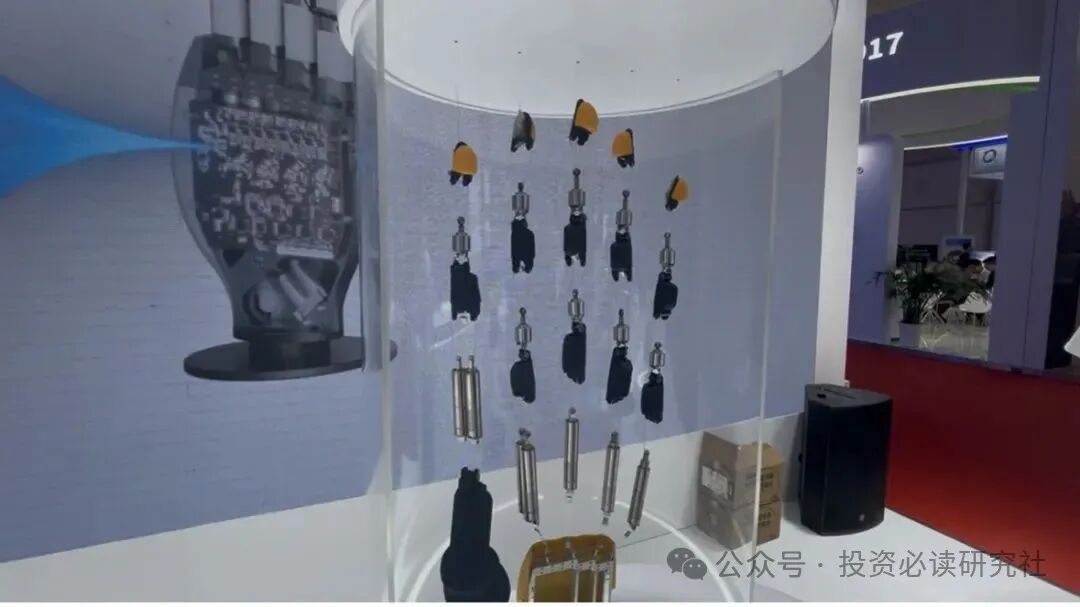
Disassembly of the dexterous hand at the Zhaowei Electromechanical booth Photo by our reporter Zheng Cuiying
Zhaowei Electromechanical’s Deputy General Manager and Chief Electric Control Expert Chen Yidong told China Securities Journal that the yellow material with a rubber touch at the tip of the dexterous hand is equivalent to the fingertips of a human hand, integrating tactile perception chips that can judge force; 17 micro motors function like the joints of a human hand, constituting 17 degrees of freedom for this robotic hand.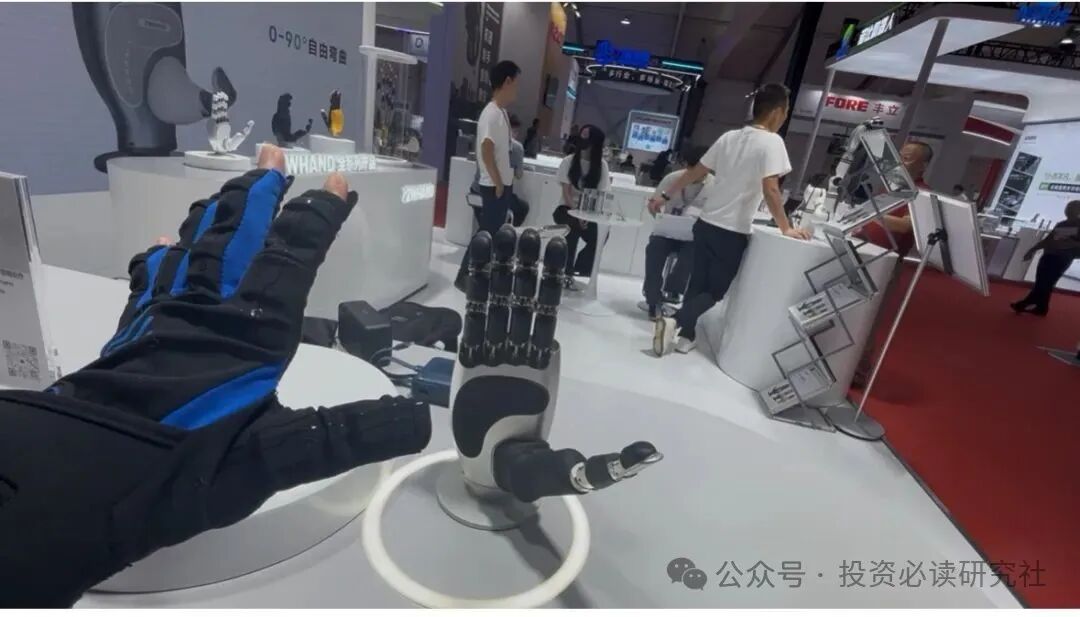
Dexterous hand displayed at the Zhaowei Electromechanical booth Photo by our reporter Zheng Cuiying
For robots and dexterous hands, finding a balance between compactness and strength is a key step in their commercialization process.After five generations of product iterations, the weight of Zhaowei Electromechanical’s dexterous hand has gradually decreased from the initial 2.063 kilograms to about 900 grams, and the performance of the dexterous hand is increasingly approaching that of a human hand. Chen Yidong introduced, “A human hand has 21 independently movable joints (degrees of freedom), and the DM17 can currently perform over 95% of human hand movements, adapting to the gripping needs of different objects in industrial scenarios, as well as basic actions like holding cups and cooking in home scenarios.”Additionally, the Revo 2 dexterous hand launched by Strong Brain Technology, with a lightweight design of only 383g, can bear loads of up to 20 kilograms and can accurately sense force information through built-in three-dimensional tactile sensors.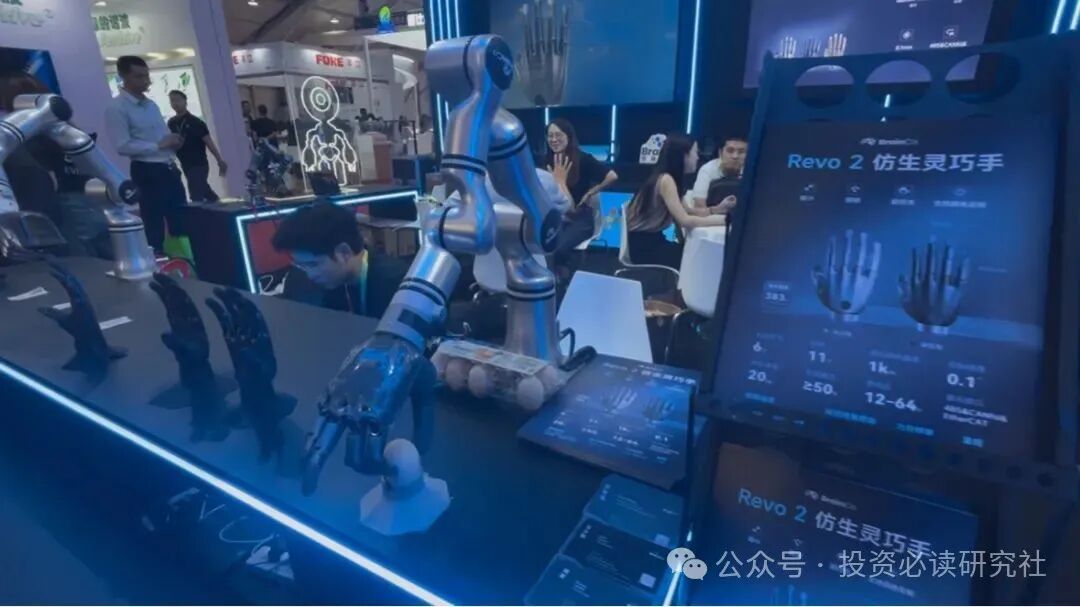
Strong Brain Technology booth, dexterous hand grasping an egg Photo by our reporter Zheng Cuiying
Richer Perception
As the application scenarios for robots expand, the perception capabilities of dexterous hands are gradually evolving. “To accurately grasp objects in complex environments, dexterous hands must possess a high level of tactile perception capability,” Chen Yidong stated. In the future, dexterous hands may integrate various perception capabilities such as temperature and vision based on scene requirements, further expanding application scenarios. Wang Zhenkun, CMO of Aoyi Technology, introduced the pressure sensing capabilities of Aoyi Technology’s dexterous hand, where the robotic dexterous hand ROH-AP001 integrates high-density matrix tactile sensors that can sense minute pressure changes from 0.1N to 25N in real-time; ROH-LiteS integrates three-dimensional force sensing, capable of sensing the direction of force. “The human hand’s perception of material and temperature affects how we grip objects, similarly, the sensors on robotic dexterous hands can provide feedback to the robot, which can then use algorithms to achieve precise gripping.” Wang Zhenkun exemplified that in the scenario of assembling new energy batteries, robots need to be able to “feel” the force when handling batteries to avoid damaging or dropping them, preventing fingerprints from being pressed into the aluminum shell of the battery cell. Pasini simultaneously produces sensors, dexterous hands, and humanoid robots, and at this conference, the company showcased its latest sensor technology. Pasini CEO Xu Jincheng introduced that Pasini’s third-generation tactile sensors have the advantage of six-dimensional force and 15 types of tactile perception information, capable of simulating human skin perception capabilities. With tactile perception capabilities, embodied intelligent agents can achieve fine operations, avoiding damage to soft objects and providing strong support for the implementation of more application scenarios.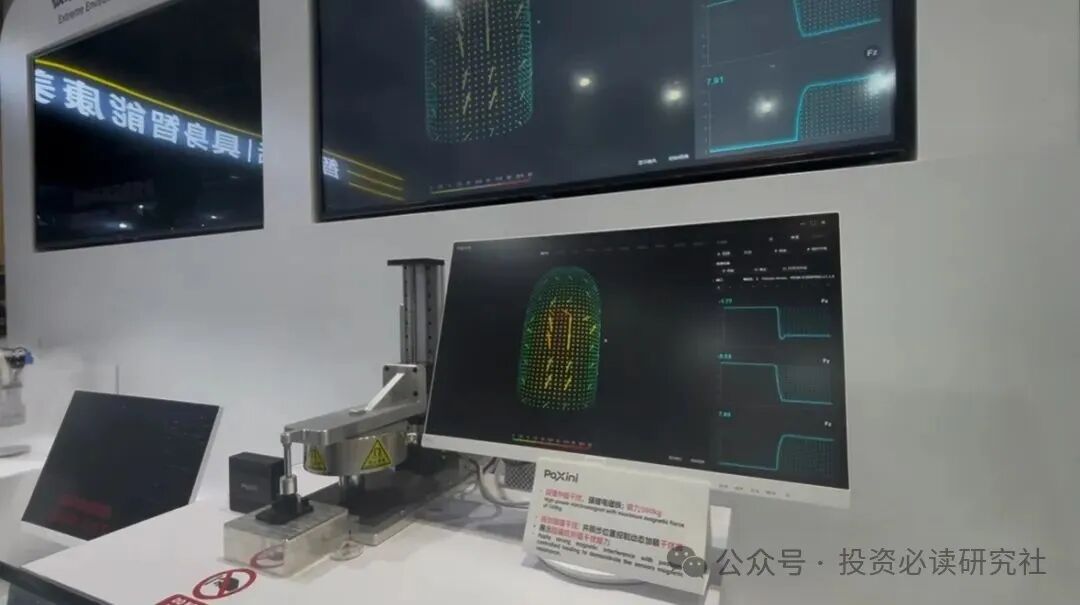
Pasini booth, fingertip sensor Photo by our reporter Zheng Cuiying
Price Adjustments Expected
Exhibitors predict that with the expansion of production scale and the acceleration of downstream robot customers in commercialization, the price of dexterous hands may decrease in the second half of the year, paving the way for cost reduction and commercialization of robots. Chen Yidong told reporters that currently, only robots priced above 100,000 yuan consider equipping dexterous hands costing between 10,000 to 30,000 yuan, while lower-priced robots tend to opt for grippers. With the rapid iteration and acceleration of commercialization of robots, the price of dexterous hands is expected to decrease. Zhang Zhige, head of the dexterous hand business at Strong Brain Technology, stated that the price of robotic dexterous hands is expected to decrease this year, partly due to technological iterations and partly due to increased production of dexterous hands, “Major manufacturers expect production to reach several thousand to tens of thousands, and mass production will lead to price reductions.” Regarding sensors, Xu Jincheng said, “Pasini’s third-generation tactile sensors start at 199 yuan, achieving the lowest price in the industry and strong versatility.” Therefore, even for dexterous hand products equipped with high-end sensors, their prices will also significantly decrease.