The 2025 World Robot Conference continues to generate excitement, with visions of the future brought by robots being constantly updated here. From industrial robots flexibly transporting components, to companion robots interacting with children through voice, and home robots performing tasks such as cooking, pouring water, and folding clothes, an increasing number of application scenarios are vividly presented before us, making us dare to dream: is the era of humanoid robots truly entering the homes of ordinary people not far away?
“As the highest form of intelligent robots and the best carrier of embodied intelligence, humanoid robots are accelerating innovation and iteration, deeply empowering social production and daily life, and increasingly playing important roles in scenarios such as manufacturing, warehousing logistics, security protection, housekeeping services, and education and healthcare,” said Wan Gang, Chairman of the China Association for Science and Technology, at the opening ceremony of the conference.
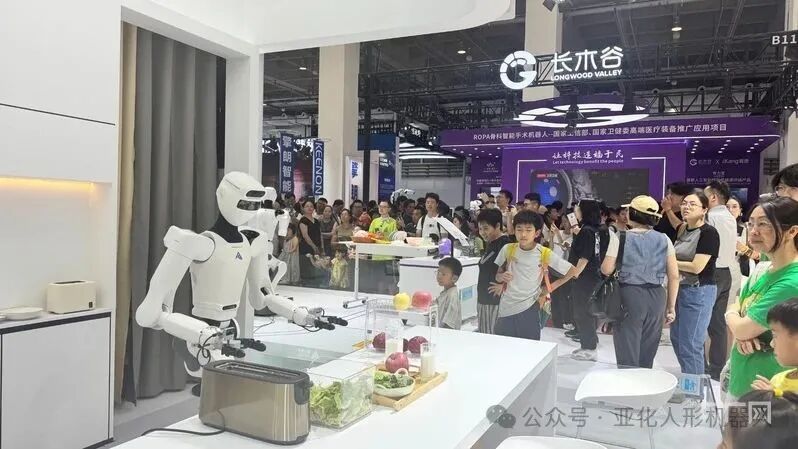
Scene from the 2025 World Robot Conference (Photo by Zhu Guanan, Central Broadcasting Network)
From Industrial Trials to Home Previews: Consumer Robots Show Diverse Exploratory Trends
At the World Robot Conference, reporters found that the forms of consumer robots have shown a trend of diverse exploration.
In the exhibition area, Huang Jiawei, Marketing Director of Yushu Technology, introduced that the humanoid robots H1, G1, and R1 released by Yushu Technology currently mainly serve B-end customers and can be further developed to complete tasks such as line transportation and assembly, while household users are not the main audience for the products. “At this stage, the core customers are still technology companies and universities, and the purchase volume from household users is relatively low.”
“Currently, it is widely recognized in the industry that the home scenario is the ultimate application of humanoid robots,” said Wan Lin, a relevant person in charge of the marketing department of Stardust Intelligence. Due to the complexity and variability of home scenarios, the requirements for the intelligence level and generalization ability of robots are the highest.
Nevertheless, at the conference, many robot companies showcased their robots’ applications in home scenarios, exploring the possibilities of robots entering family settings. Small and medium-sized robots, which are accelerating their evolutionary development, enhance their approachability by lowering their height, mainly applied in youth education scenarios. “Currently, the fully equipped version is priced at 88,000 yuan, and in the future, a simplified configuration version will be launched for families, offering better cost performance,” said Huang Qian, the sales manager of Accelerated Evolution, who plans to expand into sports scenarios and combine artificial intelligence to achieve course and large model applications on the robot body through voice interaction, thus creating consumer-grade robots that can enter homes. Huang Qian admitted that in the future, it is still necessary to improve the intelligence level and optimize the upstream and downstream of the supply chain to reduce costs, with commercialization still needing 3 to 5 years.
In the skills demonstration for home scenarios, Qianxun Intelligence and Stardust Intelligence showcased their technological breakthroughs. Qianxun Intelligence’s end-to-end VLA large model allows robots to autonomously handle crumpled clothes, completing the entire process of flattening and folding; Stardust Intelligence’s rope-driven robot demonstrated complex household chores such as making breakfast and organizing luggage, with its humanoid transmission system achieving precise force control. However, these skills are currently still limited to laboratory environments.
“To truly enter homes, robots need multi-tasking capabilities. For example, when the owner goes to work, the robot needs to complete a series of continuous actions such as cleaning, organizing clothes, and chopping vegetables for cooking, while currently, most robots are single-task forms that can only complete tasks like folding clothes through data and training,” said Zheng Lingyin, COO of Qianxun Intelligence, in an interview.
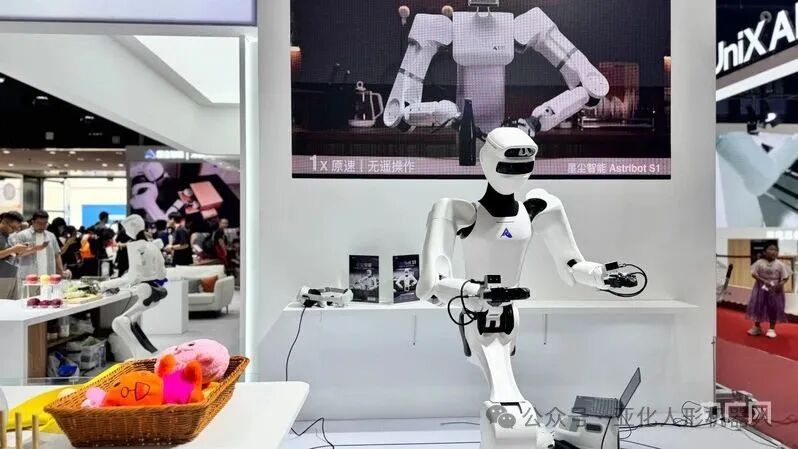
Scene from the 2025 World Robot Conference (Photo by Zhu Guanan, Central Broadcasting Network)
To Truly Enter Homes, We Need a Leap in Intelligence Level and Generalization Ability
“In fact, some companion-type, voice-interactive robots can already be well applied in home scenarios. This year, the sales growth of robot categories has been very rapid,” said Xu Lei, head of the intelligent robot business department at JD.com. Currently, household education companion robots and quadruped robotic dogs, which do not have such high requirements for intelligence level and generalization ability, are selling very well, with the embodied intelligence category growing more than 17 times during this year’s ‘618’ shopping festival.
However, the actual application and penetration of humanoid robots in home scenarios are still relatively limited. “We hope robots can truly work, liberate productivity, and improve production; this is our biggest task at present,” said Wang Xingxing, CEO of Yushu Technology. Currently, the intelligence level and generalization ability of robots in the entire industry are still insufficient. “If one day, humanoid robots can walk freely in venues and help me do things like buy food, that would be a critical point.”
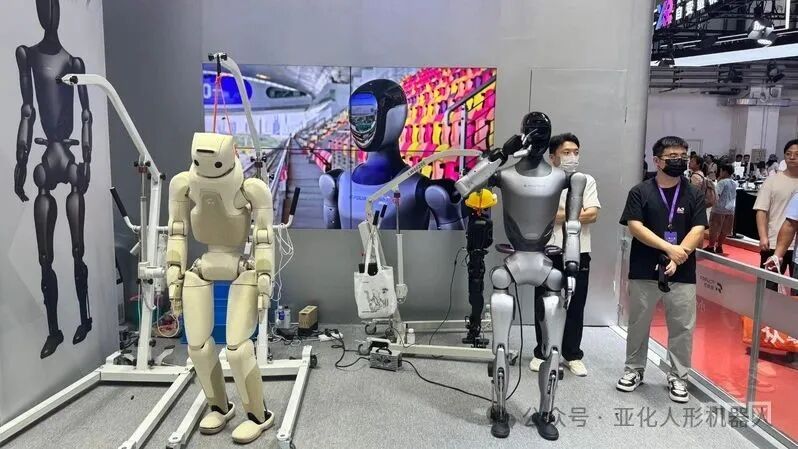
Scene from the 2025 World Robot Conference (Photo by Zhu Guanan, Central Broadcasting Network)
“Humanoid robots truly entering homes to ‘work’ is currently not achievable,” admitted Lu Xizhe, head of the public relations department at Uliqi Robotics. Although through end-to-end large models, layered technical paths, and artificial intelligence, robots can achieve multi-tasking in specific scenarios to help users complete a series of specific tasks, it is limited to specific scenarios. Wan Lin stated that achieving autonomous intelligence in rule-based environments is not a problem, but facing the myriad of family scenarios, model training remains a huge challenge.
The personalization (decor styles, item placements) and dynamic nature (new shopping items, layout adjustments) of home environments pose severe challenges to the generalization ability of robots. “Every family’s decoration and layout are different, which requires high-quality, massive data for training robots. Additionally, home scenarios are dynamic; for example, if a new TV is installed on the wall, the robot may not accurately recognize the newly added item,” Lu Xizhe believes that the core issue is still to improve the intelligence level and generalization ability of robots, which requires high-quality data collection. “However, data collection in home scenarios still faces privacy issues, and it is necessary to determine whether many families can accept data transmission, which also requires joint efforts from the industry and government to solve, such as legislation and establishing standards to allow consumers to trust such data collection.”
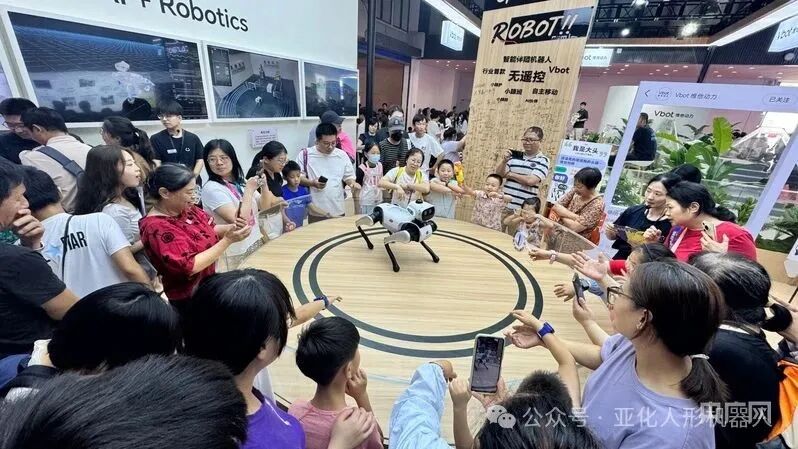
Scene from the 2025 World Robot Conference (Photo by Zhu Guanan, Central Broadcasting Network)
Breaking the Deadlock: The Synergistic Evolution of Technology, Ecology, and Social Cognition
For humanoid robots to truly enter homes, breakthroughs must be achieved in three dimensions: technology, ecological construction, and social acceptance. On the technical level, the synergistic evolution of the “brain” and “body” is key. Yushu Technology emphasizes “generalization ability,” Qianxun Intelligence focuses on “end-to-end large models,” and Stardust Intelligence adopts a “rope-driven transmission system,” each pointing to core directions for tackling intelligent algorithms, data processing, and hardware structure.
The positive cycle of data and generalization ability is particularly important. The practice of Zhongqing Robotics shows that diverse scenario data can significantly enhance the adaptability of robots, with robots being repurposed from playing soccer to boxing platforms, even leading to the emergence of remote-controlled competitive games. “The more diverse the data, the stronger the generalization ability of robots in specific scenarios,” said Wu Sicheng, marketing manager of Zhongqing Robotics, which is also a key reason why the industry expects comprehensive data to be open-sourced. The initiative by Beijing Economic and Technological Development Zone to open real-world data collection is providing possibilities for such breakthroughs.
Wu Sicheng told reporters that ecological construction requires a dual drive of standards and collaboration. Currently, the lack of unified standards for robot hardware interfaces and control algorithms leads to high costs for secondary development. Many companies are calling for leading manufacturers to collaborate with the government to establish industry standards, achieving “one set of development results adaptable to multiple robots.” “By combining ‘body + functional modules,’ we can lower the threshold for personalized development, and this approach may accelerate ecological maturity,” Lu Xizhe stated.
Improving social acceptance requires both time and technological validation. Users’ concerns about robots focus on safety and privacy. Stardust Intelligence chose the rope-driven system to achieve force control precision that “does not harm others or itself”; Uliqi sacrificed some efficiency for safety with conservative algorithms; privacy protection requires collaboration between regulations and technology to find a balance between data utilization and protection.
“I believe the path to reducing robot costs is becoming increasingly clear. Robots that cost tens of thousands or even hundreds of thousands will become less common, replaced by affordable and cost-effective robots,” Huang Qian believes that relying on China’s manufacturing supply chain capabilities, after mass production, cost differences will shrink, and the prices of robot bodies will decrease and tend to unify, with the focus of competition shifting to scene adaptation and algorithm capabilities.
Many relevant persons from robot companies believe that in the future, the real “flying into the homes of ordinary people” may occur in three aspects: first, a “robot moment” similar to GPT, achieving cross-scenario capability transfer; second, breakthroughs in flexible electronics and new materials, reducing robot hardware costs by an order of magnitude; third, the maturity of privacy computing technology, resolving the contradiction between data collection and protection. “The industry is currently in an explosive period, but from the laboratory to the ‘last mile’ of homes, it requires patience and collaboration from the entire industry chain.”
“I believe it won’t be long.” As Lu Yu, head of the embodied intelligence industry task force at the Beijing Economic and Technological Development Zone, said, in the future, from educational and elderly care scenarios to companion robots, to household service robots with multi-tasking capabilities, and finally evolving from tools to true family partners, the path for robots to enter the homes of ordinary people is already clearly visible.
When robots are no longer technological wonders at exhibitions but can quietly fold clothes, accompany children in learning, and assist the elderly in daily living, that future, which once only existed in science fiction movies, may truly arrive. This journey from industrial testing grounds to family living rooms is not only a history of technological evolution but also a social history of redefining the relationship between humans and machines.
Source: Central Broadcasting Network, if there is any infringement, please contact for deletion!