With the advent of the artificial intelligence era, robots have become the most tangible products of AI that people interact with. The media frequently reports on the development of robots, which are increasingly used in various fields such as industry, healthcare, home services, and law enforcement, replacing humans in many arduous, routine, or precision tasks. While people experience the convenience that robots bring to life and work, they also have higher expectations for the technical capabilities of robots.
How to improve the capabilities of robots? This is a question not only for the industry but also a primary research task for academia. Recently, surprising news has emerged from Shanghai: a robot has been accepted into a PhD program!
 Image Source: Shanghai Theatre Academy Official Website
01
The First Robot PhD
On July 27, at the 2025 World Artificial Intelligence Conference, the robot “Scholar 01” received an official admission notice from the Shanghai Theatre Academy, being accepted as a full-time PhD student in the 2025 cohort,with a research focus on digital performance design. Itbecomes the first embodied intelligent robot in the country to enroll as a “PhD” student. The Secretary of the Party Committee of the Shanghai Theatre Academy, Xie Wei, personally presented the admission notice to it.
The robot pursuing a PhD, receiving formal doctoral education just like humans, marks an important milestone in the history of robot development.
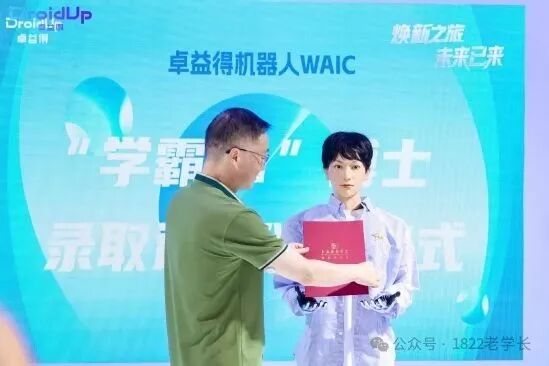 Image Source: Shanghai Theatre Academy Official Website
The first robot PhD is no ordinary creation; it is produced by Zhuoyide Robot Co., Ltd., with the physical body developed by Professor Li Qingdu’s team at the University of Shanghai for Science and Technology. The robot’s appearancewas designed by Professor Yang Qingqing from the Shanghai Theatre Academy. This reflects the importance of breaking down interdisciplinary barriers and integrating industry, academia, and research for the development of artificial intelligence.
This robot PhD has a unique training program. The training plan is jointly designed by the University of Shanghai for Science and Technology and the Shanghai Theatre Academy, with Professor Yang Qingqing as the supervisor. The program will include modules on fundamentals, arts, systems, and tasks, and will engage in research at the “AI + Performance” key laboratory and the Digital Performance Integrated Innovation Laboratory of the Ministry of Culture and Tourism.
Shanghai University of Science and Technology is a strong engineering school, while Shanghai Theatre Academy is a strong arts school. The collaboration between the two institutions exemplifies a typical model of interdisciplinary cooperation in new engineering and new liberal arts, highlighting the importance of cross-disciplinary and cross-field research as a significant trend in future technological research.
02
Impact on University Students
The purpose of human research on robots is to replace humans in performing physically demanding, repetitive tasks, or work in harsh environments, thereby improving efficiency or taking on jobs that humans cannot perform. For example, home service robots can care for the elderly for those who, for various reasons, do not have the time or ability to do so, or engage in household chores, etc. In March 2025, Musk announced thatthe Optimus robot, capable of walking dogs, babysitting, and mowing lawns, will enter trial production in 2025.Industrial robots are currently the most widely used in fields that require a large amount of human labor.
Not only in heavy labor, but also in high-precision technology fields, the application scenarios for robots will become even more extensive in the future. For instance, medical robots can assist doctors in performing surgeries in more complex environments.
As of April 2025, domestically produced Da Vinci robots have completed over 400 installations nationwide, with an annual surgical volume reaching 150,000 cases, and the cumulative surgical volume in the country has exceeded 600,000 cases. Robotic surgeries replace traditional surgeries, providing more precise removal of lesions.
The further development of robots will undoubtedly have a significant impact on human employment. Some netizens have lamented that with robots now pursuing PhDs, university students are facing increasing pressure. In various fields such as healthcare, public safety, finance, production, and high-end services, as the capabilities of robots improve, their applications will become more widespread, competing with many technical personnel for job positions.
The development of robots poses new considerations and challenges for university students regarding their future employment planning and choice of majors.
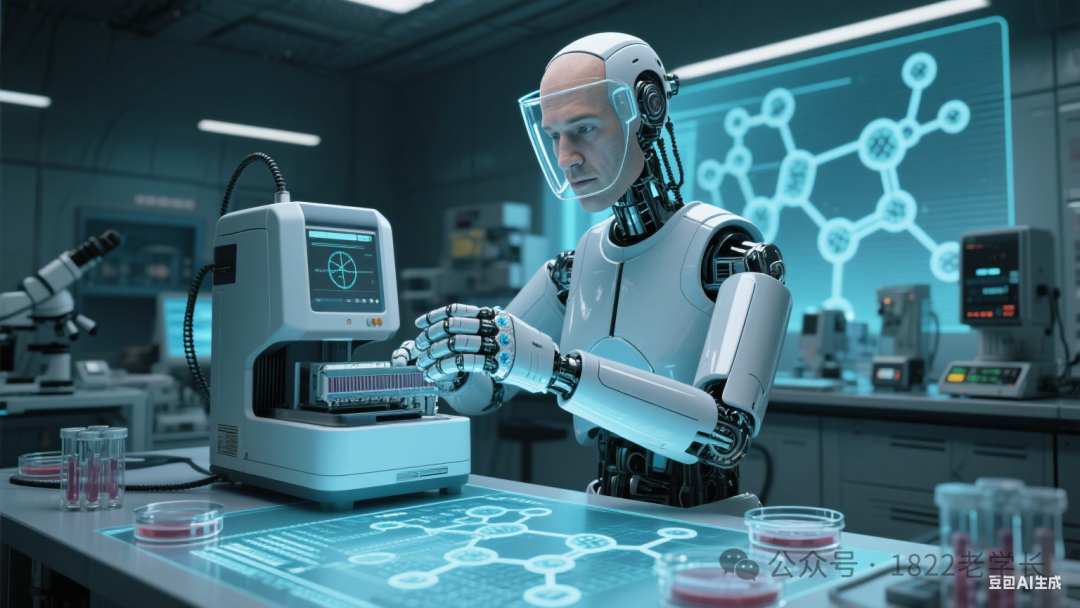
Image Source: AI Generated
03
Reflections and Suggestions
The emergence of the robot PhD is not just an academic research milestone; it signifies that robot technology has transcended its tool-like attributes and has become an important force in reshaping social structures. How robots and humans can follow the spiral trajectory of “substitution – collaboration – symbiosis” is a question that researchers need to ponder.
For contemporary university students, facing the “creative destruction” environment in the job market brought about by artificial intelligence, they should consider three questions: How to choose a major that suits themselves and their future? How to study in school to adapt to future challenges? How to balance a career plan that fits both themselves and the future environment? Only by thinking ahead can they better consolidate their professional advantages in the future AI era and prevent being displaced by artificial intelligence.
Regardingchoosing schools and majors, it is advisable to look at the discipline assessments and first-class construction evaluations of the target major, the employment reputation in the industry, the quality of further studies, etc. Before applying, it is important to understand the basic situation of the target major.
Finally, a reminder: entering university is a new starting point, and after enrollment, students should quickly prepare forfurther studies or employment planning, etc.
————————END———————–
Practical Resource Compilation:
1. High School Seniors (Major Selection)
Some articles on major selection and employment data that high school seniors and parents can refer to, such as:
Finance: School and application principles, planning after enrollment, employment data reference from 5 schools
Electronic Information: School and major analysis, learning planning after enrollment, employment data reference from 4 schools
Computer Science: School and application principles, learning planning after enrollment, employment data reference from 4 schools
Law: School and application principles, planning after enrollment, employment data reference from 6 schools
Mathematics: School selection principles and strong school analysis, planning after enrollment, employment data reference from 4 prestigious schools
Electrical Engineering: School and major analysis, planning after enrollment, employment data reference from 5 schools
2. Lower Year University Students (Further Studies and University Learning Planning)
For those who need to understand how to plan their university studies and pursue further education, it is advisable for prospective or current first and second-year students to start planning early. They can also refer to the university planning column collection (including 10 core articles):Column Introduction: Based on personal experience, a guide for university learning planning, further studies, and employment, or click on the homepage university planning menu for more information.
Note: All articles from this account, including subscription articles, represent the editor’s views, which have limitations and should not be used as the sole basis for decision-making.