Compared to cellular networks, the standards of the Internet of Things (IoT) are complex and constantly changing. This article attempts to clarify the principles, characteristics, and application scenarios of different IoT standards by discussing the evolution of smart lock applications.
First, let’s look at the main business of IoT applications. The main features of LPWA (Low Power Wide Area) services include low power consumption, low cost, low throughput, wide (deep) coverage, and a large number of involved terminals. Typical applications include metering, environmental monitoring, logistics, and asset tracking, making it a major market for global operators competing for connections.
So, what IoT communication technologies support LPWA services? The LPWA carrying technologies include: IoT technologies based on 2G/3G/4G, such as GSM, GPRS, and LTE; IoT technologies optimized for LTE, including LTE Cat 1 optimized for cost, LTE Cat 0 and eMTC optimized for both cost and power consumption; IoT technologies based on new air interface designs, such as NB-IoT; and non-cellular technologies like LoRa and Sigfox.
Finally, let’s examine how to distinguish between different network standards for smart bike locks.
1. SMS Unlocking, GSM Module
The first generation of Mobike shared bicycles had a GSM module built into the lock. Users scan the QR code on the bike, and after about 10 seconds, the motor activates, and with a “click,” the lock is successfully unlocked.
The principle of the GSM module is to use SMS for unlocking, similar to a functional mobile phone with a SIM card. The unlocking time of about 10 seconds corresponds to the time it takes for the SMS to be delivered.
The SMS unlocking method has its advantages, as it is relatively stable and does not require GPRS/3G data for unlocking.
However, there are significant disadvantages to SMS unlocking. For instance, the lock must maintain a long connection to the network, meaning this “phone” must always be powered on to receive signals. Currently, GSM terminals have a standby time of only about 20 days (excluding service), and the power consumption during this period needs to be converted into energy through other means for recharging.
2. GPRS Unlocking, GPRS/3G Module
Next, the unlocking speed of shared bicycles improved significantly, mainly by using a method where the server unlocks via GPRS/3G data.
The advantage of GPRS unlocking is the significantly reduced waiting time, from about 10 seconds with SMS unlocking to under 3 seconds, enhancing user experience. Additionally, with the decreasing cost of data, it becomes cheaper than SMS for frequent use, and the amount of information obtained is greater.
The disadvantage of GPRS unlocking is that GPRS signal coverage is not comprehensive. If there are obstructions, signal black spots can occur, and compared to other network standards, GPRS networks have many dead zones.
If 3G or 4G modules are used, the signal coverage issue is resolved, but the cost of 4G communication modules is too high, generally exceeding 200 RMB. With the rise of IoT, although there are several cellular communication module manufacturers in China, the inherent high power consumption and cost of existing cellular communication technologies still do not provide advantages over other standards.
3. Bluetooth Unlocking, Short-Distance Connection
The principle of Bluetooth unlocking is to verify through the application layer, where the user downloads an encrypted command package and sends it to the Bluetooth module to complete the unlocking. This is a short-distance connection method that allows direct interaction between the phone and the lock.
Pure Bluetooth unlocking has many drawbacks. First, the compatibility of Bluetooth chip versions among different phone manufacturers (mainly referring to Android phones) is poor. If it works on Huawei, it may not work on Meizu or Xiaomi. Moreover, there are dozens of Android phones on the market, and even among Huawei devices, there are compatibility issues across different versions, mainly due to significant differences in the Bluetooth chips procured.
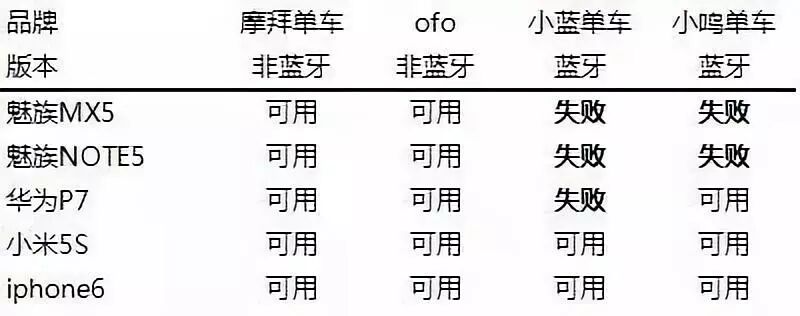
For example, with Xiaolan and Xiaoming bicycles, the failure rate is as high as 80% except for iOS systems, and the failure rate of Bluetooth is relatively high.
The advantage of Bluetooth unlocking is that it can assist in unlocking using data. The server only needs to connect to the user’s phone via data, and then the phone’s Bluetooth sends the unlocking command to the smart lock. This greatly reduces the power consumption for unlocking and does not rely on the signal strength of the module in the lock, improving stability. The data speed of 4G phones also ensures quick unlocking, resolving issues of instability, slow unlocking times, and power consumption.
Of course, a significant problem with Bluetooth unlocking is that users need to manually turn on Bluetooth and accurately locate the corresponding vehicle.
4. LTE IoT Unlocking, eMTC/NB-IoT Module
On May 23, the first eMTC/NB-IoT/GSM (LTE Cat M1/NB1 and E-GPRS) multi-mode outdoor test was launched in China, with Mobike participating in the multi-mode LTE IoT outdoor test.
eMTC/NB-IoT focuses on the low power wide area (LPWA) IoT market and is an emerging technology that can be widely applied globally.
Let’s first look at its significant advantages compared to the aforementioned IoT standards.
First, low power consumption can be achieved through physical layer optimization, new power-saving features, high-level protocol optimization, and operating system optimization. Hardware low power consumption can be achieved through improved integration, optimized device performance, and architectural optimization. The ultimate effect is that the theoretical battery life of the terminal can reach 10 years.
Second, low cost. Compared to the $20 cost of 3G modules, multi-mode LTE IoT modules can halve the cost through large-scale commercial use. Currently, NB-IoT chips at the million-unit production level are priced at $5 each, and at the tens of millions to hundreds of millions production level, the price can drop to $1 each. Additionally, the operator’s module subsidy policy will significantly reduce product prices, and the costs of chips and modules will decrease in the short term, thereby replacing traditional GSM and GPRS communication module scenarios and accelerating application deployment.
Third, wide and deep coverage. The coverage radius of NB-IoT is about 4 times that of GSM/LTE, while eMTC has a coverage radius about 3 times that of GSM/LTE.
Fourth, massive terminal connections. With optimization, eMTC/NB-IoT can achieve about 50,000 connections per cell.
However, Mobike’s choice of eMTC/NB-IoT networking also has significant disadvantages. The most direct expression is that it is like a small horse pulling a big cart.
NB-IoT is more suitable for applications like metering. Deploying NB-IoT on shared bicycles presents challenges, as base station switching and power consumption are not much better than 2G, and it is not superior to eMTC. NB-IoT has poor support for data rates and weak mobility, and in real-world testing environments, it cannot meet speeds exceeding 30 km/h. This could pose limitations for shared cars and even the express delivery industry.
Considering factors like network latency, base station switching, and power consumption, shared bicycles are more suitable for eMTC applications, but shared bicycles do not have a high demand for bandwidth. From a bandwidth supply and demand perspective, shared bicycles do not require a 1 Mbps rate, making eMTC seem less suitable for shared bicycle applications.
Therefore, joint networking may be a good approach. In the future, more application scenarios will use complementary methods of NB-IoT and eMTC, and even require short-distance connection complements. In summary, through the combination of NB-IoT and eMTC, along with 2G and eSIM, we can meet Mobike’s multi-scenario application needs.
Conclusion
Through the story of Mobike’s smart lock, we see that future networking methods are not a binary choice. Additionally, different vertical industries and application scenarios will require further exploration in selecting network standards. With the development of the industry, there is no perfect solution. Multi-mode cellular IoT modules that support various connection technologies like 2G/NB-IoT/eMTC may become the mainstream in the short term.
———— / END / ————