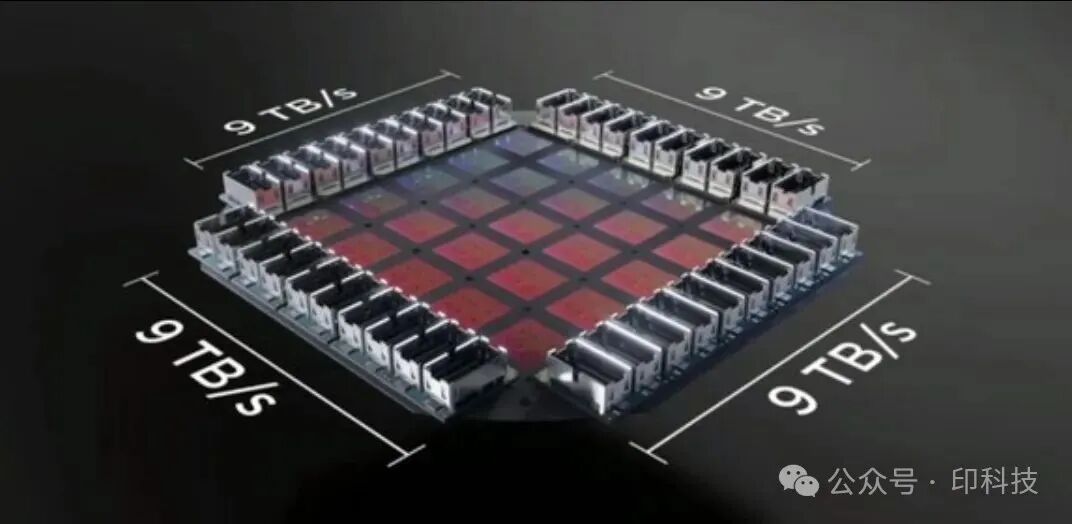
Once hailed by Musk as the “beast for training AI,” the Dojo system now faces a harsh ending. A strategic project that made a grand debut six years ago at Tesla’s Autonomy Day has now dwindled to core members leaving and a shift in technical direction.
According to insiders, Tesla is disbanding its Dojo supercomputer team, with project lead Peter Bannon set to depart, and CEO Musk has ordered the project to be halted.
Recently, about 20 team members have left for the newly established DensityAI, while the remaining Dojo employees will be reassigned to other data centers and computing projects within Tesla.
Insiders indicate that Tesla plans to increase its reliance on external technology partners, including Nvidia and AMD for computing, as well as Samsung and Nvidia for chip manufacturing and packaging.
From “computing beast” to strategic burden
Dojo is a supercomputer cluster tailored for AI training, serving as the cornerstone of Tesla’s “AI empire,” tasked with the development of Tesla’s self-designed supercomputing chips.
In 2019, Musk, under the spotlight at Tesla’s Autonomy Day, confidently defined Dojo as the “beast for training AI.” This system was designed to be the computational heart of Tesla’s autonomous driving, processing vast amounts of real-time data transmitted from the global Tesla fleet to train the neural network models for Autopilot, FSD systems, and the Optimus humanoid robot.
On the technical roadmap, Tesla showcased remarkable ambition: launching the first self-developed D1 chip in 2021; completing the first cabinet load test in 2022; and declaring in 2023 a commitment to reduce costs by an order of magnitude.
A sensational report from Morgan Stanley in 2023 further heightened market expectations—analysts predicted that Dojo could bring a $500 billion increase in Tesla’s market value. When the capital market viewed Dojo as the “next Apple-level moat,” no one anticipated its collapse would come so swiftly.
On a technical level, the purely self-developed route faced harsh realities. The development cost of a single D1 chip reached $120 million, far exceeding similar products from Nvidia. Additionally, the difficulty of software collaboration exceeded expectations, leading to frequent failures of the FSD V12 beta in complex scenarios, and the promised algorithm breakthroughs from Dojo did not materialize.
Coupled with talent departures and investment pressures, the once-glorious project ultimately faced a disbandment.
Betting on AI 5 chips to reshape the supply chain
In response to reports of Tesla disbanding the Dojo supercomputer team, Musk stated, “It makes no sense for Tesla to spread resources across two entirely different AI chip designs. The Tesla AI 5, AI 6, and subsequent chips will excel in inference, and at least perform reasonably well in training. Placing a large number of AI 5/AI 6 chips on a single circuit board can reduce the complexity and cost of network wiring by several orders of magnitude; I think this can also be considered as Dojo 3. In the future, all efforts will focus in this direction.”
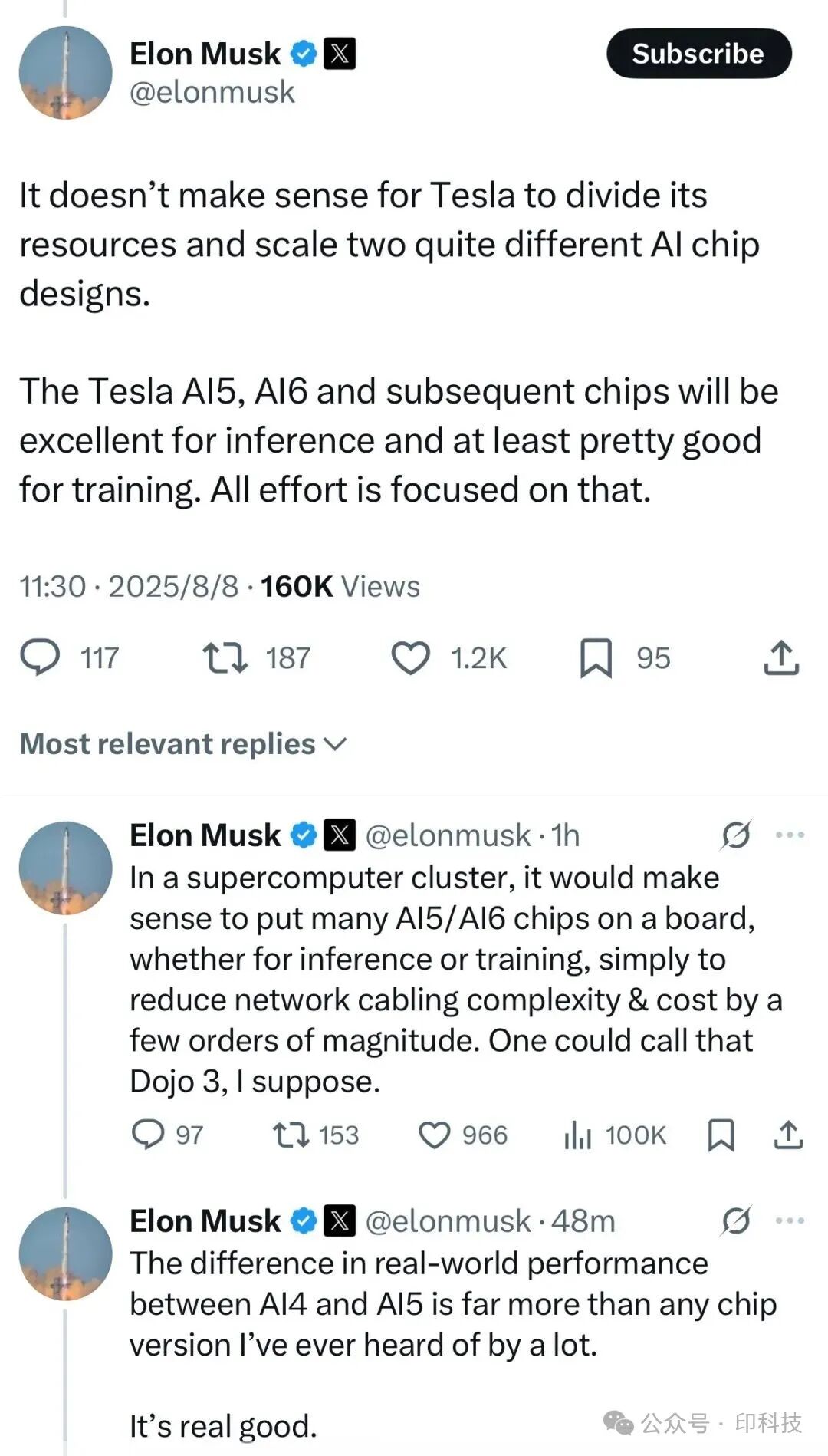
The AI 6 chip is a semiconductor applicable to Tesla’s next-generation FSD system, robots, and data centers, reportedly based on 2-nanometer technology.
Tesla has previously stated that it will not design a new chip specifically for Dojo 3, but plans to merge AI 6 with Dojo 3 into a unified architecture. During the second quarter earnings call, Musk mentioned: “We are considering unifying Dojo 3 with AI 6 into a single chip architecture, for example, using two chips for cars or robots, and 512 chips for servers.”
Tesla has also recently reached a $16.5 billion agreement with Samsung to ensure the supply of AI semiconductors until 2033. This plan aims to utilize a factory to be established in Texas to produce Tesla’s next-generation AI 6 chips, thereby diversifying Tesla’s procurement channels beyond TSMC.
The supply chain is also being reshaped: Samsung will produce the existing AI 4 chips and future AI 6 chips; TSMC will handle the manufacturing of AI 5 chips; the front-end manufacturing of the Dojo 3 system will be transferred to Samsung, while Intel will be responsible for the packaging stage, which is expected to have a profound impact on the entire supply chain.
Join the group by scanning the code