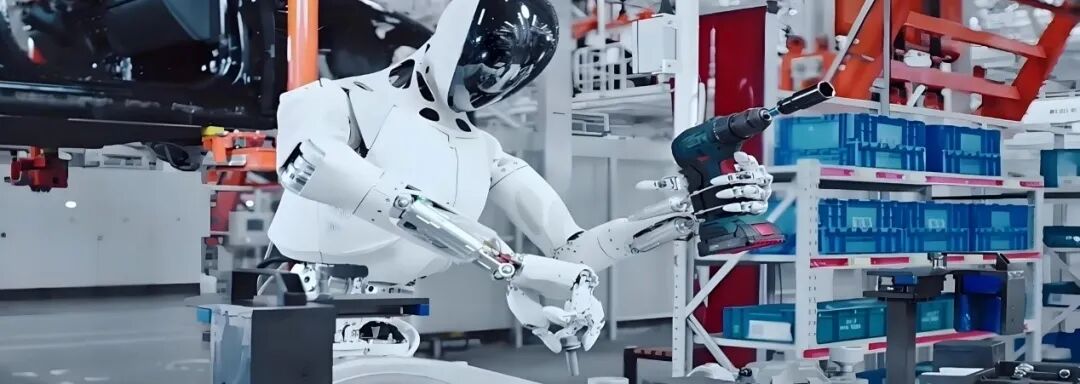
Humanoid robots are important carriers of embodied intelligence, integrating high-end technologies such as electromechanics, software algorithms, control systems, and new materials. They represent the highest level of mechatronics technology in the world and are key to leading a new round of technological revolution and industrial transformation, having disruptive impacts and strategic significance. Since 2024, the humanoid robot industry in China has shown explosive growth, with the industry scale continuously expanding. More than 150 companies are engaged in the development of humanoid robot bodies, accounting for half of the global humanoid robot body enterprises. This industrial transformation, driven by capital, technology, and policy collaboration, is propelling China from a “robot application powerhouse” to a “robot innovation powerhouse.”
While observing the rapid and explosive growth of humanoid robots in our country, we must also fully recognize the challenges such as the technical difficulty and complexity of humanoid robot development. The upstream segments of the humanoid robot development industry chain, including chips, large models, algorithms, and components, constitute the core dimensions of technological breakthroughs, and their importance and challenges can be understood from the following four aspects:
1. The core is in the chips: Hardware architecture determines the upper limit of intelligence.
Chips, as the “brain” and “small brain” of robots, directly determine their computing power, real-time response speed, and energy efficiency. For example, Tesla’s Optimus uses its self-developed Dojo chip (7nm process, integrating CPU/GPU/NPU) to achieve trillions of operations per second, supporting real-time collaboration of visual processing and motion control. Domestic companies such as Hezhima Intelligent have launched the Huashan® A2000 chip as a “brain” platform, supporting multi-modal perception fusion through a heterogeneous computing architecture; the Wudang® C1236 chip serves as a “small brain,” achieving parallel processing of AI decision-making and motion control through a time-sharing operating system, reducing system latency by 40%. The GD32 MCU series from GigaDevice is optimized for motion control, with its EtherCAT interface supporting microsecond-level communication, and its hardware current loop technology enhances motor control accuracy to 100 picoseconds, making it a mainstream choice for domestic humanoid robot joint controllers.
The core position of chips is also reflected in:
1. Exponential growth in computing power demand: Bipedal robots require independent PID control for each joint, combined with visual SLAM and force feedback, leading to a computing power demand of over 100 TOPS for a single device, far exceeding the 1 TOPS level of industrial robotic arms.
2. Stringent energy efficiency constraints: Under battery capacity limitations, chips must complete complex tasks within a 20W power consumption. For example, Yushu Technology’s H1 robot uses the Qualcomm Snapdragon platform, extending battery life to 4 hours through an edge computing architecture.
3. Accelerated domestic substitution: Although Tesla and Boston Dynamics rely on custom chips, domestic products like Horizon’s Journey 6 and Rockchip’s RK3588 have achieved over 70% performance benchmarking, with costs reduced by 30%.
2. The difficulty lies in large models: Bridging the gap from cognition to embodied intelligence.
Large models endow robots with environmental understanding and task planning capabilities, but their implementation requires overcoming three major bottlenecks:
1. Multi-modal real-time inference: The edge-side large model solution developed by Agassi in collaboration with Qualcomm achieves millisecond-level linkage of voice interaction, visual recognition, and motion control on the humanoid robot “Tongtianxiao.” However, compressing a GPT-4 level model to edge devices requires model pruning (reducing parameter count by 80%) and knowledge distillation (increasing inference speed by 5 times), which poses high demands on algorithm teams.
2. Adaptation of embodied intelligence: Traditional large models excel at text generation, while robots need to solve embodied tasks such as “how to grasp an egg without breaking it.” Alibaba Cloud used RAG technology in the Hello Chuxing case to combine knowledge bases with large models, enabling robots to adjust strategies based on real-time environments, but the issue of insufficient generalization ability still needs to be addressed in industrial scenarios.
3. Ethical and safety boundaries: Humanoid robots need to make autonomous decisions in dynamic environments, such as avoiding radiation areas during nuclear power plant inspections. This requires large models to possess causal reasoning capabilities, while current mainstream models still rely on correlation analysis, posing decision-making risks.
Domestic companies are breaking through with a “large model + small model” architecture: the main model handles general cognition, while lightweight models (such as MobileNet) focus on real-time control. For example, UBTECH’s Walker S controls response latency within 200ms, improving factory operation efficiency by 30%.
3. The challenge lies in algorithms: Breaking through the limits of dynamic balance and precise control.
Algorithms are the neural hub connecting chips and hardware, with difficulties concentrated in:
1. Bipedal motion control: Yushu Technology’s H1 robot uses the Zero Moment Point (ZMP) algorithm to optimize gait, but still relies on an Inertial Navigation System (INS) for dynamic compensation when climbing stairs, resulting in a 25% increase in energy consumption.
2. Dexterous hand operation: Wuhan Huawike’s electronic skin integrates over a thousand pressure sensors, combined with neural network algorithms to achieve tofu grasping, but the force control accuracy (±0.1N) is still lower than human levels (±0.02N).
3. Multi-machine collaborative scheduling: Shenzhen Zhongqing Technology’s quadruped robot achieves group collaborative disaster relief through distributed algorithms, but action disorder occurs when communication latency exceeds 50ms, requiring 5G private network support.
Domestic companies’ innovative paths include the following three aspects:
1. Data-driven optimization: The Galaxy General Galbot G1 robot collects over 100,000 hours of motion data, reducing the probability of falling from 30% to 5% through reinforcement learning.
2. Bionic algorithm integration: Zhijie Power draws on insect movement patterns to develop a crawling walking algorithm that reduces energy consumption by 40%, which has been applied to disaster rescue robots.
3. Open-source ecosystem construction: The Beijing Humanoid Robot Innovation Center has released the OpenWalker open-source framework, attracting over 200 companies to contribute algorithm modules, promoting the establishment of industry standards.
4. The key lies in components: Comprehensive breakthroughs from materials to processes.
Core components account for 60%-70% of the total machine cost, and their domestic substitution process directly determines industry competitiveness:
1. Precision transmission: Lide’s harmonic reducer achieves a precision of 1 arcmin and a lifespan exceeding 10,000 hours, having entered Tesla’s supply chain, but planetary roller screw still relies on the UK’s Rolls-Royce, with the lifespan of domestic brand transmission products only 60% of imported ones.
2. Sensors: Keli Sensor’s six-dimensional force sensor achieves a precision of 0.1% FS, with prices 40% lower than similar products from Keyence, but the drift rate exceeds 5% in -40℃ environments, limiting polar applications.
3. Servo motors: Hechuan Technology’s frameless torque motor achieves a power density of 5kW/kg, close to Japan’s Yaskawa level, but the temperature rise under 150% overload is 15℃ higher than imported products, affecting continuous operation.
The collaborative effect of the component industry chain is becoming evident: Wuhan has built a complete chain of “chips-joints-sensors,” with a local matching rate of 80%; Shenzhen has achieved a 24-hour R&D closed loop of “design in the morning, sample in the afternoon,” shortening the development cycle of dexterous hands from 6 months to 45 days. At the policy level, the Ministry of Industry and Information Technology provides a 15% R&D subsidy to component companies with a domestic substitution rate exceeding 50%, and it is expected that by 2027, the self-sufficiency rate of core components will exceed 70%.
The breakthroughs in these four dimensions present a non-linear dependency relationship: improvements in chip computing power can alleviate algorithm pressure (e.g., the Dojo chip reduces the complexity of Optimus’s motion control algorithm by 30%), enhanced generalization ability of large models can reduce reliance on high-precision sensors (e.g., Agassi’s solution reduces the use of 20% force sensors), while breakthroughs in component performance can unleash chip potential (e.g., Huawike’s electronic skin increases the utilization rate of the main control chip by 40%). The industry is currently at a critical turning point of “point breakthroughs-system integration-ecosystem reconstruction,” and companies need to make strategic choices in technology route selection (e.g., bipedal humanoid vs. wheeled humanoid), supply chain management (domestic substitution vs. international collaboration), and scene implementation (industrial priority vs. consumer first). In the next 3-5 years, companies with full-stack capabilities in “chips-algorithms-hardware” will dominate the market, while those relying solely on one link may face integration risks.
(Note: The technical parameters of the products mentioned in the article are compiled, compared, and analyzed based on publicly available information, with no misleading guidance.)
Author Profile:
Wang Jihong, male, born in January 1977, a member of the Jiusan Society, a professor-level senior engineer, currently serving as the executive vice president and secretary-general of the China Mechatronics Technology Application Association. He is mainly engaged in research on manufacturing automation, intelligent manufacturing, intelligent robots, smart factories, and manufacturing integration systems.