Semiconductor Industry Research Report: AI + Robotics Intelligent Controllers and Chip Technology: Empowering Breakthroughs in Embodied Intelligence (September 2025)
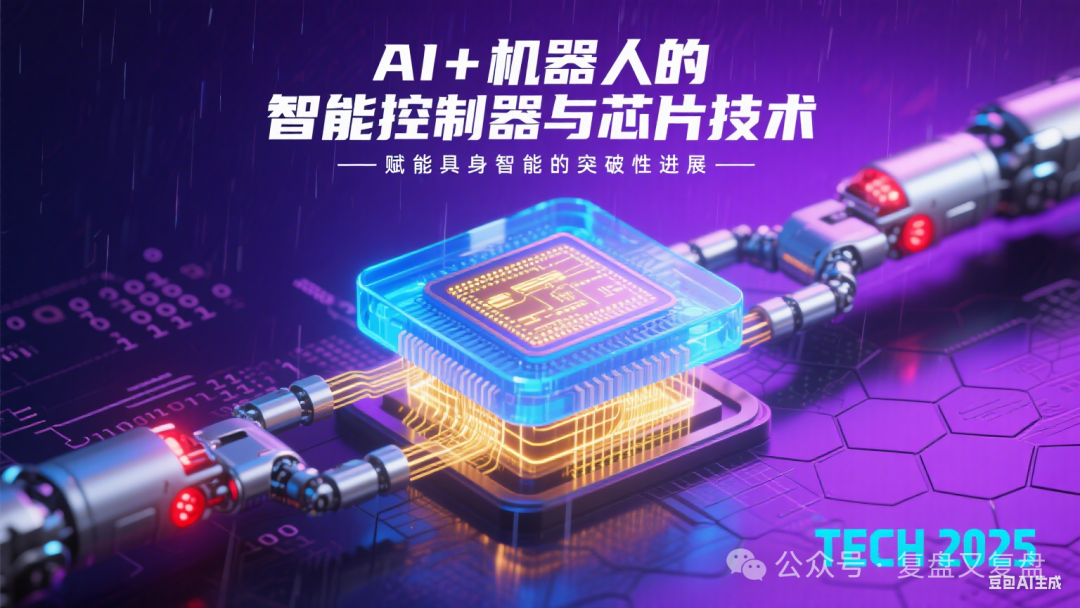
1 Overview: The Context and Research Significance of Embodied Intelligence
Embodied AI represents the forefront of artificial intelligence development, combining intelligent algorithms with physical entities to enable machines to perceive, understand, and interact with the physical world. The core of this concept lies in the integration of “body” and “intelligence,” breaking through the limitations of traditional AI that operates solely in virtual environments. The year 2025 is widely regarded as the year of the explosion of embodied intelligence, primarily due to the maturity of multimodal large models, the emergence of high-performance chips, and the collaborative development of robotic hardware1.
From a technical perspective, embodied intelligence marks a critical leap for robots from “mechanical execution” to humanoid intelligence. The robotics industry is undergoing a key transformation from “technology demonstration” to “value delivery,” where models become the infrastructure, and application deployment becomes the main battlefield1.
Physical AI (Physical AI) is a concept proposed by NVIDIA CEO Jensen Huang, who believes that Physical AI will reshape the $50 trillion manufacturing and logistics industries, with all mobile objects becoming “roboticized” and driven by AI transformation1. This vision is gradually approaching reality, thanks to the rapid advancement of chip technology, particularly the emergence of intelligent controllers and processor chips designed specifically for robots, providing the essential computational power for embodied intelligence.
2 Technical Architecture: The “Brain-Cerebellum-Limbs” Collaborative System of Robots
The technical architecture of embodied intelligent robots can be analyzed using a “brain-cerebellum-limbs” three-part framework, where each part has its own responsibilities while closely collaborating to achieve intelligent behavior in robots.
2.1 “Brain” – Environmental Perception and Decision-Making Center
-
Function: The “brain” is responsible for environmental perception, behavior decision-making, and human-robot interaction, relying on the capabilities of artificial intelligence large models, especially the capabilities of multimodal large models1.
-
Technical Foundation: Modern robot “brains” are typically based on visual language models (VLM) and visual language action models (VLA), enabling them to understand natural language instructions, interpret visual information, and generate corresponding action plans2.
-
Implementation Method: These models are usually trained in the cloud but deployed on the edge to ensure real-time performance and privacy protection. NVIDIA’s Cosmos physical intelligence large model is a representative in this field, trained on over 120 million hours of video data, building the core capability of “understanding the physical world”1.
2.2 “Cerebellum” – Motion Control and Coordination Center
-
Function: The “cerebellum” focuses on motion control, utilizing technologies such as artificial intelligence, automatic control, and the Robot Operating System (ROS) to achieve precise motion regulation in complex scenarios1.
-
Technical Characteristics: Unlike the general computing of the brain, the cerebellum requires real-time response and high reliability, typically employing dedicated control algorithms and hardware. It is responsible for converting high-level commands from the brain into specific joint movements and action sequences.
-
Challenges: Motion control algorithms are limited by data collection and labeling costs, becoming a direct obstacle to mass production1. A large amount of data from real environments is needed to train and optimize control models, which differs from the brain’s reliance on virtual data for training.
2.3 “Limbs” – Physical Interaction and Execution Mechanisms
-
Function: The “limbs” are the physical entities through which robots interact with the physical world, including humanoid robotic arms, dexterous hands, flexible feet, and other execution mechanisms1.
-
Technical Composition: Limbs integrate human motion mechanics, mechanical structure design, new materials, and sensor technologies, achieving an integrated “energy-structure-perception” system through the integration of sensors and long-lasting power units1.
-
Key Bottleneck: Among the upstream core components, the planetary roller screw has a high value proportion and manufacturing difficulty, with the domestic industry relying on imports for a long time. Currently, companies like Hechuan Co., Ltd. and New Times Chuang Electric have achieved breakthroughs in domestic production of planetary roller screws for humanoid robots1.
Table: Core Components and Functions of the Technical Architecture of Embodied Intelligent Robots
 3 Key Hardware: Breakthroughs in Chip Technology Empowering Embodied Intelligence
As the “core brain” of robots, chips have evolved from general processors to highly integrated, heterogeneous computing, energy-efficient dedicated systems on chip (SoC)6. The design philosophy of modern robotic chips is profoundly shaping the intelligent future of robots.
3.1 Computing Power Enhancement: From General Computing to Dedicated Acceleration
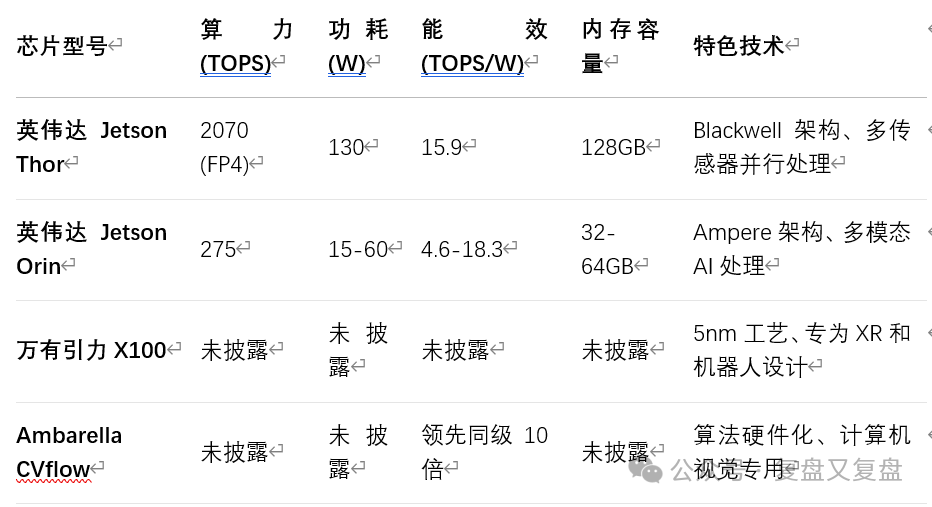
The most significant advancement of the new generation of robotic chips is the leap in computing power. NVIDIA’s Jetson Thor chip, released in August 2025, represents the highest level in the industry, with AI computing capabilities reaching 7.5 times that of the previous generation Jetson Orin, achieving up to 2070 FP4 TFLOPS (trillions of floating-point operations per second), while power consumption is controlled within 130W25.
This enhancement in computing power is crucial for embodied intelligence, as robots need to process massive amounts of data from various sensors (such as cameras, LiDAR, and force control sensors) and make real-time decisions. NVIDIA states: “Robots require rich sensor data and low-latency AI processing to support real-time operation, which must rely on powerful AI computing and memory to parallel process data from multiple sensors.”5
3.2 Energy Efficiency Optimization: Balancing Computing Performance and Power Consumption
For battery-powered robots, energy efficiency (TOPS/W) directly determines endurance6. The energy efficiency of Jetson Thor has improved by 3.5 times compared to the previous generation5, a progress achieved through the combination of various technologies:
-
Advanced Processes: Utilizing advanced semiconductor processes such as 5nm/6nm FinFET, like the 5nm XR chip released by Gravitational Company3.
-
Architectural Innovation: Technologies like dynamic voltage frequency scaling (DVFS) adjust power consumption dynamically based on load6.
-
Algorithm Optimization: Reducing computational complexity through techniques like sparsification and quantization6.
These energy efficiency optimizations allow robots to operate longer on limited battery capacity, laying the foundation for their application in real-world scenarios.
3.3 Heterogeneous Computing: Matching Diverse Task Requirements
The core feature of modern robotic chips is the heterogeneous computing architecture. A single type of processor cannot simultaneously meet the diverse computing power needs for perception, decision-making, and control6. Flagship robotic chips typically integrate multiple processing units:
-
CPU: Responsible for general logic and task scheduling6.
-
GPU/NPU: Parallel processing of visual SLAM, deep learning inference, and other intensive computations6.
-
Dedicated Acceleration Units: Efficiently processing sensor data (such as LiDAR point clouds, camera image preprocessing), significantly reducing latency and power consumption6.
This heterogeneous architecture enables chips to handle various tasks of robots simultaneously, maximizing efficiency from high-level decision reasoning to low-level motion control.
3.4 Safety Mechanisms: Ensuring Reliable Operation
Functional safety is a strict requirement for industrial/service robots6. Chips need to incorporate various safety mechanisms:
-
Hardware Redundancy: Key modules have backups, and a single failure will not lead to system failure6.
-
Error Correction Code (ECC): Ensures data integrity in memory6.
-
Memory Protection Unit (MPU): Isolates tasks and data of different security levels6.
These safety mechanisms, derived from automotive-grade chips (such as ISO 26262 ASIL-D standards), are being migrated to the robotics field to ensure safe and reliable operation of robots in human environments6.
Table: Comparison of Mainstream Robotic Chip Performance
 4 Industry Ecosystem: A Comprehensive Analysis from Core Components to System Integration
The embodied intelligence industry is forming a complete ecosystem globally, with rapid development in all aspects from core chips, sensors to complete machine manufacturing, and application development.
4.1 Global Landscape: Competition and Collaboration Among Leading Enterprises
The global robotics industry has formed a diversified player landscape, including tech giants, specialized robotics companies, and startups. Based on assessments of technological maturity and financial strength, the top five companies include Tesla, Figure AI, Agility Robotics, Boston Dynamics, and Unitree (宇树科技)1.
NVIDIA, while not directly manufacturing robots, has become a core enabler of the entire ecosystem by providing chips and software platforms. NVIDIA’s Vice President of Robotics and Edge AI, Deepu Talla, clearly stated: “We do not manufacture robots or cars, but we support the entire industry with infrastructure computing and related software.”2 This “selling shovels” strategy has allowed NVIDIA to build a vast ecosystem, currently boasting over 2 million developers joining the NVIDIA robotics technology ecosystem5.
4.2 Chinese Market: From Technological Catch-Up to Partial Leadership
China has shown strong development momentum in the field of embodied intelligence. Statistics show that there are 176 humanoid robot companies in China, completing 85 financing rounds with a total amount of $5.5 billion (accounting for 26% of the global total)1. The development characteristics of the Chinese market include:
-
Complete Industry Chain: A full-chain layout from core components to complete machine manufacturing, such as Ningbo has built a complete industry chain covering complete machine manufacturing, brain and cerebellum algorithms, sensors, and actuators9.
-
Technological Breakthroughs: Achieving international leadership in certain fields, such as the aviation motor controller of Yongjiang Laboratory achieving a peak power of 340kW with a weight of 5kg, reaching a 99% efficiency level internationally9.
-
Diverse Application Scenarios: With a strong manufacturing base, providing diverse testing grounds and application scenarios for robots.
4.3 Industry Chain Structure: Core Components and System Integration
The embodied intelligence industry chain can be divided into upstream core components, midstream system integration, and downstream application scenarios:
-
Upstream: Includes chips (such as NVIDIA Jetson series), sensors (such as Sunny Optical), actuators (such as Zhongdali De’s humanoid robot modules), etc.9. These core components have high technical barriers and significant value proportions, such as the high value proportion and manufacturing difficulty of planetary roller screws, which is one of the bottlenecks in the domestic industry chain1.
-
Midstream: Mainly complete machine manufacturing enterprises, such as UBTECH, Zhiyuan Robotics, etc., which integrate and optimize various components to form complete robotic products19.
-
Downstream: Covers multiple application fields such as industrial manufacturing, medical care, and household services4. The demand in these application scenarios is driving technological iteration and product optimization.
4.4 Policy Support: Comprehensive Promotion by the Chinese Government
The Chinese government is promoting the development of the embodied intelligence industry through multi-level policy support. The “Implementation Plan for the Development of the Embodied Intelligent Robot Industry” released by Hefei High-tech Zone is a typical example, with its policy system including4:
-
Technical Breakthroughs: Providing up to 10 million yuan in matching funds to support core technology research and development, specifically commissioning breakthroughs in “brain-cerebellum-core components-body” full-chain technology.
-
Enterprise Cultivation: Implementing gradient support, with startup teams receiving up to 10 million yuan in rewards, cultivating specialized and innovative enterprises.
-
Platform Empowerment: Arranging 50 million yuan in computing power vouchers annually, subsidizing 30% of the investment for new platforms, accelerating technology transformation.
-
Scenario Applications: Allocating special funds to support scenario opening and promote commercialization.
-
Ecological Safeguarding: Heavily investing in attracting top global teams, establishing industry-specific policies and funds to support industry development.
This “five-in-one” policy system provides comprehensive support for the embodied intelligence industry, helping to accelerate technological research and industrialization processes.
5 Challenges and Opportunities: Constraints and Future Growth Points
Despite the broad prospects for embodied intelligence, its development still faces multiple challenges while also containing significant opportunities.
5.1 Technical Challenges: The Gap from Laboratory to Practical Application
-
Core Component Bottlenecks: Among the upstream core components, the planetary roller screw has a high value proportion and manufacturing difficulty, with the domestic industry relying on imports. Although companies like Hechuan Co., Ltd. and New Times Chuang Electric have achieved breakthroughs in domestic production, there are still gaps in precision, lifespan, and consistency compared to international leading levels1.
-
Bottom Layer Algorithm Limitations: The enhancement of computing power for motion control (“cerebellum”) and large models (“brain”) relies on algorithm iteration, but motion control algorithms are limited by data collection/labeling costs, becoming a direct obstacle to mass production1.
-
Real-Time Requirements: Robots need to achieve millisecond-level responses in dynamic environments for the “perception-decision-control” closed loop, which places high demands on chip interface bandwidth and computational latency6.
5.2 Commercial Challenges: The Contradiction Between Cost and Demand
-
High Costs: The “bottleneck” problem of humanoid robots leads to significant disparities in manufacturing costs—products from Honda, NASA, etc., exceed $2 million, while most companies’ products are priced in the tens of thousands to $370,000 range; Elon Musk proposed that “costs must be controlled within $20,000 for mass production,” but the industry is still far from this goal1.
-
Ambiguous Demand: Application scenarios are not yet clearly defined, market demand has not scaled, and there is insufficient motivation for mass production1. Robotics companies need to identify truly valuable and technically feasible application scenarios to achieve the transition from “technology demonstration” to “value delivery.”
-
Safety and Ethical Factors: The industry lacks unified standards and regulations, hindering the commercialization process1. Especially, safety standards and ethical guidelines for robots operating in human environments still need to be improved.
5.3 Future Growth Points: Multiple Opportunities Coexist
Despite the challenges, there are multiple growth opportunities in the field of embodied intelligence:
-
Continuous Technological Progress: Chip computing power continues to increase while costs decrease, such as NVIDIA’s Jetson Thor developer kit priced at $3,4997, which, while still not cheap, is more accessible than before. As scale expands, costs are expected to decrease further.
-
Gradually Clear Scenarios: Clear demands have emerged in fields such as industrial manufacturing, warehousing logistics, and medical care4. The pain points in these scenarios (such as labor shortages, working in hazardous environments, etc.) provide opportunities for robots.
-
Strengthened Policy Support: Such as the policy support from Hefei High-tech Zone4 and Ningbo’s initiatives to build strategic points for the embodied intelligence industry9, providing a favorable environment for industry development. The Chinese government is accelerating the development and application of embodied intelligence technology through industrial policies, financial support, and various means.
6 Future Trends: Directions of Technological Integration and Industrial Transformation
The embodied intelligence industry will exhibit multiple development trends in the future, covering various dimensions such as technological routes, application scenarios, and industrial ecosystems.
6.1 Technological Integration: Breakthroughs Through Interdisciplinary Collaboration
The future development of embodied intelligence will increasingly rely on interdisciplinary technological integration:
-
Deep Integration of AI and Robotics: Large models will be more closely integrated with robot control, achieving higher levels of autonomy and adaptability. NVIDIA’s concept of “Physical AI” represents this direction, aiming to teach AI to understand the physical world1.
-
Edge-Cloud Collaborative Computing: Edge-side chips handle real-time tasks, while cloud-side trains complex models and dispatches parameters6. This division of labor can balance real-time performance and computational complexity, achieving optimal resource utilization.
-
Bionic Materials and Structures: Such as the color-changing electronic skin from Round Core Electronics achieving pressure sensing9, and the AI olfactory sensor from ZK Micro-sensing breaking through biological recognition limits9, these innovations will enable robots to interact better with their environment.
6.2 Application Expansion: From Industrial to Service Proliferation
The application scenarios of embodied intelligence will gradually expand, following the path from industrial to service, from specialized to general:
-
Industrial Scenarios First: From 2023 to 2028, the complete machine market scale is expected to reach 2-5 billion yuan (initial stage), primarily focused on industrial scenarios (such as special operations)1. Industrial environments are relatively structured, and tasks are relatively clear, making them more suitable for the current capabilities of robots.
-
Service Scenarios Budding: From 2028 to 2035, service scenarios will begin to emerge, with a complete machine scale of 5-50 billion yuan1. As technology matures, robots will gradually enter service fields such as elderly care and education.
-
Comprehensive Proliferation: From 2040 to 2045, the number of humanoid robots is expected to exceed 100 million, covering all industries including industrial and service, with a complete machine + industry application market scale exceeding 10 trillion yuan1. By then, robots will become a common presence in social life.
6.3 Industry Chain Restructuring: Specialized Division of Labor and Ecological Construction
The embodied intelligence industry chain will gradually mature and form a more specialized division of labor:
-
Chip Specialization: More chips designed specifically for robots will emerge, such as Gravitational’s 5nm XR chip3, optimized for specific scenarios rather than pursuing general performance.
-
Component Modularity: For example, Zhongdali De’s humanoid robot module achieves a 30% increase in torque density9, this modular component can lower the R&D threshold for complete machine enterprises.
-
Ecological Platformization: For example, NVIDIA’s CUDA + Jetson ecosystem6, through an integrated software and hardware platform, reduces development difficulty and accelerates the innovation cycle.
Table: Predictions for the Development Stages of Embodied Intelligent Robots
 Conclusion and Recommendations
Embodied intelligence is at the intersection of technological breakthroughs, market explosions, and the reconstruction of business paradigms1. The advancement of chip technology, particularly the emergence of intelligent controllers designed specifically for robots, provides the core driving force for this field. From NVIDIA’s Jetson Thor to Gravitational’s 5nm XR chip, these dedicated processors enable robots to truly achieve the “perception-decision-action” closed loop through innovations in computing power enhancement, energy efficiency optimization, heterogeneous computing, and safety mechanisms.
However, the development of embodied intelligence still faces multiple challenges in technology, business, and ecology. Core component bottlenecks, algorithm limitations, high costs, and ambiguous demand need to be collaboratively addressed by all links in the industry chain. China has already shown certain advantages in this regard, such as a complete industry chain layout, an active innovation ecosystem, and strong policy support, but continuous breakthroughs in core technologies are still needed.
For practitioners and investors, we propose the following recommendations:
-
Technical Level: Focus on heterogeneous computing architecture, edge-cloud collaboration, and dedicated acceleration chips, as these technologies can effectively balance computing power, power consumption, and real-time requirements.
-
Product Level: Focus on specific application scenarios, addressing practical pain points, achieving the transition from “technology demonstration” to “value delivery,” and avoiding excessive pursuit of generality at the expense of practicality.
-
Industry Level: Build an open collaborative ecosystem, reducing innovation thresholds through standardization and modularization, accelerating technological iteration and industrialization processes.
-
Investment Level: Focus on enterprises with unique advantages in core components (such as chips, sensors, actuators) and scenario applications, as these links have high value proportions and strong barriers.
The journey of embodied intelligence has just begun, and the advancement of chip technology has already equipped machines with a “brain”; the next step is to inject them with a “soul”—the ability to truly understand and adapt to the physical world. This transformation will not only reshape the robotics industry but will profoundly change human production and lifestyle. As technology continues to break through and application scenarios expand, the future of human-robot coexistence is gradually becoming a reality.
This response was generated by AI, and the content is for reference only; please verify carefully.
The article was largely generated by AI, and the content is for reference only and does not constitute investment advice! Semiconductor Industry Analysis Research Report (2025 Updated Version)