While traditional microwave ovens still rely on bulky power frequency transformers, TRinno’s IGBT single tube and modern ABOV microcontrollers are driving kitchen appliances into the era of precise energy control. This dual-core drive solution replaces mechanical structures with semiconductor technology, reducing the size of microwave ovens by 40% and achieving a leap from millisecond-level power adjustment to intelligent cooking programs, fundamentally reconstructing the technical foundation of household heating devices.
1. Energy Conversion Revolution: The Evolution of Magnetron Drive
Physical Bottlenecks of Traditional Solutions For the past forty years, microwave ovens have relied on the principle of electromagnetic induction—220V AC is boosted by a power frequency transformer weighing over 3 kg, then converted to 3000V DC by rectifier diodes to drive the magnetron. This system has three technical shackles:
-
Energy Efficiency Black Hole: Core eddy current losses result in energy conversion efficiency of less than 70%, with excess energy dissipated as continuous buzzing and heat from the unit.
-
Control Inaccuracy: Mechanical timers introduce a ±10% time error, and five levels of power adjustment cannot meet the precise needs of yogurt fermentation and low-temperature defrosting.
-
Size Curse: The transformer occupies 23% of the total space, severely hindering the trend towards ultra-thin designs.
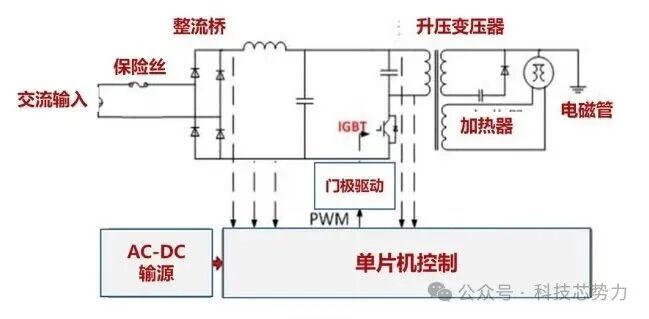
Breakthrough Logic of Semiconductor Solutions Modern solutions use IGBT high-frequency inverter technology to achieve precise energy control: first, the mains power is rectified to 300V DC, then the IGBT chip switches the current direction at a high speed of 20kHz, and finally, a high-frequency transformer boosts the voltage to drive the magnetron. This transformation raises energy efficiency to over 85% and compresses the overall thickness to 60% of traditional models.
2. IGBT: The Energy Commander Behind the Magnetron
Decoding Key Performance Dimensions The technological breakthrough of TRinno’s IGBT single tube is reflected in four physical aspects:
-
Voltage Defense Fortress: A withstand voltage of 1350V (e.g., G40N135 model) can withstand grid surge impacts, maintaining circuit stability even during lightning strikes.
-
Conduction Loss Suppression: A saturation voltage drop of 0.85V reduces conduction heat generation by 40%, allowing for a reduction in heatsink size.
-
High-Frequency Switching Control: A turn-off speed of 35 nanoseconds reduces electromagnetic radiation interference, allowing the microwave oven to pass CLASS B EMC certification.
-
Survival Under Extreme Conditions: A junction temperature tolerance of 175°C and a short-circuit carrying capacity of 10 milliseconds eliminate the risk of tube explosion caused by dry cooking.
Dynamic Thermal Management Intelligence The chip integrates a temperature-current feedback protection mechanism: when the outer shell temperature exceeds the safety threshold of 110°C, it automatically triggers a current limiting function and sends a power reduction request to the main control chip. This intelligent protection allows commercial microwave ovens to operate continuously for over 8 hours.
3. Microcontroller: The Intelligent Core of Cooking Logic
Three-Level Evolution of Control Architecture ABOV microcontrollers provide differentiated solutions based on product positioning:
-
Basic Type: Equipped with AFM8 series 8-bit chips, controlling mechanical buttons and LED digital tubes through GPIO, achieving basic timing and five levels of power.
-
Advanced Type: Using a 32-bit AFM32 core, running a real-time operating system (RTOS), supporting touchscreen interaction and 20 preset menus.
-
Smart Type: Integrating a WiFi module for mobile connectivity, with built-in AI algorithms to automatically match heating curves based on food weight.
Precise Power Chain Analysis The microcontroller ensures heating accuracy through three closed-loop controls:
-
Current transformers monitor the working current of the magnetron in real-time.
-
Temperature sensors collect the thermal field distribution in the cavity.
-
128-level PWM signals dynamically adjust the IGBT conduction ratio. Laboratory data shows that this solution controls power fluctuations within ±15W (the national standard allows ±100W), with the blood water exudation rate of frozen meat reduced to below 3%.
4. The Engineering Aesthetics of Dual-Core Collaboration
Real-Time Power Adjustment Process When the user selects the “Milk Heating” program, the following collaboration occurs:
-
The microcontroller calls the stored specific heat capacity parameters for milk, calculating the required energy of 120kJ.
-
Based on the refrigerated temperature of 4°C, it sets a stepped power curve: 800W for rapid heating in the first 30 seconds, followed by 300W for the next 90 seconds to prevent boiling over.
-
The IGBT receives a PWM signal with a duty cycle of 60%, converting DC power into high-frequency pulses.
-
The current sensor detects an actual power deviation of +5%, immediately correcting the IGBT drive timing. The entire process is completed within 50 milliseconds, ensuring the milk temperature accurately reaches the ideal drinking point of 55°C ±1°C.
Perceptible Value Upgrades for Users
-
Silent Experience: The high-frequency transformer replaces the power frequency iron core, reducing noise from 65 decibels to 42 decibels (equivalent to an office environment).
-
Smart Cooking: Pre-packaged meal heating automatically recognizes packaging QR codes, matching exclusive power curves.
-
Safety Redundancy: Dual interlocks of door switch signals and current monitoring cut off high-voltage output the moment the door is opened.
5. The Evolution Direction of Future Kitchens
Three Major Technology Integration Trends
-
Work Condition Perception Expansion: By inferring the dielectric constant of food from the IGBT drive waveform characteristics, automatic food identification is achieved (e.g., distinguishing between frozen beef and pork).
-
Energy Management Innovation: Standby power consumption is compressed from 5W to 0.5W, combined with photovoltaic systems to achieve automatic energy storage heating during off-peak hours.
-
Safety Architecture Upgrade: Dual MCU redundancy design builds a hardware-level watchdog, reducing system failure rates to one in a billion.
A leading manufacturer’s laboratory is testing oil temperature sensing functionality: by monitoring the attenuation characteristics of microwaves in fats, it can automatically determine the doneness of fried foods, with an error range controlled within ±5°C.
Conclusion: A Mini Industrial Revolution on the Stove
From the heavy iron cores of the electromagnetic induction era to the precision control of semiconductor drives, the technological evolution of microwave ovens reveals a hard truth: the more basic the household appliance, the more it conceals the crystallization of cutting-edge technology. As TRinno’s IGBT and ABOV’s microcontroller engage in energy dialogue at 20,000 times per second on a tiny circuit board, we witness not only a quantitative change in heating efficiency but also the beginning of a qualitative change in the intelligent kitchen ecosystem.
Note: This article is sourced from the internet and is intended to convey more information.
The views expressed in this article are for sharing and communication purposes only and do not represent the position of this public account.
Please indicate the source when reprinting. If there are any errors in source attribution or issues related to copyright, please contact us, and we will promptly correct or delete it. Thank you.