

Recently, Associate Professor Wu Yichuan from the University of Electronic Science and Technology of China and his team focused on the key challenges faced by wireless soft microrobots during development, particularly the difficulties in achieving high mobility and robustness. They developed a wireless soft robot weighing only about 1 gram and measuring 2 centimeters in length. This robot is equipped with a single actuator but can achieve multi-directional, controllable movement by adjusting its leg motion patterns.
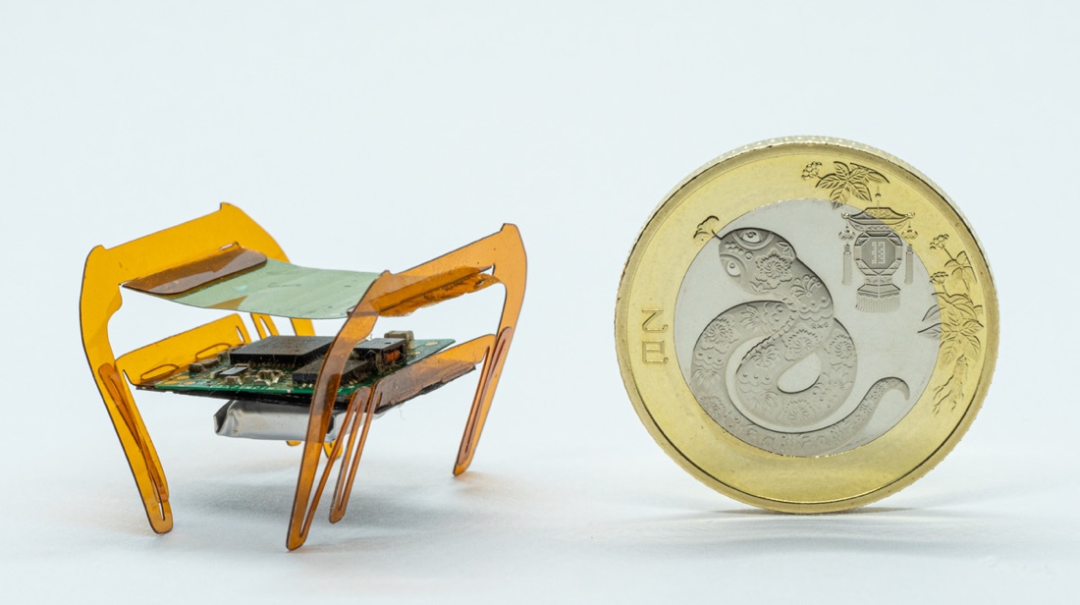
Image | Physical model of the “electronic cockroach” robot, comparable in size to a coin (Source: https://doi.org/10.1038/s41467-025-61810-1)
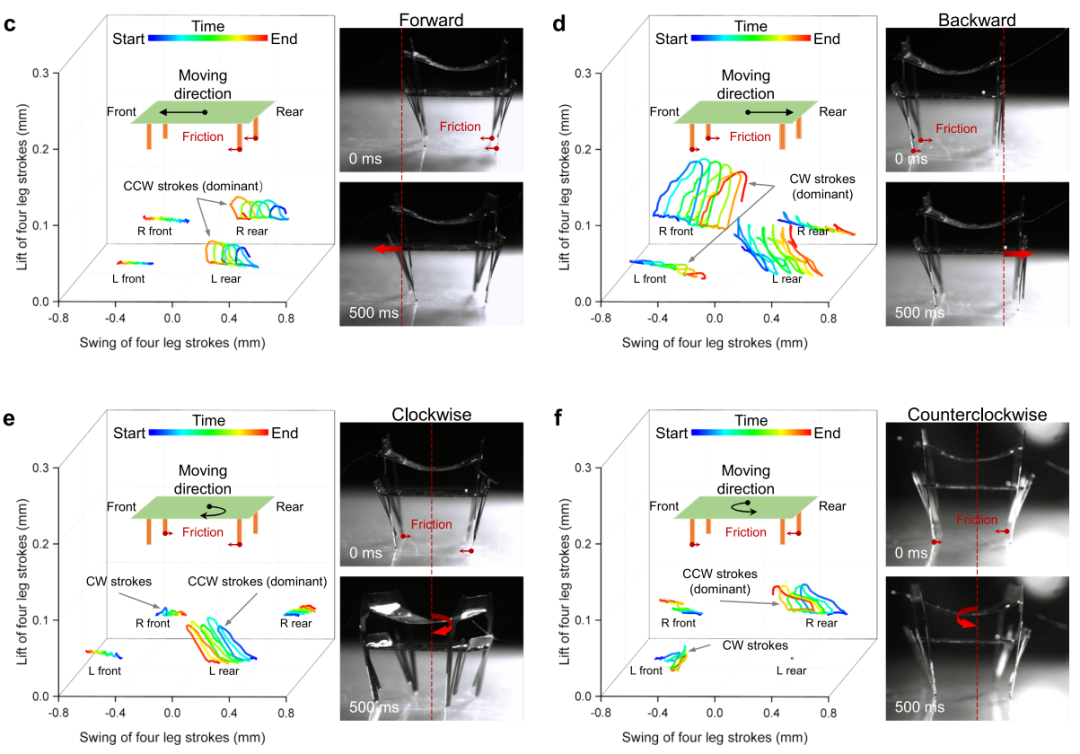
Previous wireless microrobots typically required two or more actuators to achieve steering control. In contrast, the team introduced superimposed vibration modes, allowing a single actuator to stimulate multiple leg motion patterns, thereby endowing this soft robot with excellent maneuverability.
The team’s microrobot achieved the highest relative motion speed among all wireless microrobots weighing less than 1.5 grams, reaching a level of high maneuverability previously only attainable by multi-actuator robots. More importantly, this is the first wireless robot at this scale that can still operate normally even when stepped on, demonstrating exceptional structural resilience and environmental adaptability.
Meanwhile, the integrated design proposed in this research, utilizing a single actuator combined with a simple structure and control method, has achieved high flexibility, strong controllability, and high robustness, providing new ideas for the design of soft microrobots under simplified driving mechanisms.
The team believes this robot has application potential in various real-world scenarios, especially in confined spaces that are “inaccessible to humans,” such as:
-
Disaster search and rescue: It can navigate through rubble, cracks, and debris for detection and localization.
-
Pipeline inspection: Suitable for fine pipelines, underground gaps, ventilation systems, and other hard-to-reach areas.
-
Environmental monitoring: It can carry sensors to collect data in complex terrains such as forests and underground.
-
Bionic education: Its structure and motion design have significant implications for bionic teaching and popular science.
Currently, the team is also considering further miniaturizing and smartening this platform, planning to enhance its practicality by integrating camera modules.
Image | Related paper (Source: https://doi.org/10.1038/s41467-025-61810-1)
Wu Yichuan was born in Fushun County, Zigong City, Sichuan Province, and has been fascinated by hands-on activities and observing nature since childhood, particularly the behavior of insects, especially how they navigate quickly through complex terrains, flip, jump, and even fly. This interest has gradually evolved into his current research direction—bionic robots at the insect scale.
“The School of Mechanical and Electrical Engineering at the University of Electronic Science and Technology has a solid foundation in robotics research and places a high emphasis on interdisciplinary research in bionic robots, providing me with a fertile ground for scientific research. The university is located in Chengdu, a city rich in technology and innovation, which is conducive to promoting technology implementation,” he stated. Therefore, after completing his PhD, Wu Yichuan chose to return to his hometown to continue his research, hoping to transform his understanding of nature and love for technology into solutions for real-world problems, such as disaster search and rescue and exploration of confined spaces.

Image | Wu Yichuan (Source: Wu Yichuan)
In this research, he and his team aimed to create a small, lightweight, structurally simple, and highly capable microrobot that can flexibly navigate through narrow and complex spaces while exhibiting good environmental adaptability.
However, achieving this goal faces multiple challenges: First, making a microrobot that is “wireless and controllable” is difficult. A 1-gram robot must integrate a battery, circuitry, and control multi-directional motion trajectories. Most existing solutions rely on multiple actuators, which can lead to increased weight and complexity in control. Second, microrobots often have poor environmental adaptability. Traditional robots are prone to failure when impacted or dropped, making them unsuitable for high-risk scenarios, such as exploring rubble gaps in disaster areas or underground pipelines.
Thus, the team proposed: Can we control multiple motion trajectories using just one actuator? Can we design the structure and materials so that the robot cannot be “crushed”? This research revolves around these two core questions.
Meanwhile, the inspiration for this team’s work is quite “natural”—it comes from insects. For example, cockroaches can quickly navigate through narrow spaces and are not damaged when falling from heights. They wondered: If robots could learn these abilities, could they help humans accomplish more dangerous and challenging yet meaningful tasks? Wu Yichuan has always believed that nature is the best teacher. If the team can draw inspiration from nature and gradually “mimic” and “evolve” these abilities through technology, they could produce some truly interesting and meaningful scientific research results.
During the research, the most impressive moment for the team was when they first captured the robot “surviving being stepped on.” They placed the robot on the experimental platform and pressed it with a ruler and stepped on it. It was flattened, but once the external force was released, it quickly regained its shape and continued to run! Additionally, they unexpectedly discovered that the robot could still achieve trajectory control even when in an “upside-down” position. Compared to previous microrobots that required external wires, this research presents the first microrobot platform at this scale that achieves system integration, wireless control, and can withstand such strong impacts.
(Source: https://doi.org/10.1038/s41467-025-61810-1)
In the future, the team hopes to advance in several areas: First, to achieve more motion modes, such as adding jumping, gliding, and flying capabilities to enhance the robot’s adaptability in irregular terrains; second, to optimize energy use, as the current endurance is weak, the team plans to adopt strategies such as energy recovery, wireless power supply, and lightweight efficient power sources to extend working time; finally, to achieve collective collaboration, for which they plan to develop multiple “electronic cockroaches” to form a swarm system, hoping they can collaborate like ants to complete tasks such as exploration, transportation, and construction. “In short, we hope this is not just a ‘flexible individual,’ but a ‘collaborative team,'” Wu Yichuan told DeepTech.
Currently, Wu Yichuan has not yet participated in entrepreneurship but is considering combining some laboratory technologies with industrial applications. The team hopes to form a technology startup team focused on “bionic robots at the insect scale” in the future, promoting their results in education, security, inspection, and other fields.
“We hope that in the future, this ‘little strong’ will not only stay in the laboratory but also enter the corners of real life to accomplish tasks that traditional methods find difficult, becoming the team’s ‘micro assistant,'” Wu Yichuan concluded.
References:
Wu, Y., Cao, L., Lu, G. et al. Untethered soft microrobot driven by a single actuator for agile navigations. Nat Commun 16, 6842 (2025). https://doi.org/10.1038/s41467-025-61810-1
Operation/Formatting: He Chenlong


 01/ Former Meta developer of the first production-level full-stack RL framework, now starting a company to develop a general agent that can accurately call thousands of tools in minutes02/ Breaking through 60 years of principle-based synthesis limitations: Scientists develop the world’s first solidified ribosome-like molecular reactor, reaching previously inaccessible compound zones03/ Building the world’s largest human cell model training dataset, Chinese scientists jointly establish, potentially doubling the accuracy of AI cell model predictions04/ Former OpenAI executive and DeepMind scientist team up, blank website but secured $200 million led by a16z, aiming for an AI materials revolution?05/ Shanghai Jiao Tong University alumni develop new materials inspired by Fujian Tulou, with a specific surface area equivalent to four football fields per kilogram, have established a startup company and received FDA certification<img src=”https://mmbiz.qpic.cn/mmbiz_jpg/JJtKEey0hPYlXr70tz6LtgTOobMsb4xFhI9jUNsVmStLV8V4ToTYKDIrejSjqrNQqGanhqmKxpmBiboj118L7rw/640?wx_fmt=jpeg&from=appmsg&wxfrom=5&wx_lazy=1&randomid=cxv7padz&tp=wxpic”