Open Source! Smart IoT Data Gateway Platform
Source Code
https://www.gitpp.com/kelang/project0808-iot_gateway
A high-performance IoT data gateway platform based on a new architecture with a high-speed data bus, designed for collecting and preprocessing large-scale device data. Built with Go language, it supports multi-protocol device access, real-time data processing, an intelligent rules engine, and various aggregation functions, providing a complete plugin architecture and a modern web management interface, suitable for industrial intelligence and smart city scenarios.
Main Console – Real-time Monitoring Dashboard
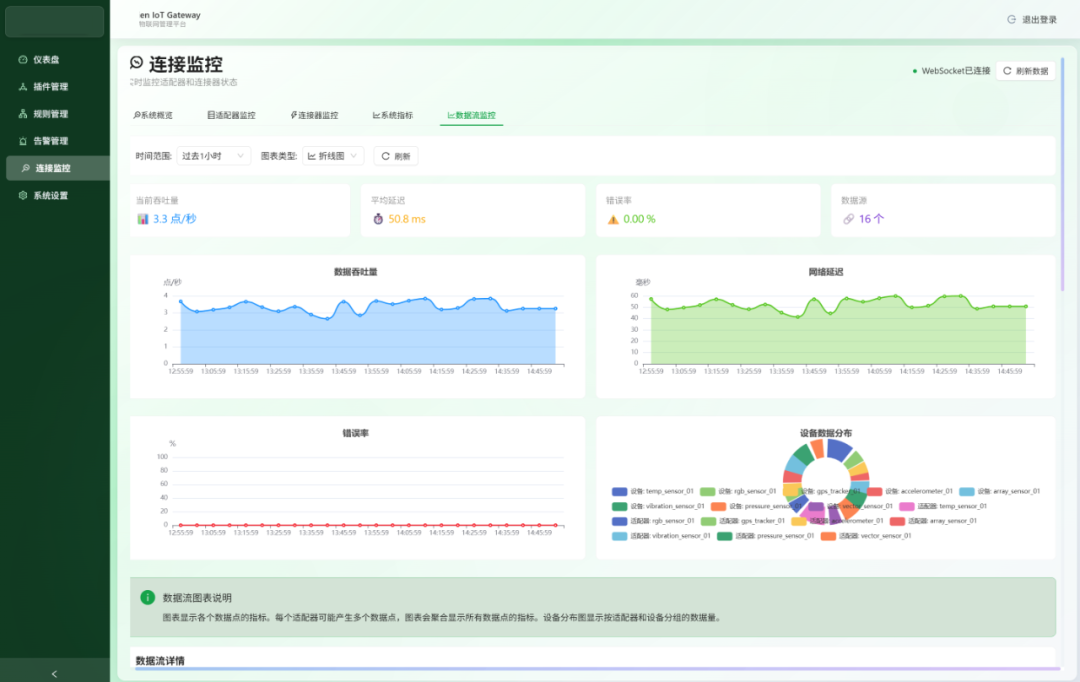
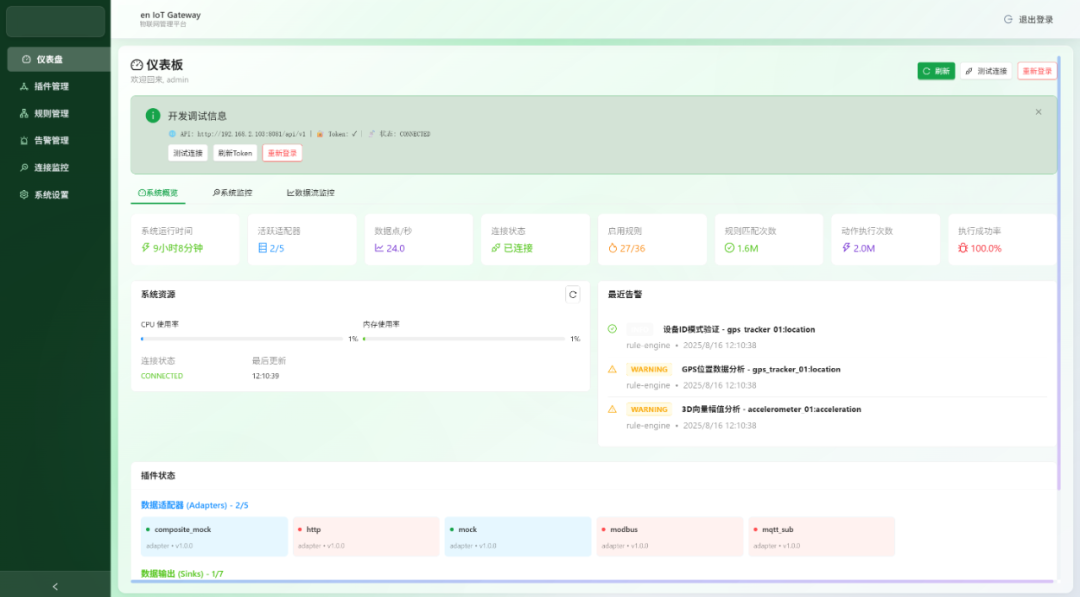
Real-time display of system operation status, number of device connections, data processing statistics, and recent alarm information
📈 System Monitoring – Performance Metrics
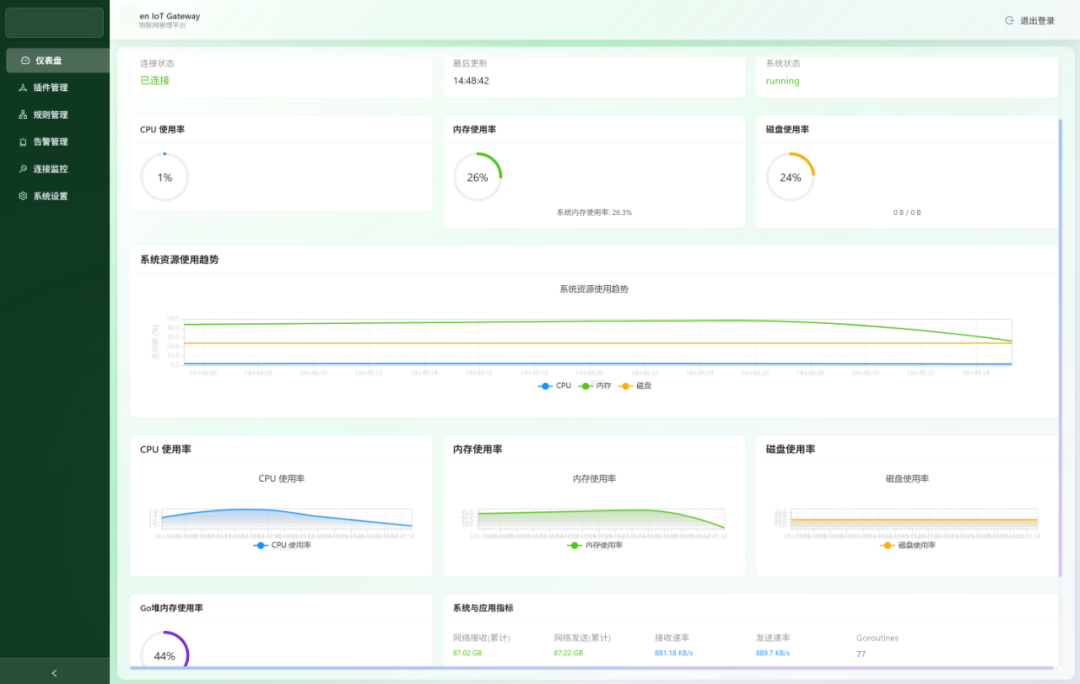
Detailed system resource usage, including CPU, memory, disk usage, and Go runtime statistics
🔌 Plugin Management – Adapters and Receivers
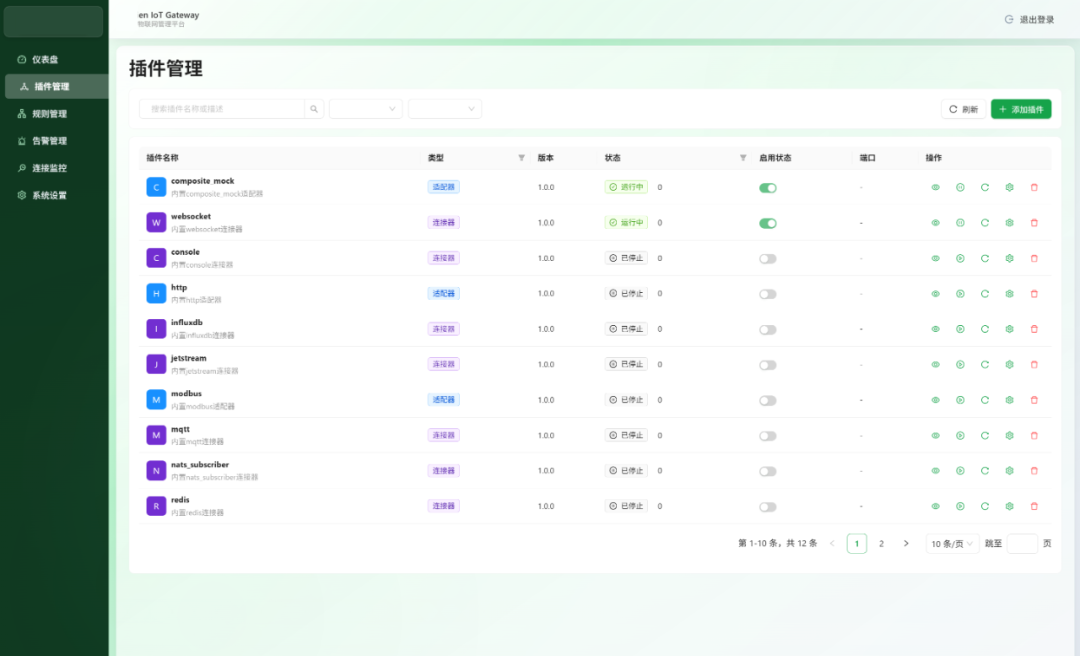
Manage southbound adapters and northbound receivers, supporting dynamic configuration and status monitoring
⚙️ Rules Engine – Data Processing Rules
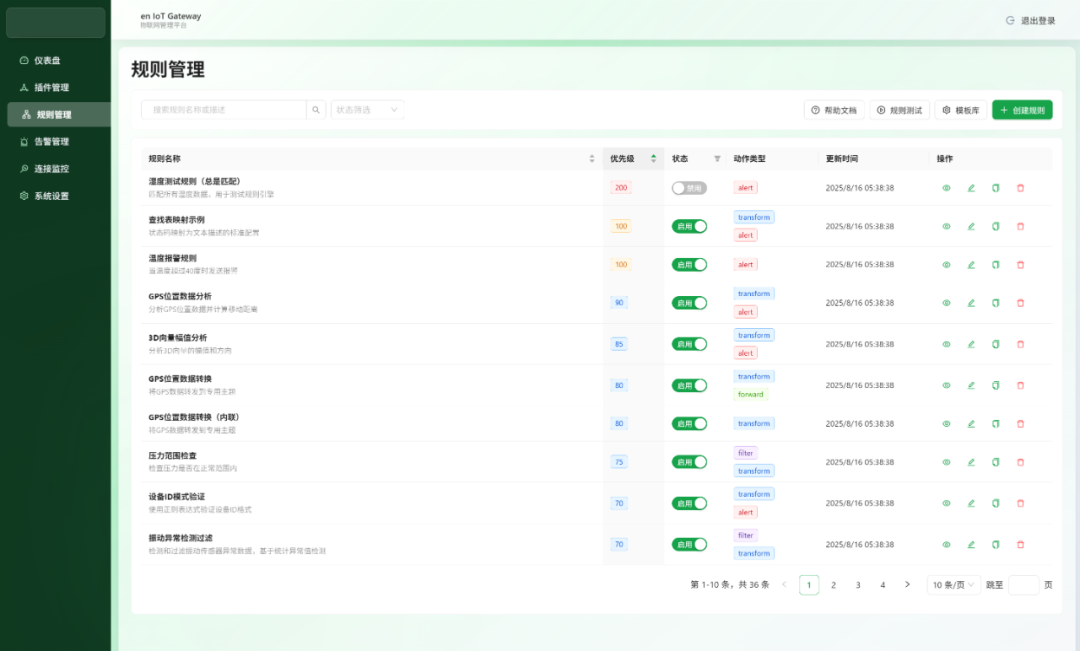
Real-time display of data flow charts, error rate statistics, and device data distribution
📊 Data Statistics – Device Data Details
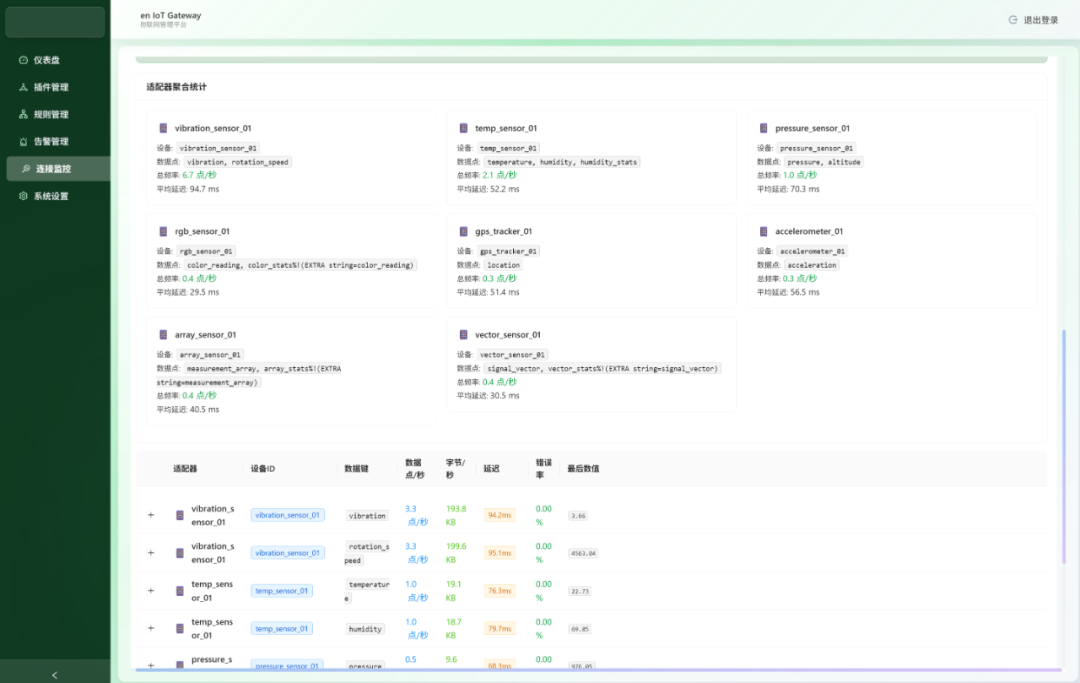
A high-performance IoT data gateway platform based on a new architecture with a high-speed data bus, designed for collecting and preprocessing large-scale device data. It provides a complete solution for data collection, processing, routing, and management, supporting various communication protocols and data formats.
🎯 Core Advantages
- 🚀 High Performance: Developed in Go language, supporting connections for millions of devices
- 🔧 Plugin-based: Flexible plugin architecture, supporting custom adapters and data processors
- ⚡ Real-time Processing: High-speed messaging bus based on NATS, with millisecond-level data processing
- 🧠 Intelligent Rules: Powerful rules engine supporting 28 aggregation functions and complex data types
- 📊 Visualization: Modern web interface for real-time monitoring and management
- 🔒 Enterprise-grade: Comprehensive authentication, permission management, and auditing features
✨ Features
📡 Data Collection
- Multi-protocol Support: Modbus, MQTT, HTTP, WebSocket, etc.
- Device Management: Automatic discovery, status monitoring, fault detection
- Data Validation: Real-time data quality checks and anomaly handling
- Cache Mechanism: Intelligent caching strategy to improve data processing efficiency
🔄 Data Processing
- Rules Engine: Real-time data filtering, transformation, aggregation
- Complex Data Types: Supports arrays, vectors, GPS, colors, and other complex data
- 28 Aggregation Functions: Statistical analysis, percentiles, anomaly detection, etc.
- Stream Processing: High-throughput data stream processing
📤 Data Output
- Multi-target Routing: InfluxDB, Redis, MQTT, WebSocket, etc.
- Format Conversion: JSON, CSV, Protocol Buffers, etc.
- Batch Processing: Configurable batch size and buffering strategy
- Fault Tolerance Mechanism: Automatic retries, failover
🎛️ Management Interface
- Real-time Monitoring: Device status, data flow, system performance
- Rules Management: Visual rule editor supporting complex conditions and actions
- Plugin Management: Dynamic loading, configuration, and monitoring of plugins
- System Settings: User management, permission control, audit logs
Introduction to the Open Source Smart IoT Data Gateway Platform
1. Project Overview
This open-source project (Gitpp link) is a high-performance IoT data gateway platform built with Go language, adopting a high-speed data bus architecture, specifically designed for large-scale device data collection and preprocessing. Its core goal is to address the challenges of heterogeneous devices, large data volumes, and high real-time requirements in scenarios such as industrial intelligence and smart cities through plugin-based architecture, real-time processing, and intelligent rules engine.
2. Core Application Scenarios
- Industrial Intelligence
- Device Monitoring and Predictive Maintenance: Connect sensors, PLCs, industrial robots, etc., in factories to collect real-time data on vibration, temperature, pressure, etc., triggering abnormal alarms or predicting failures through the rules engine.
- Edge Computing Collaboration: Preprocess data at the factory edge to reduce cloud load, supporting localized decision-making (e.g., dynamic adjustments of production lines).
- Infrastructure Management: Integrate traffic lights, environmental monitoring stations, smart meters, etc., to achieve unified data collection and visualization monitoring.
- Energy Optimization: Analyze regional electricity peaks through aggregation functions, dynamically adjusting energy distribution strategies.
- Vehicle Status Monitoring: Collect real-time data on GPS, fuel consumption, engine status, etc., supporting fleet scheduling optimization.
- Cold Chain Logistics: Trigger abnormal alarms through temperature sensor data to ensure cargo safety.
- Smart Buildings: Integrate subsystems such as air conditioning, lighting, and security to achieve energy consumption analysis and automated control.
- Photovoltaic/Wind Power Plants: Collect data from power generation equipment to optimize maintenance plans.
3. Core Advantages
- High Performance and Scalability
- Connections for Millions of Devices: Based on Go language’s concurrency model and NATS messaging bus, supporting low-latency, high-throughput data transmission.
- Plugin-based Architecture: Quickly adapt to new devices or protocols through custom adapters (e.g., Modbus, MQTT drivers) and data processors (e.g., JSON parsers, encryption modules).
- Millisecond-level Response: Utilizing NATS’ publish/subscribe model, achieving end-to-end latency of less than 10ms from data collection to processing.
- Stream Processing Engine: Supports sliding windows, time series aggregation, etc., suitable for real-time statistics (e.g., calculating the average temperature over the past 5 minutes).
- 28 Aggregation Functions: Including standard deviation, percentiles, anomaly detection, etc., meeting industrial statistics and machine learning preprocessing needs.
- Complex Data Type Handling: Directly supports GPS coordinates, RGB colors, multi-dimensional vectors, etc., reducing parsing overhead.
- Fine-grained Permission Control: Based on RBAC model, supporting access control at device level and data field level.
- Audit Logs: Record all operational behaviors to meet compliance requirements (e.g., GDPR).
- Real-time Monitoring Dashboard: Drag-and-drop components display key metrics such as device status, data flow, and system performance.
- Rules Editor: Configure trigger conditions (e.g., “temperature > 50℃ and duration > 5 minutes”) and actions (e.g., send email, start cooling system) through a visual interface.
4. Detailed Features
- Data Collection Layer
- Protocol Support: Modbus (industrial devices), MQTT (lightweight IoT protocol), HTTP/WebSocket (web devices), CoAP (low-power devices).
- Device Management: Automatic discovery of new devices, heartbeat detection, self-healing (e.g., reconnection mechanism).
- Rules Engine: Supports conditional branches, nested logic, for example:
IF (temperature >80 AND humidity >70) THEN TRIGGER alarm AND FORWARD data TO "emergency_topic" - Data Validation: Automatically filter invalid values (e.g., negative temperature readings) and mark anomalous data.
- Multi-target Routing: The same data can be written simultaneously to InfluxDB (time series database), Redis (cache), MQTT (message queue), etc.
- Format Conversion: Supports JSON (general), Protocol Buffers (efficient binary), CSV (log analysis).
- Plugin Hot Loading: Update or add functional modules without restarting the service.
- Batch Processing Strategy: Configure batch size (e.g., trigger write every 1000 data points) and buffering time (e.g., maximum delay of 5 seconds).
5. Why Choose This Platform?
- Open Source and Free: No commercial licensing restrictions, highly customizable.
- Technological Forwardness: The combination of Go language and NATS is suitable for IoT scale expansion needs in the next 5-10 years.
- Ecological Compatibility: Seamless integration with cloud-native tools like Kubernetes and Prometheus, supporting hybrid cloud deployment.
Applicable Users: Industrial automation manufacturers, smart city solution providers, IoT device manufacturers, open-source technology enthusiasts.
Project Value: Reducing device access costs through a unified gateway, enhancing data value through real-time processing, and lowering operational thresholds through visualization.
Open Source! Smart IoT Data Gateway Platform
Source Code
https://www.gitpp.com/kelang/project0808-iot_gateway