Follow “Electronic Engineering Magazine” and add the editor’s WeChat
Regional groups are now open, please send a message with 【Shenzhen】【Shanghai】【Beijing】【Chengdu】【Xi’an】 to the public account
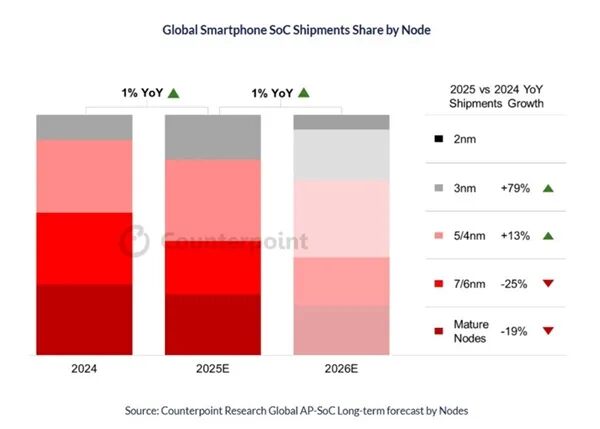
By 2026, approximately one-third of flagship smartphone SoCs globally will adopt 3nm or 2nm process technology, a trend driven by major suppliers such as Apple, Qualcomm, and MediaTek.
Recently, market research firm CounterPoint Research released its latest report titled “Global Mobile Processor (AP-SoC) Node Long-Term Forecast,” predicting that by 2026, about one-third of flagship smartphones’ SoCs will utilize advanced 3nm or 2nm process technology. The driving factors behind this trend include the demand for stronger AI capabilities, immersive gaming, and high-resolution content processing in smartphones.
Major fabless smartphone SoC suppliers such as Apple, Qualcomm, and MediaTek have already adopted 3nm technology. Apple introduced TSMC’s 3nm A17 Pro chip in the iPhone 15 Pro series in 2023. Qualcomm and MediaTek are set to launch flagship SoCs based on 3nm technology in 2024.
Parv Sharma, a senior analyst at CounterPoint Research, pointed out that the current demand for AI computing capabilities on devices is a significant factor driving the evolution of chips towards smaller, more powerful, and more efficient nodes. However, due to rising wafer prices and the increasing semiconductor content in smartphone SoCs, the overall cost of chips is rising.
Currently, TSMC dominates the chip manufacturing sector. It is expected that by 2025, TSMC will hold an 87% share of smartphone SoC shipments at nodes below 5nm (3nm and 2nm), with this figure projected to grow to 89% by the end of 2028. TSMC is expected to begin trial production of the 2nm node in the second half of 2025 and commence mass production in 2026.
Apple, Qualcomm, and MediaTek are expected to launch the first flagship SoCs using 2nm technology by the end of 2026. Initial adoption will focus on flagship and high-end smartphones, while other terminal devices will gradually transition from 7/6nm to 5/4nm processes, and subsequently to the 3nm node in the following years.
Although Samsung’s foundry is also developing 3nm and 2nm processes, it has faced some yield issues in the past, causing delays in the adoption of 3nm in smartphones. Samsung’s foundry is expected to focus on the 3nm and 2nm process nodes and is anticipated to begin mass production of 2nm in 2026.
Despite facing cost challenges, CounterPoint Research believes that the 3nm and 2nm nodes will bring stronger performance and higher energy efficiency to smartphones, becoming key to enhancing user experience.
Additionally, Brady Wang, Deputy Research Director at CounterPoint Research, predicts that by 2025, TSMC’s market share in smartphone SoCs at 5nm and below (including 3nm and 2nm) will reach 87%, increasing to 89% by 2028. Currently, aside from TSMC, there are limited foundry options available for smartphone chip manufacturers.