
New Cancer Immunotherapy Technology: Multi-TAC

New Cancer Immunotherapy Technology: Multi-TAC

Immunotherapy brings hope for the complete cure of cancer by activating the human immune system to kill tumors. Currently, most approved immunotherapies show significant effects in hematological tumors, but have low response rates and poor efficacy in solid tumors. The main reason is the complex and highly heterogeneous tumor immune microenvironment in solid tumors, where various types of immune cells interact to affect the efficacy of immunotherapy. Under ideal conditions, the development of treatment strategies that can simultaneously mobilize multiple immune cells will maximize immune activation and improve the treatment effect of solid tumors.
Traditional immunotherapies, such as immune checkpoint inhibitors and adoptive cell therapies, mostly target a single type of immune cell. Bispecific/multispecific antibodies can bind to multiple targets simultaneously, thus offering the possibility of targeting different types of immune cells. However, to date, most bispecific/multispecific antibodies can only recruit one type of immune cell (e.g., T or NK cells). Therefore, developing a method that can simultaneously recruit multiple immune cells to combat tumors remains unmet, which is particularly critical for advancing immunotherapy.
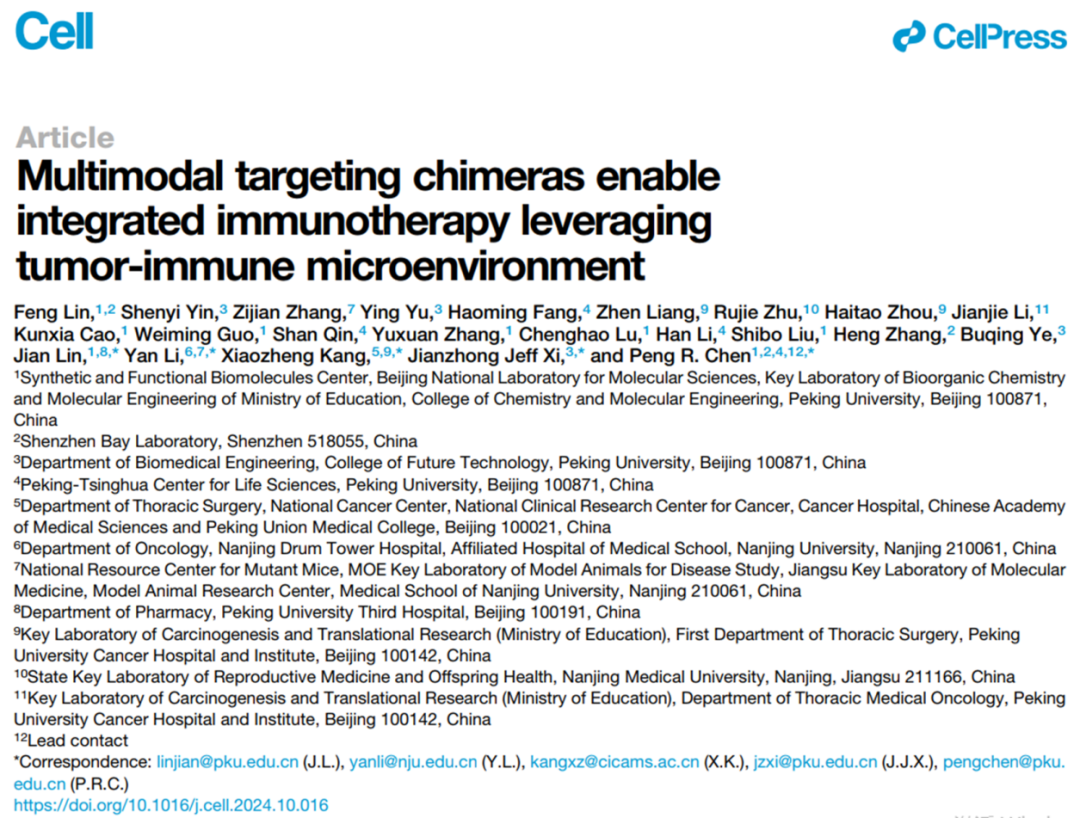
On November 5, 2024, Professor Chen Peng from Peking University and his team, along with several interdisciplinary collaborators (Professor Xi Jianzhong from Peking University, Professor Kang Xiaozheng from the Chinese Academy of Medical Sciences Cancer Hospital, Professor Li Yan from Nanjing University, and Researcher Lin Jian from Peking University Third Hospital), published a research paper titled Multimodal targeting chimeras enable integrated immunotherapy leveraging tumor-immune microenvironment in the journal Cell. The paper systematically develops a bioorthogonal chimera platform, utilizing its constructed multispecific bioorthogonal conjugation arms (T-Linker) to achieve specific and efficient integration of three different drug modules, forming bioorthogonal chimeras (Multi-TAC), which enables the simultaneous recruitment of multiple immune cells in the solid tumor microenvironment, significantly enhancing the efficacy of immunotherapy.
New Cancer Immunotherapy Technology: Multi-TAC
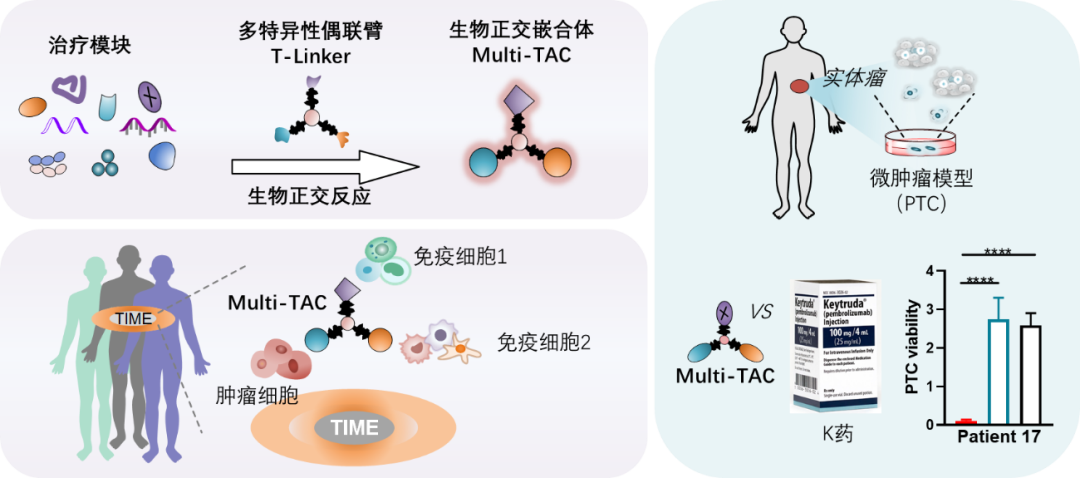
Specifically, the researchers first screened bioorthogonal reactions to obtain three mutually orthogonal and efficient conjugation reactions. Based on these reactions, they synthesized a multispecific bioorthogonal conjugation arm (T-Linker). This conjugation arm T-Linker contains three different reactive functional groups from the aforementioned reactions, allowing it to simultaneously conjugate three modules with corresponding reactive functional groups. To demonstrate the versatility of this platform, they used T-Linker to complete the conjugation of two nanobodies and small molecular compounds, nucleic acids, peptides, proteins, and other different modules. Furthermore, by further integrating dendritic linkers and cleavable linkers, they also demonstrated T-Linker’s ability to conjugate modules of different ratios and release module molecules in situ. This conjugation platform is characterized by modularity, site specificity, and efficiency, allowing precise integration of any three module molecules, including antibodies, to generate various types and uses of bioorthogonal chimeras Multi-TACs.

Subsequently, the authors attempted to explore whether the constructed Multi-TAC molecules could be used to recruit various immune cells and enhance the efficacy of immunotherapy. Tumor T cells and dendritic cells (DCs) have been shown to synergistically promote anti-tumor immunity, so they developed the EGFR-CD3-PDL1 Multi-TAC to simultaneously recruit T cells and DCs targeting the tumor. In in vitro studies, they confirmed that the EGFR-CD3-PDL1 Multi-TAC achieves simultaneous recruitment of T cells and DCs to the tumor by binding to tumor cell EGFR, T cell CD3, and DC cell PDL1 receptor molecules.

In a multicellular culture system, they found that the EGFR-CD3-PDL1 Multi-TAC promotes the physical interaction among “tumor cells-T cells-DC cells,” simultaneously activating T cell-DC cell anti-tumor immunity. Specifically, they found that the tumor-T and T-DC interactions mediated by the EGFR-CD3-PDL1 Multi-TAC can instantaneously activate T cells, releasing perforin and granzyme, thereby directly lysing tumors. Meanwhile, the T-DC interaction mediated by the EGFR-CD3-PDL1 Multi-TAC can induce DC maturation and activation, increasing the presentation of tumor antigens, activating antigen-specific T cells, and ultimately completing tumor-specific killing.
Furthermore, the authors tested the in vivo therapeutic effects of EGFR-CD3-PDL1 Multi-TAC in three different humanized mouse models. In a human peripheral blood mononuclear cell (PBMC) reconstructed humanized mouse model, the EGFR-CD3-PDL1 Multi-TAC significantly inhibited tumor growth and activated T cells within the tumor tissue. In a human CD34+ hematopoietic stem cell (HSC) reconstructed humanized mouse model, they found that the EGFR-CD3-PDL1 Multi-TAC completely controlled tumor growth, while activating tumor T cells and DCs, it also reshaped the tumor immune microenvironment, enhancing the activation of other effector cells such as NK and NKT cells and reducing the proportion of immunosuppressive Treg cells. In a transgenic humanized mouse model, the EGFR-CD3-PDL1 Multi-TAC almost completely eradicated the tumor, activating both T cells and DCs within the tumor and ultimately inducing a tumor-specific immune response in the mice, indicating that the EGFR-CD3-PDL1 Multi-TAC treatment can trigger anti-tumor immune memory.

Moreover, the researchers evaluated the therapeutic effects of EGFR-CD3-PDL1 Multi-TAC in patient-derived microtumor (PTC) organoid models. PTC is a primary tumor model that can maintain the original characteristics of patient tumor tissues, including their immune microenvironment, in vitro, making it very suitable for the screening of personalized drugs in clinical settings. The authors validated through immunofluorescence, flow cytometry analysis, and ELISA that EGFR-CD3-PDL1 Multi-TAC can activate T cells and DCs in patient tissues to inhibit the growth of PTC.

The authors also conducted a “head-to-head” comparison of EGFR-CD3-PDL1 Multi-TAC with the clinically widely used PD1/PDL1 immune checkpoint inhibitor “K drug” (pembrolizumab), finding that in 6 out of 7 tested tumor patient tissues, EGFR-CD3-PDL1 was significantly more effective than the “K drug.” Ultimately, the authors tested a total of 6 different cancer types and 44 tumor patient samples. The overall effective rate of EGFR-CD3-PDL1 Multi-TAC was 75%, while in most tested non-small cell lung cancer (NSCLC) samples, the effective rate reached 86%, indicating the clinical therapeutic potential of EGFR-CD3-PDL1 Multi-TAC.

In addition to the aforementioned EGFR-CD3-PDL1 Multi-TAC chimera, the authors also constructed other Multi-TAC molecules to simultaneously recruit more types of immune cells. As a specific example, they constructed and validated EGFR-CD3-CD16 Multi-TAC, which achieves simultaneous recruitment of tumor-targeting T-NK cells by binding to tumor EGFR, T cell CD3, and NK cell CD16 receptors. They also constructed and studied HER2-CD3-(IMDQ)6 Multi-TAC, which, by binding tumor HER2 and T cell CD3 receptors, can recruit T cells while responding to the tumor reductive microenvironment and releasing 6 molecules of TLR agonist IMDQ, thereby activating myeloid immune cells around cancer cells.
New Cancer Immunotherapy Technology: Multi-TAC

In summary, this study developed a highly modular bioorthogonal chimera platform that can precisely integrate multiple drug modules to construct various types of multispecific bioorthogonal chimeras for the simultaneous recruitment of T, DC, NK, and myeloid immune cells, targeting the solid tumor immune microenvironment. As a representative, EGFR-CD3-PDL1 Multi-TAC mediates direct interactions among “tumor cells-T cells-DC cells,” simultaneously activating T cells and DCs in the tumor tissue, reversing the tumor immune microenvironment, and ultimately inducing tumor-specific immune responses. This work provides a new approach for tumor immunotherapy and offers powerful technical tools for mechanism research and target validation in complex life systems from a multicellular perspective.

This article is reproduced from thePeking University-TsinghuaJoint Center for Life Sciences, with the original title Cell | Chen Peng and collaborators develop bioorthogonal chimeras for “multicellular recruitment,” targeting solid tumor immune microenvironment.

New Cancer Immunotherapy Technology: Multi-TAC
Scan the WeChat QR code to add Yao Shikong editor
Please specify: Name + Research Direction!
New Cancer Immunotherapy Technology: Multi-TAC

Leave a Comment