Introduction
MuseV is a virtual human video generation framework based on diffusion models, featuring the following characteristics:
-
Supports infinite length generation using a novel visual condition parallel denoising scheme, eliminating cumulative error issues, especially suitable for fixed camera position scenarios.
-
Provides a pre-trained model for virtual human video generation trained on a character-type dataset.
-
Supports image-to-video, text-to-image-to-video, and video-to-video generation.
-
Compatible with Stable Diffusion’s text-image generation ecosystem, including base_model, lora, controlnet, etc.
-
Supports multi-reference image techniques, including IPAdapter, ReferenceOnly, ReferenceNet, and IPAdapterFaceID.
-
We will also release training code later.
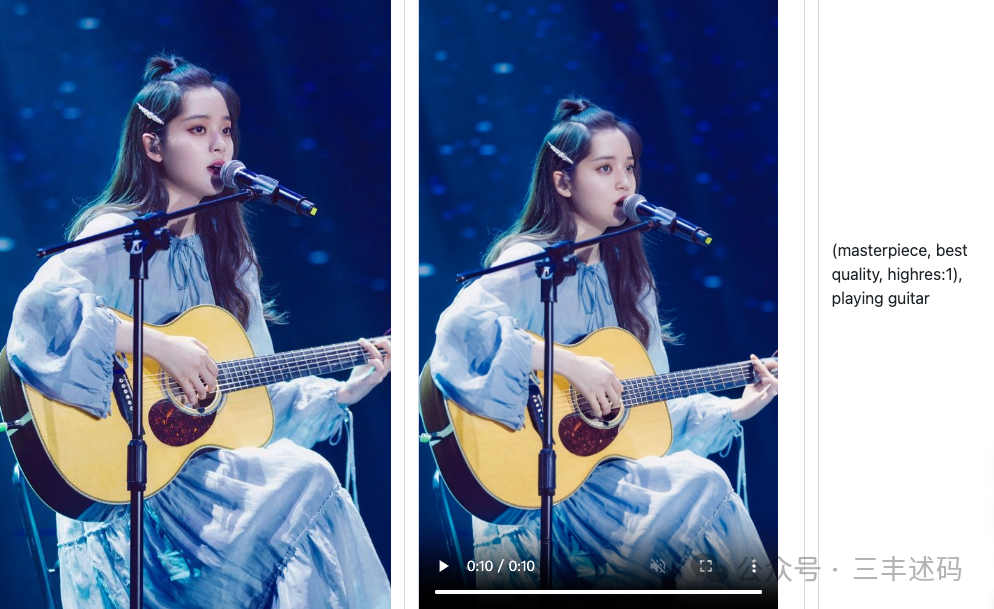
MuseV is a diffusion-based virtual human video generation framework that supports infinite length generation using a novel visual condition parallel denoising scheme. A virtual human video generation model trained on human datasets has been released.
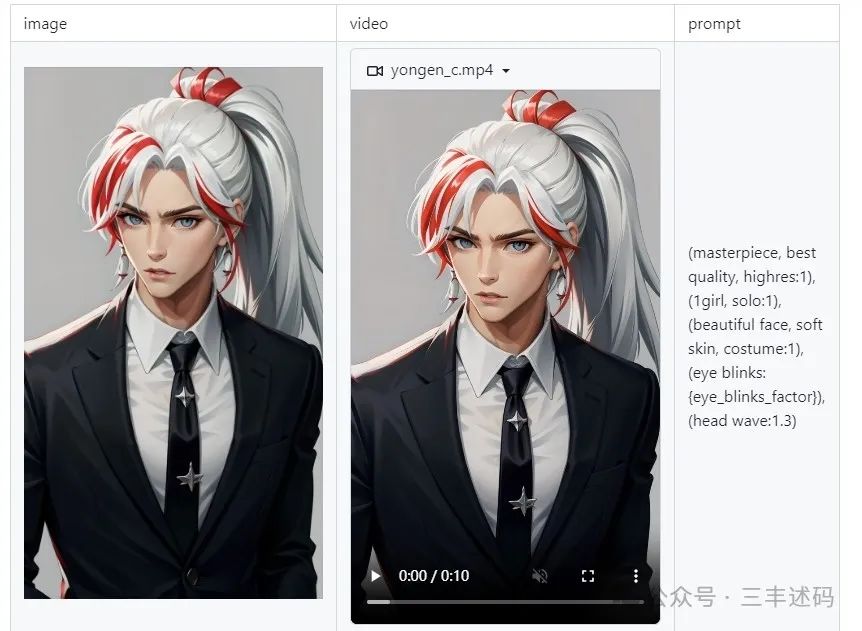
The MuseV framework has various generation functions, including converting images to videos, converting from text to images to videos, and video-to-video generation, while being fully compatible with the Stable Diffusion ecosystem, supporting base_model, lora, controlnet, and other technologies. In short, MuseV, based on SD technology, can generate videos from text, images, and videos, maintaining character consistency without being limited by video length.
MuseV also introduces various reference image techniques, covering IPAdapter, ReferenceOnly, ReferenceNet, and IPAdapterFaceID. The development team plans to launch MuseTalk, a model capable of real-time high-quality lip-syncing, which, when combined with MuseV, will become a complete virtual human generation solution.
Recently, OpenAI Sora has quickly emerged in the industry with its excellent video generation effects, becoming a leader in the text-to-video field and promoting the development of technology in this area. Today, we introduce a new open-source text-to-video project MuseV, which can create unlimited-length AI videos.
The Qingying AI video generation agent is now online, generating desired videos from any text or image within 30 seconds. The agent is located as follows:
•【APP】: Top agent – Official Product – Qingying – AI Video Generation
•【PC】: Below the chatGLM in the left agent list
Project Background
The MuseV project was already realized in July 2023, but inspired by the recent progress of Sora, it was decided to open-source it. According to the team, MuseV has grown on the shoulders of open source and hopes to give back to the community.
Project Introduction
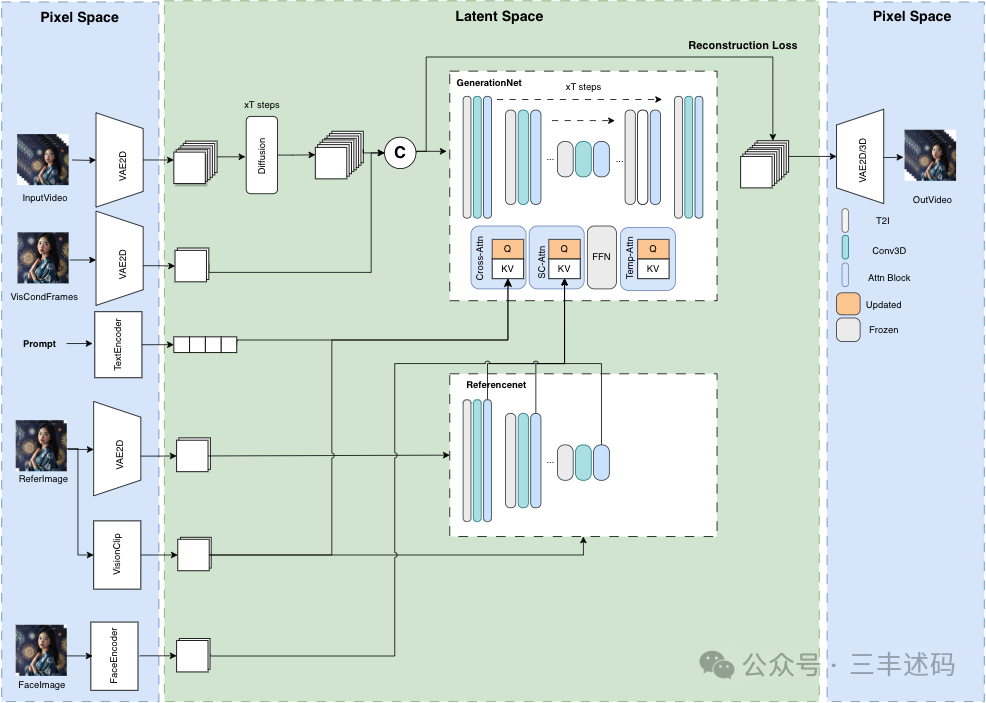
<span>MuseV</span> is a virtual human video generation framework based on diffusion models. It employs a novel visual condition parallel denoising scheme that supports infinite length video generation.
It provides a pre-trained virtual human video generation model with powerful functions such as <span>Image2Video, Text2Image2Video, and Video2Video</span>. Moreover, MuseV is compatible with Stable Diffusion ecosystem, including base models, LoRA, and ControlNet.
Featured Functions
-
•
<span>Infinite length video generation</span>: Breaks traditional video length limits, allowing your creativity to extend infinitely. -
•
<span>Multiple function modes</span>: Image2Video, Text2Image2Video, Video2Video, meeting various creative needs. -
•
<span>Supports Stable Diffusion ecosystem</span>: Compatible with existing technologies, providing more creative possibilities. -
•
<span>Multi-reference image techniques</span>: Enhance video quality through techniques such as IPAdapter, ReferenceOnly, ReferenceNet, and IPAdapterFaceID.
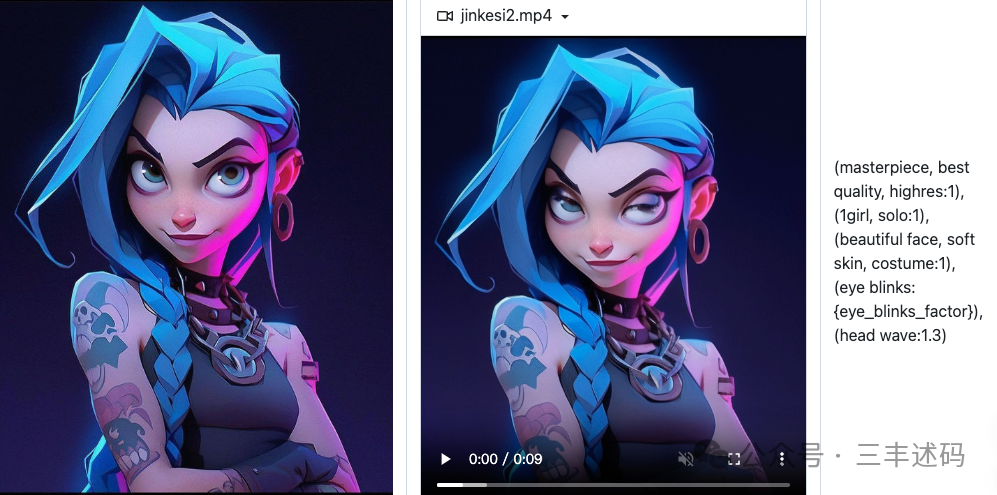
Using MuseV is very simple. Just select your preferred function mode, input the corresponding materials (such as images, text, or videos), and it will generate high-fidelity virtual human videos for you. At the same time, you can adjust various parameters as needed for personalized creation.
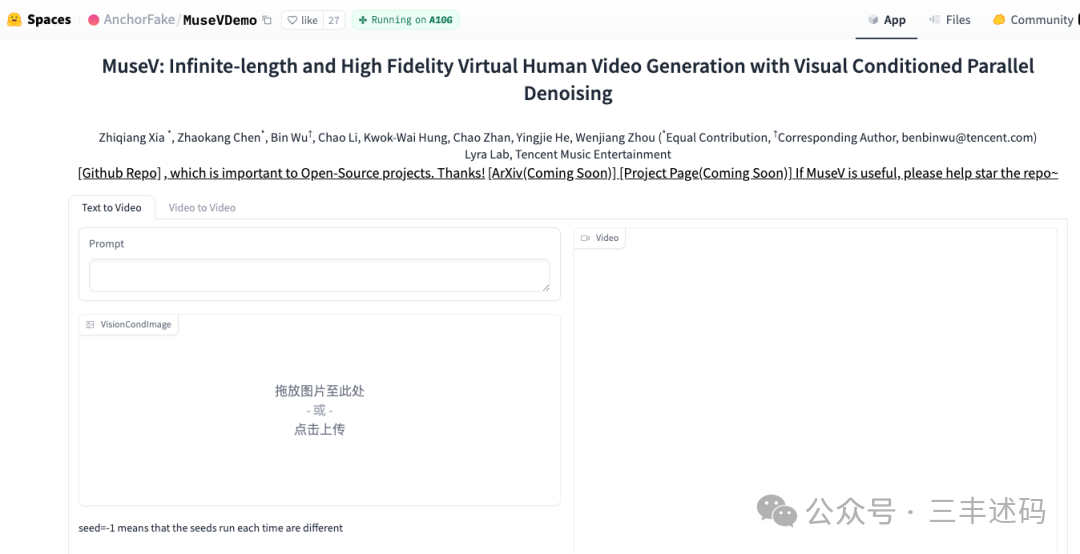
The official team has also created an experience project on HuggingFace, available for unconditional building for groups or beginners.
Demo: https://huggingface.co/spaces/AnchorFake/MuseVDemo
Areas for Improvement
-
• Lack of generalization ability. Sensitive to visual condition frames, some visual condition images perform well, while others do not.
-
• Limited types of video generation and limited range of motion, partly due to the limited types of training data. MuseV has a larger range of motion at lower resolutions, but lower video quality. MuseV has excellent image quality at high resolutions but a smaller range of motion. Training on larger, higher resolution, and higher quality text video datasets may improve MuseV.
-
• Limited types of long video generation. The visual condition parallel denoising can resolve cumulative errors in video generation, but the current method only applies to relatively fixed camera position scenarios.
Conclusion
MuseV, with its infinite length video generation and support for the Stable Diffusion ecosystem and multi-reference image techniques, has become an emerging force in the field of video generation.
At the same time, the MuseV team plans to develop another project called MuseTalk, a real-time high-quality lip-sync model that will become a complete virtual human generation solution when combined with MuseV.
Open-source address
Follow the official WeChat account and reply 20241123 to obtainYou might also like:
[Open Source] Local Knowledge Base Q&A System Supporting Any Format Files or Databases, Can Be Installed Offline.
[Open Source] Comprehensive, Independent, and Extensible Domestic Workflow Engine
[Open Source] A High-Performance, Flexible Tree-Based HTTP Router
[Open Source] A Distributed Microservice Architecture Upgraded and Optimized from a Commercial Project, Reconstructed Business Code with Java17 API, while Supporting Multiple Frontend Frameworks
[Open Source] End-to-End RAG Solution RAGFlow
Add WeChat to join relevant discussion groups,
Note “Microservices” to join the group for discussions
Note “Low Start” to join the low start group for discussions
Note “AI” to join the AI big data, data governance group for discussions
Note “Digital” to join the IoT and digital twin group for discussions
Note “Security” to join the security-related group for discussions
Note “Automation” to join the automation operations group for discussions
Note “Trial” to apply for product trials
Note “Channel” for cooperation channel information
Note “Customization” for project customization, full source code delivery