To address the challenges posed by flower morphology in traditional hybrid breeding that hinder robotic automation, a research team from China has innovatively proposed the “Crop-Robot Co-Design (GEAIR)” strategy. By editing the ABC model genes of tomatoes and soybeans to create male sterile lines with exserted stigma, combined with AI visual recognition and robotic pollination technology, they have significantly improved the efficiency of F1 hybrid breeding, providing a scalable technical paradigm for precision agriculture.
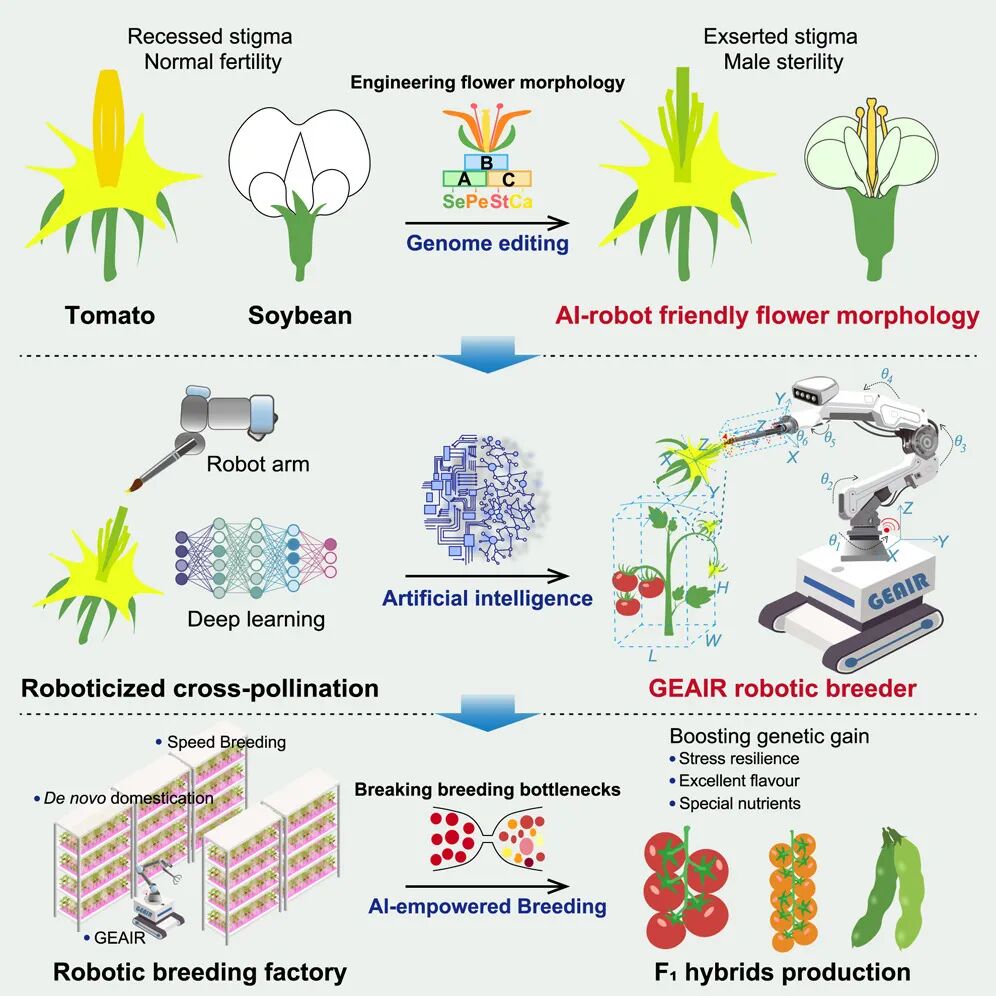
On August 11, 2025, a research paper titled “Engineering crop flower morphology facilitates robotization of cross-pollination and speed breeding” was published in Cell by a smart breeding team led by researcher Xu Cao from the Institute of Genetics and Developmental Biology, Chinese Academy of Sciences. This study deeply integrates BT (biotechnology) and AI (artificial intelligence), proposing for the first time the concept of “Crop-Robot Co-Design” as a “mutual advancement” approach. By redesigning crop flower morphology through gene editing, they rapidly and accurately created “robot-friendly” structural male sterile lines, and successfully developed the world’s first intelligent breeding robot “GEAIR” (Genome Editing combined with AI-based Robotics) capable of automatic cruising for hybrid pollination, breaking through the bottlenecks of hybrid breeding and seed production, significantly reducing breeding costs, shortening breeding cycles, and improving breeding efficiency. This research opens up a new intelligent breeding model of “BT foundation + AI empowerment + Robot labor (BAR)”, showcasing the significant application prospects of “AI for Science” in the innovation of biological breeding paradigms and the generation of new productive forces.
This groundbreaking research cleverly combines genomic editing technology with AI robotic systems, creating a new paradigm of “Crop-Robot Co-Design (GEAIR)”. Researchers successfully cultivated male sterile lines with exserted stigma characteristics by precisely editing the ABC model genes of tomatoes and soybeans (key genes controlling flower organ development). This genetically modified flower morphology acts as a tailored “interface” for robots, enabling AI-driven mobile robots to accurately identify and perform automated pollination operations.
The intelligent system developed by the research team includes three major innovative modules: a deep learning-based visual recognition system that can locate exserted stigmas in real-time, a high-precision robotic arm that achieves non-destructive pollination, and a closed-loop control system that ensures hybridization success rates. Experiments in tomatoes indicate that the hybridization efficiency of this system is comparable to manual operations, and combined with speed breeding technology, they successfully cultivated new varieties that possess both flavor and stress resistance. Even more exciting is that the phenotype was replicated in soybeans through multiple gene editing, proving the universality of this strategy across crops.
This research cleverly overcomes the bottleneck of “flower morphology hindering mechanization” in traditional breeding, with its core being the precise matching of crop phenotype engineering with robotic functional requirements. The design of exserted stigma retains the natural pollination structure of the flower while providing an ideal working interface for robotic operations. The study also innovatively integrates de novo domestication strategies into the speed breeding system, significantly shortening the breeding cycle.
This achievement provides a scalable technical template for precision agriculture, with its dual optimization approach of “biological design – machine adaptation” offering intelligent solutions to food security challenges under climate change. This interdisciplinary integration strategy is not only applicable to hybrid breeding but can also be extended to automated scenarios across the entire agricultural chain, such as phenotype monitoring and intelligent harvesting.
References
Engineering crop flower morphology facilitates robotization of cross-pollination and speed breeding