Founded in Shenzhen in 1993, Jingwang Electronics has steadfastly focused on the PCB (Printed Circuit Board) industry for 32 years. Starting from a modest factory in Nanshan, Shenzhen, the company has gradually risen to become one of the top ten PCB manufacturers globally, with a market value exceeding 56 billion yuan, thanks to its commitment to technological innovation and product quality.“The innovative gene of Shenzhen has long been embedded in the DNA of Jingwang Electronics,” said Liu Shaobai, Chairman of Jingwang Electronics, in an interview with China Securities Journal. Rooted in this daring and experimental city, Jingwang Electronics has boldly navigated the tides of change—from its beginnings in the telecommunications and home appliance sectors to its precise positioning in the automotive electronics arena, and now to its high-end capacity layout in the era of artificial intelligence, each step resonates with the rhythm of the times. The company’s growth story is not only a tale of hard work and entrepreneurship but also a narrative of leveraging the capital market for soaring development.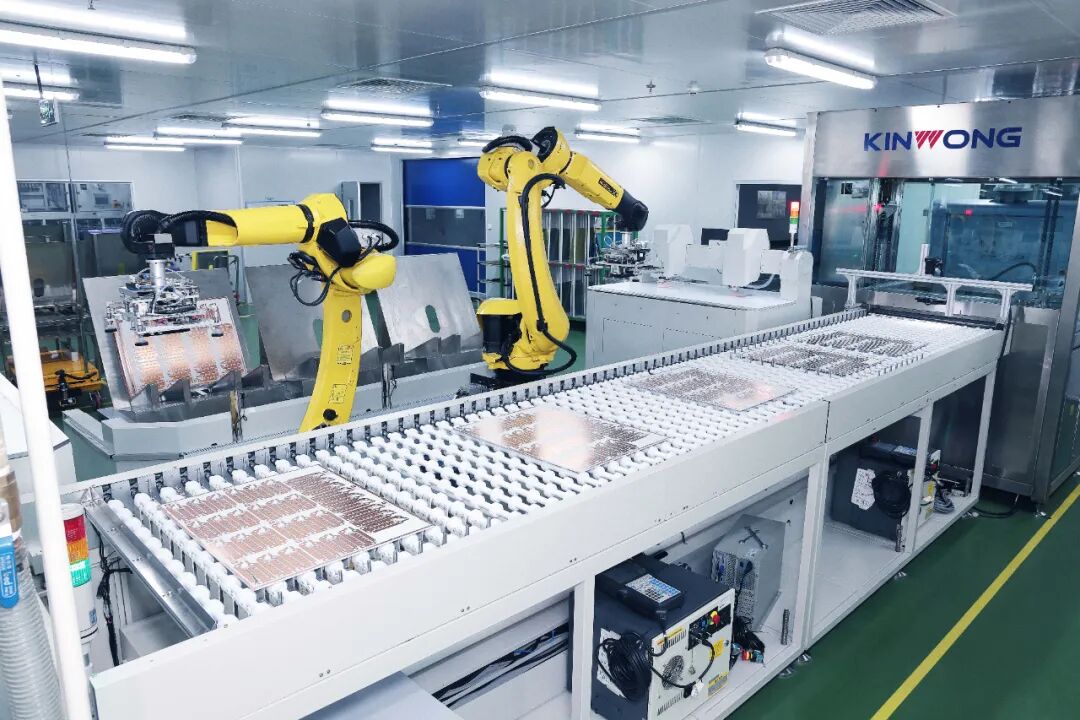 Automated production line of Jingwang Electronics’ metal-based circuit board factory. Image provided by the company.
From Shenzhen to a “Global Leading Enterprise”
PCBs are known as the “mother of electronic products,” hidden in the critical components of every mobile phone, car, and data center. In the early 1990s, the wave of global electronic industry transfer to the Asia-Pacific region surged, with the rise of products like computers and mobile phones leading to a surge in PCB market demand. At that time, this market was firmly controlled by companies from Europe, America, and Japan, with only a few players like Shennan Circuits, Huafa Electronics, and Zhizhuo Feigao in Shenzhen. It was against this backdrop that Jingwang Electronics was born in 1993.In its early days, Jingwang Electronics operated in a factory in Nanshan, Shenzhen, with two to three hundred employees busy around manual equipment, with almost zero automation. The company faced operational difficulties, and Liu Shaobai focused on three aspects: funding, product quality, and employee cohesion. There were no shortcuts; it was all about treating each circuit board as a reflection of oneself, driving up orders and helping the company emerge from its predicament.With this resilience, Jingwang Electronics gradually established a foothold in the telecommunications and home appliance sectors. In 2008, the company set its sights on the higher-threshold automotive electronics sector. “Automakers have almost stringent requirements for reliability; a single faulty circuit board could lead to a recall of an entire batch of vehicles. But we saw the future—automobiles have a greater demand for PCBs and higher value,” Liu Shaobai admitted.As the wave of new energy vehicles swept in, the number of electronic devices installed in vehicles increased dramatically, leading to a surge in PCB usage. By 2024, the company’s automotive electronics business achieved revenue of 5.8 billion yuan, a year-on-year increase of 33%, making it the largest automotive PCB supplier globally.“Now, in every ten mainstream vehicles globally, six use our high-end circuit boards,” Liu Shaobai proudly stated, his eyes firm. “Quality is life, and it is also dignity. Even if there are many orders, if it could affect quality, we would rather not take them.”In Liu Shaobai’s view, Jingwang Electronics has gradually moved from a small factory in Shenzhen to the global stage, thanks to the nurturing of this fertile land: “This is an important center for the global electronic manufacturing industry, with a responsive industrial chain; talent flows in like fresh water, and innovative ideas can be quickly realized; the government provides efficient and pragmatic services to help enterprises solve problems.”
Positioning for High-End to Enter the AI Era
In January 2017, Jingwang Electronics was listed on the Shanghai Stock Exchange, accelerating the company’s development. Liu Shaobai stated that going public gave the company the confidence to make long-term plans. Leveraging the power of the capital market, Jingwang Electronics transformed from “small steps and quick runs” to “leapfrog development.” After going public, Jingwang Electronics conducted three public offerings of convertible bonds, raising a total of 3.912 billion yuan, providing solid financial support for expanding advanced production capacity.In 2019, as the trumpet of 5G commercialization sounded and the blueprint for artificial intelligence and industrial internet gradually became clear, Liu Shaobai sensed another business opportunity. Jingwang Electronics initiated a 5 billion yuan investment in Zhuhai to build a high-multilayer and substrate-like circuit board factory. This was seen as a significant risk by industry insiders at the time.As expected, after the project was put into production in 2021, the pressure on performance was considerable. “Those days were indeed tough, but our team was very clear that the more complex the situation and the more pressure we faced, the more we needed to maintain confidence and strategic determination. We advanced step by step, overcoming numerous challenges, continuously refining our technology and products, and gaining recognition from global high-end customers,” Liu Shaobai admitted. Competing on price in the low-end market has no future. Although making high-end circuit boards is challenging, once you break through, the prospects are promising.With the explosion of artificial intelligence, the demand for computing power has grown exponentially, leading to a surge in demand for high-end PCBs in areas such as AI servers, data centers, and optical modules. Jingwang Electronics’ advanced HDI (High-Density Interconnect) and high-multilayer PCB products have precisely hit this market trend, becoming highly sought after. Currently, Jingwang Electronics has made breakthroughs in fields such as optical modules and AI servers, becoming a partner to leading global customers and supplying in bulk.Liu Shaobai stated that now, at the peak of artificial intelligence, Jingwang Electronics is witnessing a series of “ice-breaking” achievements with its customers. The company is tirelessly upgrading its production capacity, fully committed to the technological transformation and upgrading of existing HDI factories, and building new factories for high-end HDI capacity in areas such as AI servers and data centers.
Winning Industry Reputation Through Long-Termism
After 32 years, Jingwang Electronics is no longer the small workshop in the Malong Industrial Park of Nanshan. Today, it has established seven production bases in Guangdong Shenzhen, Heyuan Longchuan, Zhuhai Jinwan, and Jiangxi Ji’an, Ganzhou, with 19,000 employees busy creating value. By 2024, the company’s revenue exceeded 12.6 billion yuan, ranking tenth in the global PCB industry—this achievement has been earned through the hard work of each circuit board.“The way out for enterprises lies in high technology and high value-added products.” When discussing the secret to success, Liu Shaobai’s answer is simple yet profound. Over a decade ago, Jingwang Electronics began to position itself in the high-end market, investing in high-precision equipment, attracting talent, and conducting front-end research with customers. Over the past decade, the company has invested over 3.5 billion yuan in R&D, ensuring sufficient talent and financial input each year, which has led to its current leading position in automotive electronics and AI servers. This is also the key to the company’s ability to stand firm in the industry and achieve its current status.“It’s not easy to persist in manufacturing for 32 years. Every time I see a well-made circuit board product and receive recognition from customers, I feel it’s all worth it,” Liu Shaobai said with emotion, but more importantly, with determination.“Entrepreneurs must have a sense of national responsibility, adhere to long-termism, and bear social responsibility,” Liu Shaobai said. For 32 years, they have remained focused, resisting temptations, and deeply cultivating the PCB industry. The company will continue to root itself in Shenzhen, effectively utilize the empowerment of the capital market, focus on its main business without deviation, and adhere to the philosophy of “people-oriented, manufacturing quality products, expanding the enterprise, and giving back to society,” to produce more high-end circuit boards of “Chinese intelligence.”
Recommended Reading
➤ Old Gold Shop, Price Increase Again! How to Continue the Narrative of Luxury Goods as “One Price” Recycling is Broken?➤ 688478, Planning Important Acquisition! Suspension from Tomorrow➤ 301345, Proposing a Dividend of 15 Yuan for Every 10 Shares➤ Dongfeng Motor Group, Surge! The Company Responds to Privatization and Delisting