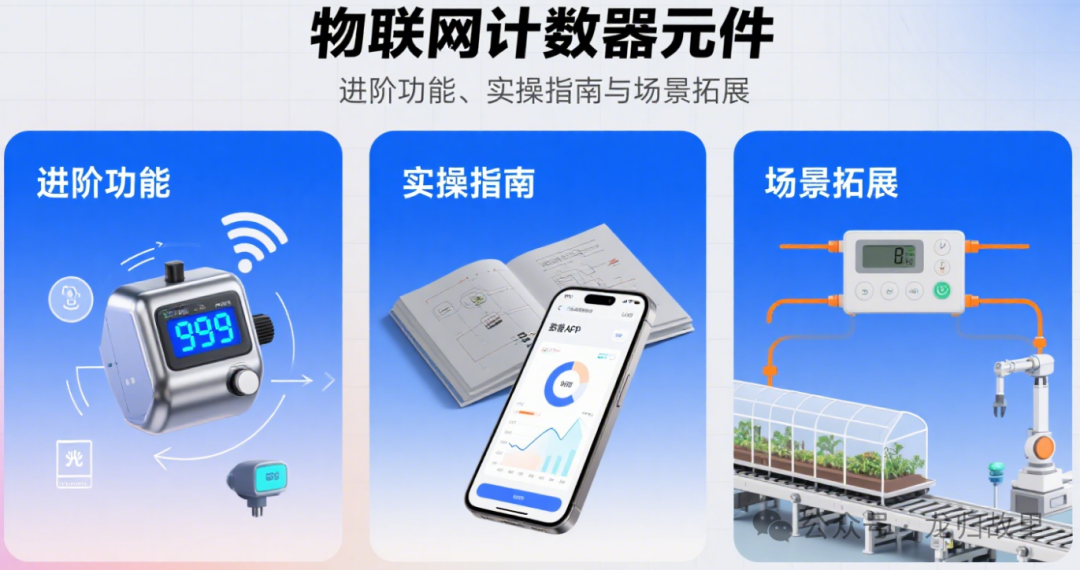
The IoT counter components serve as critical nodes connecting the physical world with digital systems. By accurately capturing and digitizing the “event frequency,” they become fundamental perception units in fields such as industrial automation, smart cities, and public services. Compared to traditional counters, their core advantages lie in “networking,” “intelligence,” and “scenario adaptability.” The following sections will elaborate on these aspects from the perspectives of functional upgrades, practical details, and emerging scenarios.
1. Core Functions (Advanced Version)
1.Multi-mode Counting and Event Analysis
In addition to basic pulse counting, it supportscomposite event recognition: For example, “if the interval between two consecutive pulses is < 0.5 seconds, it is considered one valid count” (to filter interference signals), “rising edge + falling edge combined counting” (such as a gate fully opening and closing), and “analog threshold counting” (for instance, counting +1 every 5 minutes when the temperature exceeds 30℃). Some high-end models come with built-in AI algorithms that can directly recognize complex events (such as counting abnormal vibration occurrences through a vibration sensor).
2.Distributed Collaborative Counting
Supports multi-device networking (Mesh network) to achieve collaborative counting over large areas. For example, deploying counters at multiple entrances and exits of a large warehouse to aggregate total traffic through local networking, avoiding blind spots of single devices, with data synchronization delay < 100ms.
3.Data Security and Privacy Protection
Utilizes end-to-end encryption (AES-256) for transmitting counting data, supports device identity authentication (PSK key), preventing data tampering or unauthorized access. For sensitive scenarios (such as counting people in residential buildings), a “local desensitization mode” can be enabled—only uploading statistical values (e.g., “total count for today”) without uploading real-time details.
4.Adaptive Power Consumption Adjustment
Dynamic matching of scene requirements: In high-frequency counting scenarios (such as assembly lines, counting 10 times per second), it automatically switches to “high-performance mode”; in low-frequency scenarios (such as counting overflowing trash bins, a few times a day), it switches to “deep sleep mode,” with static power consumption as low as 0.1μA, and battery life can last up to 10 years.
5.Hardware-level Anti-interference Design
Industrial-grade products featurethree-level filtering circuits (RC filtering + opto-isolation + software filtering), capable of resisting electromagnetic interference from devices like motors and inverters; outdoor models adopt a structure of “anti-direct sunlight + anti-rainwater backflow,” ensuring stable operation in environments of -50℃ to 125℃ and humidity of 95% (non-condensing).
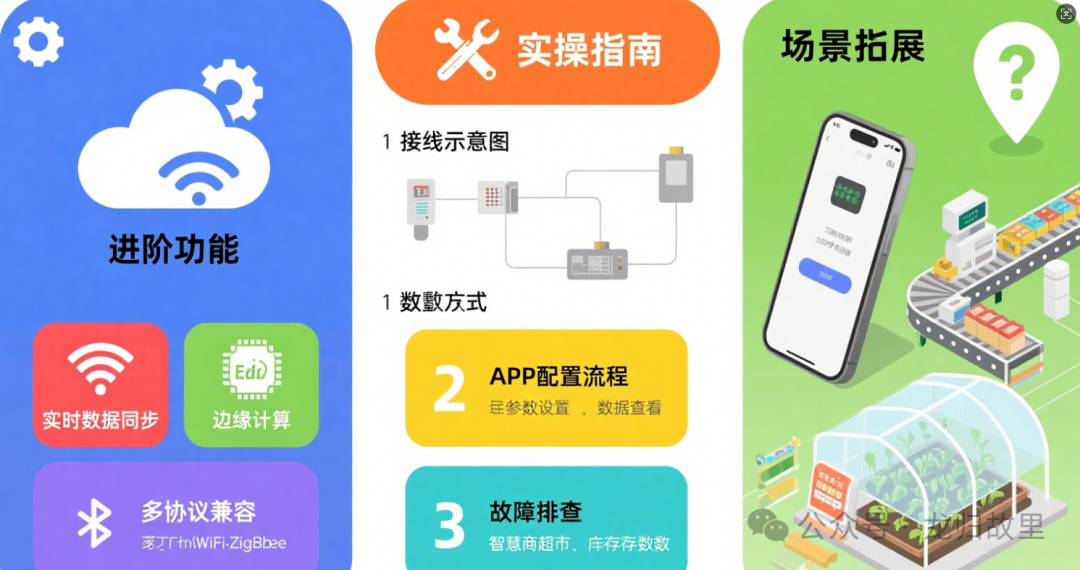
2. Practical Guide (Scenario Adaptation)
1.Hardware Deployment: Scene-based Installation Techniques
◦Industrial Assembly Line: Use a “side-mounted bracket” to fix the photoelectric counter, keeping the sensor 5-10cm away from the conveyor belt to avoid product reflection interference; if detecting metal parts, prioritize using Hall sensors (response speed < 1ms).
◦Outdoor Environment: Choose counters with sunshades, installed at a height of 2-3m from the ground (to avoid human contact), with the communication antenna facing the gateway to ensure signal strength ≥ -80dBm.
◦Narrow Spaces (e.g., distribution boxes): Use mini counters (size < 30mm×20mm), fixed with magnetic bases to avoid cable entanglement (preferably use wireless sensors to reduce wiring).
2.Parameter Configuration: Key Parameter Debugging
◦Counting Threshold: In interference-prone scenarios (e.g., dusty workshops), set “count only after detecting the signal continuously 3 times” to reduce false triggers;
◦Transmission Strategy: In high-frequency scenarios (e.g., traffic flow), use “batch transmission” (uploading every 100 data points), to reduce network bandwidth usage; in low-frequency scenarios (e.g., agricultural irrigation), use “event-triggered transmission” (upload only when counting changes).
◦Linkage Rules: Configure “counting – execution” linkage through the platform, for example, “when the personnel count in a certain area exceeds 50, automatically trigger the ventilation system to start.”
3.Troubleshooting: Common Issues Resolution
◦Inaccurate Counting: Check if the sensor is too far from the target (adjust to the recommended range) or if there is co-frequency interference (change the communication channel);
◦Data Disconnection: Check SIM card traffic/battery level (replace if below 20%), whether the gateway is offline (restart the gateway or switch to a backup network);
◦False Alarms: Recalibrate the threshold (e.g., “adjust the ‘abnormal count’ from 5 times to 10 times”), increase the “cooling time” (no repeat alarms within 1 minute).
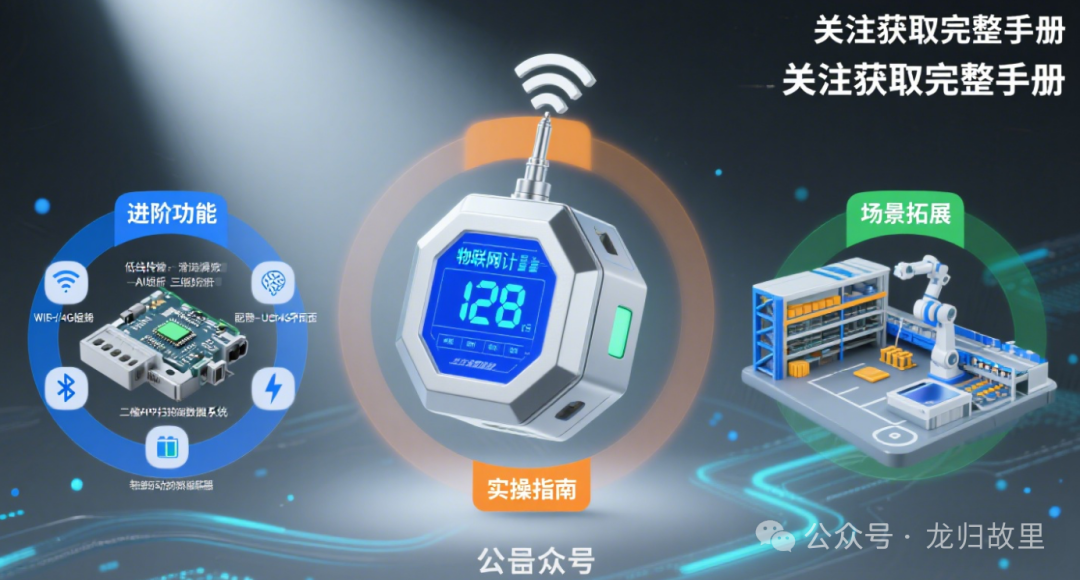
3. Emerging Use Cases (Deep Adaptation Cases)
1.Smart Retail: Refined Operations
◦Shelf Interaction Counting: Install infrared counters on supermarket shelves to record the number of times consumers pick up products (“pick-up rate”), combined with final purchase data to analyze product attractiveness (e.g., “a snack has a pick-up rate of 30% but a purchase rate of 5%, packaging needs optimization”).
◦Fitting Room Traffic Statistics: Deploy millimeter-wave radar counters at fitting room entrances to count the flow of customers from “entering the store → trying on → purchasing,” guiding staff to adjust service strategies (e.g., increase recommendations when try-on rates are low).
2.Environmental Governance: Waste Management
◦Smart Trash Can Counting: Install mechanical trigger counters at trash can openings, counting +1 for each trash deposit, combined with internal weight sensors, when “count reaches 50 times and weight > 80% capacity,” notify sanitation vehicles for precise collection (avoiding empty runs).
◦Wastewater Discharge Monitoring: Install flow meter counters at enterprise discharge outlets (1 pulse per liter of wastewater), real-time upload of cumulative discharge amount, if exceeded (e.g., > 1000L within 1 hour), automatically trigger environmental protection platform alarms and lock the discharge valve.
3.Healthcare: Equipment and Process Control
◦Medical Equipment Usage Counting: Integrate counters on devices like defibrillators and infusion pumps to record power-on times and operation counts, automatically generating maintenance reminders (e.g., “defibrillator usage reaches 100 times, electrodes need calibration”).
◦Ward Access Management: Install facial recognition + infrared dual-mode counters at ICU ward entrances to record healthcare personnel access counts associated with their IDs, ensuring “hourly rounds ≥ 1 time,” forming traceable process records.
4.Sports Venues: Optimizing Audience Experience
◦Audience Flow Management: Install AI video counters at various entrances/passages in sports venues to real-time count the number of people in each area, guiding audience flow through large screens (e.g., “East area is full, recommend going to the West area”).
◦Facility Usage Frequency Analysis: Install vibration counters on fitness equipment (e.g., treadmills) to record daily usage counts, prioritizing maintenance for high-frequency equipment (e.g., “Treadmill A used 120 times weekly, schedule weekly maintenance”).
Conclusion
The value of IoT counter components lies not only in“counting” itself but also in transforming discrete physical behaviors into optimizable operational metrics through the chain of “event quantification → data interconnection → intelligent decision-making.” The future trend will move towards “smaller size, lower power consumption, and stronger edge computing capabilities,” further penetrating into unattended, precise control, and public service scenarios, becoming the “nerve endings” of the digital economy.
IGBT (Insulated Gate Bipolar Transistor) Function Usage and Application Scenarios ExplainedIoT Component Rectifier Bridge: From Basic Functions to Smart Scene Energy HubsFunction, Usage, and Application Scenarios of IoT Component TransformersIoT Power Conversion DevicesCore IoT Components MOS Devices: From Smart Sockets to Medical Equipment, Analyzing Their Full-Scene ApplicationsBuzzer: The Guardian of Safety in the IoT EraIntroduction to IoT Component Connectors and Their Functional Usage ScenariosCore IoT Components: How Transistors Empower Smart Devices“Electronic Valves” in the IoT Era: How Diodes Reshape the Smart World?