The School of Optoelectronic and Communication Engineering originated from the Department of Electronics and Electrical Engineering established in 2003 and the Department of Mathematics and Physics established in 2005. To promote the integration and development of disciplines and majors, it was reorganized in November 2012. The school includes the Department of Electronic Engineering, Department of Communication Engineering, Department of Optoelectronic Engineering, Basic Teaching Department, and Basic and Professional Laboratories. Currently, there are 88 faculty and staff members, including 10 professors (3 of whom are full-time flexible hires), 24 associate professors, with a senior title ratio of 44%. There are 66 faculty members with doctoral or master’s degrees, accounting for 85% of the full-time faculty. The school offers four undergraduate programs: Electronic Information Engineering, Communication Engineering, Optoelectronic Information Science and Engineering (including Optoelectronic Engineering and Applied Technology directions), and Microelectronics Science and Engineering, with a total of 1,310 students enrolled, among which the Optoelectronic Information Science and Engineering (Applied Technology) and Microelectronics Science and Engineering are part of the Fujian-Taiwan 4+0 cooperation project.
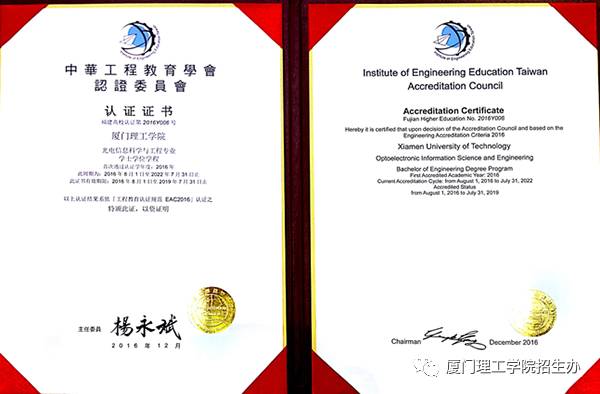
The school has several research platforms, including the Key Discipline of Fujian Province “Optical Engineering”, the Key Laboratory of Optoelectronic Technology and Devices, the Key Laboratory of Optoelectronic Technology in Fujian Province, the Xiamen City Optoelectronic Information Engineering Technology Research Center, the Institute of Electronic Technology Applications, the San Dao Automotive Electrical Design Research Institute, and the Innovation Method Research Institute. Among these, the bus power management system developed for Xiamen King Long Bus, based on the San Dao Automotive Electrical Design Research Institute, has generated a cumulative output value of over 36 million, resulting in significant social and economic benefits. The Optoelectronic Information Science and Engineering program has passed the IEET Engineering and Technology Education Professional Certification in Taiwan. In recent years, faculty members have led over 60 national, provincial, and municipal research projects and published more than 300 papers in domestic and international academic journals.
The school currently has five experimental teaching platforms: the Provincial Physics Experimental Teaching Demonstration Center, the Provincial Electrical and Electronic Experimental Teaching Demonstration Center, the Provincial Optoelectronic Communication Experimental Teaching Demonstration Center, the Optoelectronic Information Technology Experimental Center, and the SOPC Laboratory, with a total of 28 laboratories and equipment valued at over 45 million. Among them, the Optoelectronic Information Technology Experimental Center, SOPC Laboratory, Smart Home Laboratory, and University Physics Laboratory have received funding from the Ministry of Finance for “Central and Local Joint Construction“.
To better cultivate students’ application and innovation abilities, the school has established a student innovation laboratory that is open 24 hours. In recent years, students have achieved remarkable results in national and provincial competitions such as the National College Student Electronic Competition, the National College Electronic Innovation Competition, the National College Student Optoelectronic Design Competition, and the “Freescale” Cup Intelligent Car Competition.
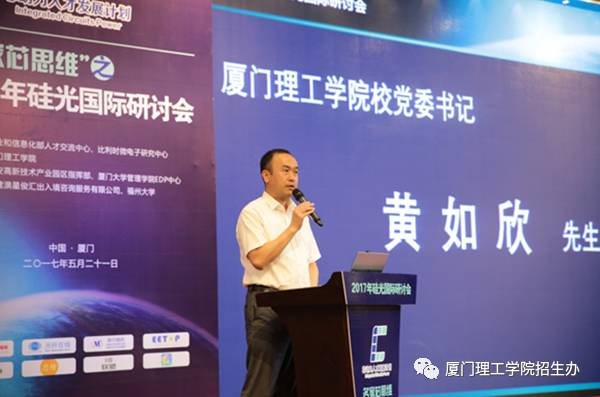
1、Electronic Information Engineering (Bachelor’s, four years)
【Training Objectives】
Focusing on the cultivation of application-oriented and international talents, the goal is to train electronic engineers who meet the development needs of the West Coast Economic Zone, possessing solid theoretical foundations and professional knowledge, strong engineering awareness, engineering quality, engineering practical ability, and innovation consciousness, capable of engaging in the design, manufacturing, testing, engineering management, and technical services of electronic products, devices, and systems, adapting to the needs of enterprise development.
【Program Features】
The Electronic Information Engineering program was established in September 1984 and is one of the first seven undergraduate programs at our school. The curriculum is well-structured and the experimental facilities are complete, with the Electrical and Electronic Experimental Center being a provincial teaching demonstration center. The PCB and Process Laboratory, EDA and SOPC Laboratory, and Innovation Laboratory are unique in the province. We have a dedicated faculty team with rich teaching and research experience. Our department has established cooperative education relationships with companies such as Xiamen Tongshida Lighting Co., Ltd., Xiamen Hualian Electronics Co., Ltd., Xiamen Lilin Technology Co., Ltd., and Shenzhen Saiyi Technology Development Co., Ltd.
【Core Courses】
Circuit Theory, Signals and Systems, Low-Frequency Electronic Circuits, High-Frequency Electronic Circuits, Digital Electronic Technology, Microcontroller Principles and Applications, Electronic System Design, EDA, Embedded System Design, Communication Principles, and corresponding experiments and course designs.
【Employment Directions and Advantages】
Due to the emphasis on professional knowledge and skills training, graduates have a solid professional foundation, strong hands-on abilities, and a high engineering awareness, with most students employed in enterprises and a high employment rate, receiving positive feedback from employers.
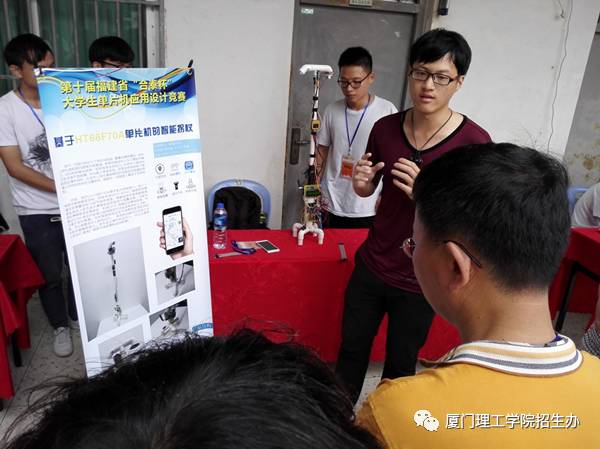
2、Communication Engineering (Bachelor’s, four years)
【Training Objectives】
This program aims to cultivate talents who adapt to the economic and social development needs of the West Coast Economic Zone, especially Xiamen City, with comprehensive development in morality, intelligence, and physical fitness. Students will master a solid foundation in natural sciences and broad professional knowledge, possess innovative spirit, engineering practical ability, and the ability to keep up with new theories, knowledge, and technologies in the communication field, and be able to engage in research, design, development, application, and management work in the field of electronic and communication engineering, gradually growing into technical backbones or mid-to-high-level management experts.
【Program Features】
Currently, there are specialized laboratories such as “Communication Principles”, “Switching Technology”, “Mobile Communication”, and “Wireless Communication”, providing excellent conditions for the cultivation of application-oriented talents. This program also has a faculty team with both teaching and practical experience, with several teachers having work experience in well-known enterprises.
While strengthening its own construction, this program has established laboratories in cooperation with companies such as China Mobile Communications Xiamen Branch, Xiamen Xinglian Electronics Co., Ltd., and Lenovo Mobile Communication Technology Co., Ltd., signing comprehensive cooperation agreements for talent cultivation, providing students with a good practical environment.
【Core Courses】
Circuit Theory, Analog Electronic Technology, Digital Electronic Technology, C Language Programming, Fundamentals of Computer Software Technology, Signals and Systems, Digital Signal Processing, Electronic System Design, Embedded Systems, Communication Principles, and Wireless Mobile Communication.
【Employment Directions】
Graduates mainly work in communication operators, well-known multinational companies abroad, and domestic high-tech enterprises, engaging in applied research, development, design, manufacturing, and project management and marketing in communication technology, electronic technology, and computer technology.
3、Optoelectronic Information Science and Engineering (Excellence Engineer Training Program) (Bachelor’s, four years)
【Training Objectives】
This program focuses on practical and application-oriented training, cultivating high-level engineering application talents who meet the development needs of the optoelectronic industry in the West Coast region, possessing good scientific and cultural literacy, and mastering the theoretical knowledge required for generating, processing, and applying electronic signals and optoelectronic information signals. Graduates will be capable of engaging in scientific research, teaching, application, development, production, and management work in fields such as lasers, optical instruments, fiber optic communication, optoelectronic devices, and related optical design and electronic design, with a strong sense of innovation.
【Program Features】
The Optoelectronic Information Science and Engineering program is one of the earliest optoelectronic programs established in Fujian Province, designed to meet the development needs of the optoelectronic industry and social economy in the West Coast region, aligning with Xiamen’s trillion-yuan industrial chain in lighting and flat panel displays. This program relies on the provincial key discipline “Optical Engineering” and the provincial key laboratory “Optoelectronic Technology and Devices Laboratory” platform, emphasizing theoretical knowledge education in engineering optics, lasers, fiber optic communication, flat panel displays, modern lighting (LED), and solar photovoltaics, while also focusing on the cultivation of engineering technology and design capabilities. It emphasizes collaboration with local optoelectronic industries, establishing internship bases with over 20 external companies such as Xiamen Guangjie Technology, Qianzhao Lighting, Sunshine Ennai, Tongshida Lighting, and Jingyu Optoelectronics, enhancing students’ practical abilities and innovation consciousness through rich internship and training activities.
【Core Courses】
Circuit Theory, Analog Electronics, Digital Electronics, Microcontrollers, Signals and Systems, Engineering Optics, Laser Principles and Technology, Fiber Optics and Technology, Principles and Techniques of Optical Radiation Measurement, Optoelectronic Display Technology, Optoelectronic Devices and Testing Technology, Introduction to Solid State Electronics, Design and Simulation of Lighting Driver Circuits, Optical Design CAD, and corresponding practical components, lighting design, and comprehensive optical information experiments.
【Employment Directions】
Graduates can work in the fields of optical instruments, optoelectronic displays, optoelectronic signal detection and processing, optical communication technology, electronic design, and especially in the integrated industries of optics, mechanics, electricity, and computing, engaging in scientific research, application design and technology development, manufacturing and production project management, and teaching. Graduates can also pursue further studies for a master’s degree in Optical Engineering, Optics, Physical Electronics, and related fields.
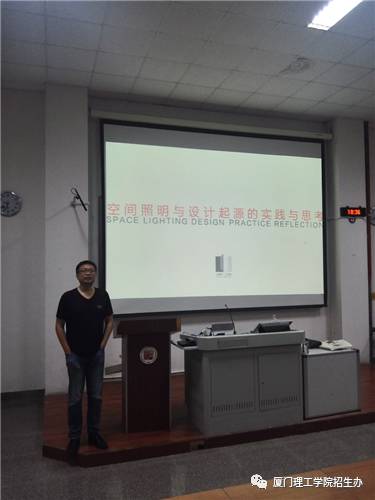
4、Optoelectronic Information Science and Engineering (Bachelor’s, four years, Fujian-Taiwan “4+0”)
【Training Objectives】
This program emphasizes the combination of optoelectronic theory and practice, the infusion of new knowledge in the optoelectronic industry-academia-research field, and the cultivation of application and innovation capabilities. With a curriculum system closely aligned with industry and high-quality teaching resources, students are trained to be professionals familiar with the social and cultural contexts of both sides of the Taiwan Strait, meeting the development needs of the optoelectronic industry in the West Coast region, possessing solid optoelectronic professional knowledge, and having strong practical and innovative abilities.
【Program Features】
This project is jointly promoted by Xiamen University of Technology, Xiamen Guangjie Technology, and National Chung Hsing University in Taiwan, aiming to strengthen comprehensive and in-depth joint talent cultivation between schools and enterprises, pioneering the application-oriented university model. The talent cultivation of this cooperative education project will be oriented towards students’ vocational skills and quality development, fully introducing the Taiwanese educational model, drawing on the experiences of Taiwanese universities and enterprises in talent cultivation, combining internationalization with localization, and integrating on-campus faculty with industry elites. The curriculum system will be implanted with Taiwanese courses, with Taiwanese faculty and industry experts primarily teaching, while students will receive theoretical and practical education at Xiamen University of Technology in the first three years and will undertake on-site internships in relevant enterprises in the fourth year.
【Core Courses】
Circuit Theory, Analog Electronics, Digital Electronics, Microcontrollers, Signals and Systems, Applied Optics, Physical Optics, Solid State Electronics, Principles and Techniques of Optical Radiation Measurement, TFT Technology and Applications, Thin Film Physics and Technology, Optoelectronic Components and Testing, Electromagnetic Waves and Applications, 6 Sigma, Production Problem Analysis and Solutions, Solar Cell Manufacturing and Testing Technology, LED Lighting Practices, Design and Simulation of Lighting Driver Circuits, Optical Design CAD, and Production Internships.
【Employment Directions】
Graduates can work in information display, optoelectronic technology, and related fields, engaging in the design of new optoelectronic devices, especially display devices, the design, manufacturing, testing of display driver circuits, and related scientific research, teaching, application, development, production, and management work. Additionally, graduates can continue their studies for a master’s degree.
5、Microelectronics Science and Engineering (Bachelor’s, four years)
【Training Objectives】
This program aims to cultivate talents who adapt to the economic and social development needs of the West Coast Economic Zone, especially Xiamen City, mastering the basic principles of microelectronic devices and integrated circuits, acquiring basic skills in integrated circuit design and manufacturing processes, familiarizing with the basic theories and applications of electronic circuits, and possessing fundamental knowledge in computer, signal processing, and communication-related electronic systems, with a sense of innovation and potential for development, capable of engaging in research, design, manufacturing, packaging testing, application, and development of integrated circuits.
【Program Features】
This program collaborates with renowned universities in Taiwan and Taiwan’s United Microelectronics Corporation, ranked third in the world in integrated circuit manufacturing, introducing high-quality courses and teaching resources from Taiwanese universities, leveraging Taiwan’s leading technology and rich production experience in integrated circuit manufacturing, enabling students to gain theoretical foundations and practical experience in integrated circuit design, manufacturing, and testing. Students have the opportunity to study short-term at National Chiao Tung University in Taiwan, and outstanding students may have the chance to undertake a one-year professional internship at United Microelectronics Corporation in Taiwan.
【Core Courses】
Circuit Theory, Low-Frequency Electronic Circuits, Solid State Physics and Semiconductor Physics, PCB Layout Design, Integrated Circuit Manufacturing Technology, Large Scale Integration Manufacturing Process Simulation Technology, Analog Integrated Circuit Design and Simulation, Digital Integrated Circuit Design, Integrated Circuit Layout Technology, Integrated Circuit EDA Technology, Microcontroller Principles and Design, Embedded System Design.
【Employment Directions】
Graduates can work in integrated circuit design, manufacturing, testing, PCB design, testing, integrated circuit system design, large panel manufacturing, and other industries, engaging in application, design, R&D, sales, and can also pursue further studies for a master’s degree.
Source: School of Optoelectronic and Information Engineering
Image Source: School of Optoelectronic and Information Engineering
Editor: Your Good Friend