With the trend towards lightweight and intelligent electronic devices, the choice of circuit board type, as a core component, directly affects product performance and cost. PCB (Rigid Circuit Board), FPC (Flexible Circuit Board), and FPCB (Flexible Printed Circuit Board, synonymous with FPC) each have their advantages and disadvantages. This article will rationally discuss these three types of circuit boards.
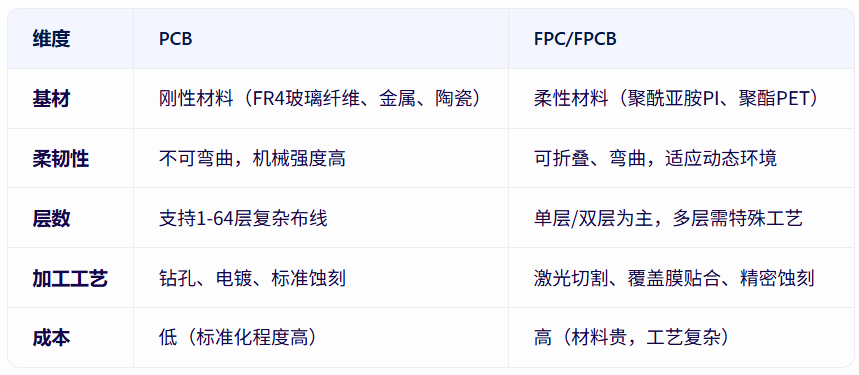
1. Basic Definitions and Structural Comparisons
2. Application Scenarios and Adaptation Requirements
PCB Applicable Scenarios
Fixed installation devices: computer motherboards, home appliance control boards, communication base stations, industrial control modules.
High density/high frequency requirements: 5G base stations, AI servers (high frequency and high-speed boards), electric vehicle electronic control systems.
Heat-sensitive scenarios: LED lighting (aluminum substrate), electric vehicle IGBT modules (copper substrate).
FPC Applicable Scenarios
Dynamic/compact spaces: mobile phone foldable screen connectors, drone gimbals, wearable devices (smartwatches).
Lightweight requirements: camera modules, battery connection wires, medical endoscopes.
Cutting-edge innovation fields: AR/VR devices, humanoid robot flexible sensors, brain-machine interface signal transmission.
Rigid-Flex Boards
Complex structures: circuit boards in the hinge area of foldable smartphones, automotive electronics (requiring both fixed and flexible parts).
3. Key Decision Points for Selection
Space limitations:
Ample space, need to support components → choose PCB.
Compact space, need to bend → choose FPC.
Performance requirements:
High-frequency signals (e.g., 5G), extreme temperatures (aerospace) → ceramic substrate PCB.
Lightweight, dynamic transmission → PI substrate FPC (high-temperature resistant up to 260°C).
Cost and mass production:
Mid to low-end mass production → PCB (lower cost).
Small batch high-end innovation → FPC (flexible adaptation).
Future upgrade potential:
Automotive intelligence (increased onboard sensors) → increased penetration of FPC.
6G, AI computing power upgrades → growth in demand for high-end PCB (high frequency and high-speed boards).
This article is an original piece by Yiy Education, please indicate the source when reprinting!