✅ Author Profile: A Matlab simulation developer passionate about research, skilled in data processing, modeling simulation, program design, complete code acquisition, paper reproduction, and scientific simulation.
🍎 Previous Review: Follow my personal homepage:Matlab Research Studio
🍊 Personal Motto: Investigate to gain knowledge, complete Matlab code and simulation consultation available via private message.
🔥 Content Introduction
In the field of digital image processing, image quantization is a crucial foundational technology, with the core goal of minimizing image data while maximizing the retention of key visual information. With the rapid development of multimedia technology, the storage, transmission, and real-time processing of massive image data face significant challenges, making efficient image quantization methods a key breakthrough to address these issues.
Traditional image quantization methods (such as uniform quantization and adaptive quantization) can reduce data volume to some extent, but often struggle to achieve an ideal balance between compression ratio and image quality. When processing complex scene images (such as natural landscapes and portraits), issues like detail loss and color blocking can easily occur, severely affecting the visual effect of the image and subsequent analysis applications (such as target recognition and image retrieval). The introduction of the Cultural Optimization Algorithm (COA) provides a new intelligent optimization approach for image quantization. This algorithm simulates the formation, dissemination, and evolution of human social culture, achieving efficient solutions to complex problems through the dual interaction of belief space and population space. Applying it to image quantization is expected to break through the limitations of traditional methods, further enhancing quantization compression performance while ensuring image quality, laying the foundation for efficient applications of images in resource-constrained environments (such as mobile devices and network transmission).
II. Core Technical Principles
(1) Basic Concepts of Cultural Optimization Algorithm
The Cultural Optimization Algorithm is an evolutionary algorithm based on swarm intelligence, characterized by the construction of two interrelated spaces: population space and belief space. The population space simulates the survival and evolution of biological individuals in nature, with each individual representing a potential solution to the problem; the belief space corresponds to the cultural knowledge system in human society, storing excellent experiences and knowledge distilled from the population evolution process.
In the image quantization problem, individuals in the population space can represent different quantization schemes, such as quantization level allocation and color mapping strategies; the belief space stores general knowledge proven effective in past quantization processes, such as the correlation between specific image features and optimal quantization parameters. The algorithm achieves the co-evolution of the two spaces through the following two mechanisms:
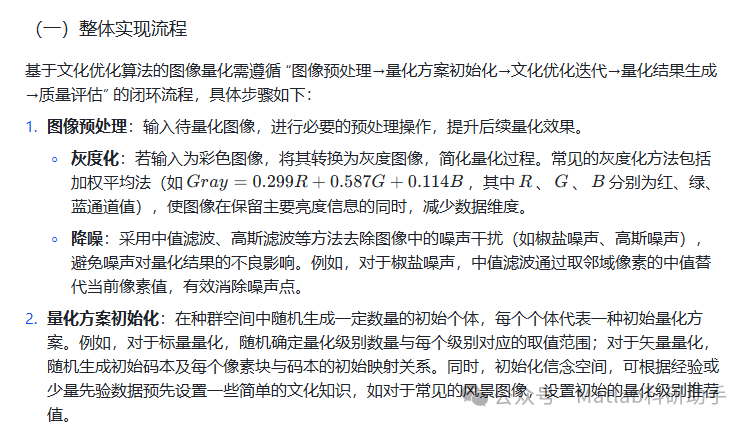
- Acceptance Operation: Individuals in the population space selectively transmit the characteristic information of excellent individuals to the belief space based on their fitness (i.e., the comprehensive performance of the quantization scheme on image quality and compression ratio), updating cultural knowledge. For example, if a certain quantization scheme achieves a lower data volume while maintaining high image quality, its related parameters (such as quantization step size and palette selection) will be incorporated into the belief space.
- Influence Operation: The cultural knowledge in the belief space, in turn, guides the evolutionary direction of individuals in the population space. Newly generated individuals perform mutation and crossover operations based on the knowledge from the belief space, generating more competitive quantization schemes. For example, when the belief space records the optimization relationship between a certain type of image texture and specific quantization levels, new individuals will tend to follow this knowledge when generating quantization schemes, adjusting their quantization parameters.
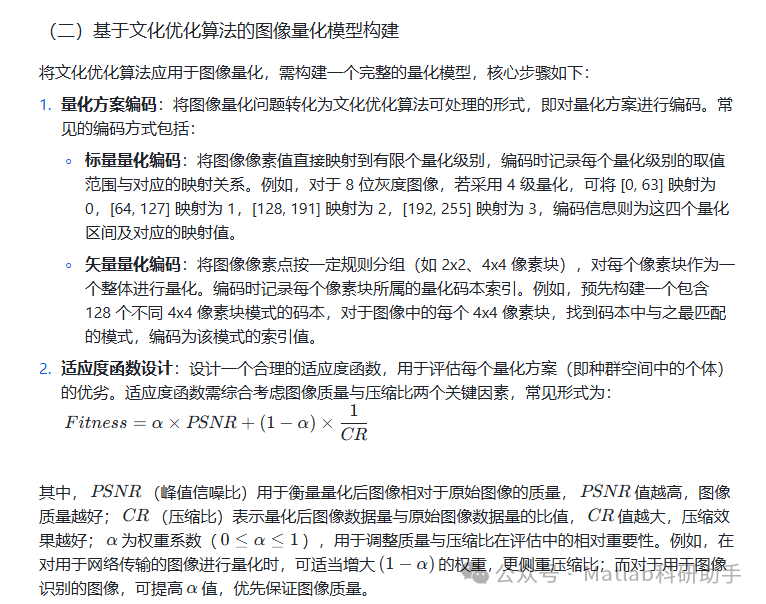
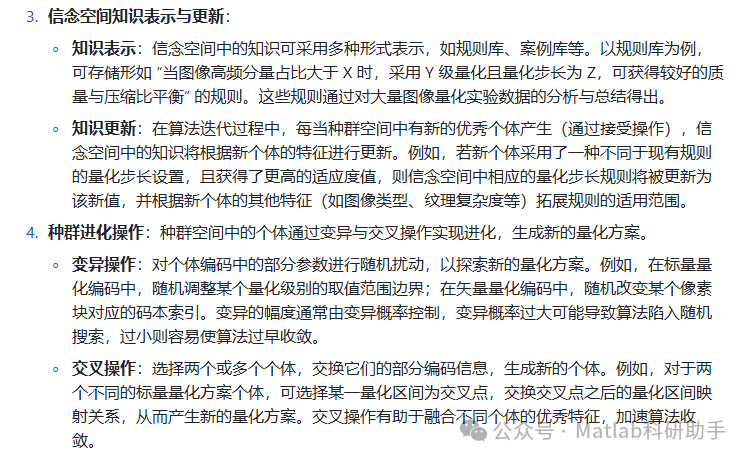
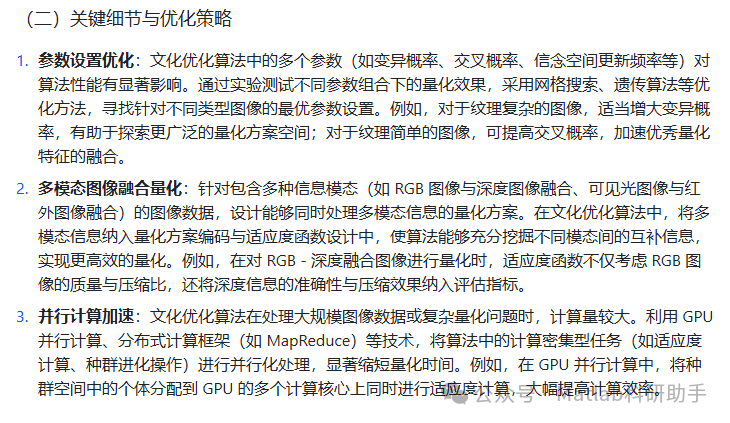
III. Technical Implementation Steps and Key Details
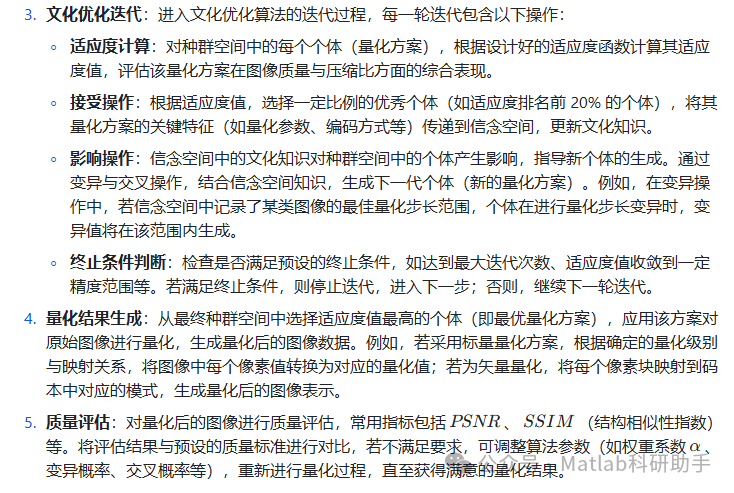
IV. Key Application Scenarios
(1) Image Storage and Transmission on Mobile Devices
In mobile devices (such as smartphones and tablets), storage space and network bandwidth are limited, making efficient image quantization crucial. The image quantization technology based on the Cultural Optimization Algorithm can significantly reduce image data volume while ensuring that the visual quality meets user needs. For example, in a mobile photo album, using this technology to quantize and store user-captured photos can save a lot of storage space; in mobile social applications, quantizing user-uploaded images can speed up image transmission and enhance user experience. Experimental tests show that compared to traditional JPEG quantization, the image quantization using the Cultural Optimization Algorithm can achieve an average compression ratio improvement of 10% – 20% under the same visual quality, with transmission time reduced by 20% – 30%.
(2) Video Surveillance Systems
The massive image data generated by video surveillance systems requires efficient storage and real-time transmission. By quantizing image frames in surveillance videos using the Cultural Optimization Algorithm, data storage and transmission costs can be reduced without affecting the identification of key targets (such as people and vehicles). For example, in urban security monitoring, quantizing images collected by road surveillance cameras can reduce storage device capacity requirements while ensuring that surveillance videos can be transmitted smoothly under limited network bandwidth, providing timely and effective information to security personnel. In practical applications, using this technology can reduce the storage costs of video surveillance systems by 30% – 40% and decrease network bandwidth usage by 25% – 35%.
(3) Medical Image Analysis
The accurate storage and rapid transmission of medical images (such as X-rays, CT, and MRI images) are crucial for medical diagnosis. The image quantization technology based on the Cultural Optimization Algorithm can compress image data while ensuring that key diagnostic information (such as lesion features and tissue boundaries) is not compromised. For example, in remote medical consultations, quantizing and transmitting patients’ medical images can shorten transmission times, allowing experts to access images for diagnosis in a timely manner. Research shows that in medical image quantization, this technology can compress image data to 30% – 50% of the original size while maintaining diagnostic accuracy, providing strong support for the efficient application of medical images.
V. Future Research Directions and Challenges
(1) Core Challenges
- Adaptability to Complex Scene Images: Real-world image scenes are complex and varied, with multiple lighting conditions, texture features, and target types. How to enable the image quantization technology based on the Cultural Optimization Algorithm to adapt more quickly and accurately to different complex scenes and automatically adjust quantization strategies remains an urgent problem to be solved. For example, in low-light environments, traditional quantization methods tend to lose details, while the Cultural Optimization Algorithm needs further optimization in its perception of lighting changes and quantization scheme adjustment mechanisms.
- Semantic-Aware Quantization: Current image quantization mainly relies on pixel-level features, lacking effective utilization of image semantic information. Future research needs to explore how to integrate semantic understanding of images (such as target recognition and scene classification results) into the quantization process, achieving semantic-aware quantization that aligns more closely with human visual cognition. For example, for an image containing people and landscapes, based on semantic information, higher precision quantization can be applied to the person part while using relatively lower precision quantization for the landscape part, improving compression efficiency while ensuring the quality of key information.
- Real-time Performance and Energy Consumption Balance: In some applications requiring high real-time performance (such as video live streaming and autonomous driving visual perception), image quantization needs to be completed in a very short time while considering device energy consumption limits. How to optimize the computational complexity of the Cultural Optimization Algorithm while ensuring real-time performance and reducing energy consumption is one of the key challenges for its widespread application. For example, when performing real-time video image quantization on mobile devices, the algorithm needs to operate efficiently without significantly increasing the device’s battery consumption.
(2) Future Directions
- Integration of Deep Reinforcement Learning and Cultural Optimization: Utilizing the decision-making capabilities of deep reinforcement learning, the Cultural Optimization Algorithm can dynamically adjust quantization strategies based on real-time feedback information from images during the quantization process. For example, by constructing a reinforcement learning agent that autonomously learns and selects optimal quantization parameter adjustment actions based on quality assessment feedback (such as changes in PSNR and SSIM) after quantization, assisted by knowledge from the belief space, adaptive image quantization can be achieved.
- Image Quantization Enhancement Based on Generative Adversarial Networks: Combining the image generation capabilities of generative adversarial networks (GANs) to enhance the quality of quantized images. After the Cultural Optimization Algorithm completes image quantization, the GAN’s adversarial mechanism can be used to generate high-quality images that are closer to the original, further improving the visual effect of quantized images. For example, by training a generator network to take quantized images as input and generate outputs that are close to the original image quality, while training a discriminator network to distinguish between generated images and original images, continuous optimization of the generator can be achieved through adversarial training, improving the quality of quantized images.
- Quantum Computing Accelerating Cultural Optimization Algorithm: With the development of quantum computing technology, exploring the introduction of quantum computing into the image quantization process of the Cultural Optimization Algorithm. Utilizing the parallelism and superposition characteristics of quantum bits to accelerate key computational steps in the algorithm (such as fitness calculation and population evolution operations), significantly improving algorithm efficiency and enabling rapid quantization of large-scale, high-resolution images. For example, using quantum gate operations to achieve rapid mutation and crossover of quantization scheme encoding is expected to find better quantization schemes in a very short time.
VI. Conclusion
The image quantization technology based on the Cultural Optimization Algorithm provides an innovative intelligent solution to the image quantization problem by simulating the mechanisms of human social cultural evolution. This technology breaks the limitations of traditional quantization methods, achieving a better balance between image quality and compression ratio, demonstrating enormous application potential in various fields such as mobile devices, video surveillance, and medical imaging. Its core value lies in utilizing the co-evolution of population and belief spaces to extract potential optimization knowledge from large amounts of image data, guiding the generation and optimization of quantization schemes, transitioning from a “data-driven” to a “knowledge-driven” image quantization process.
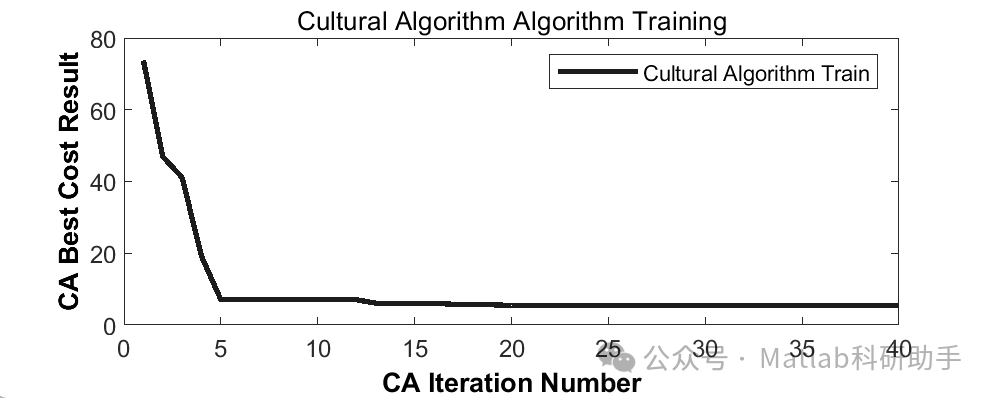
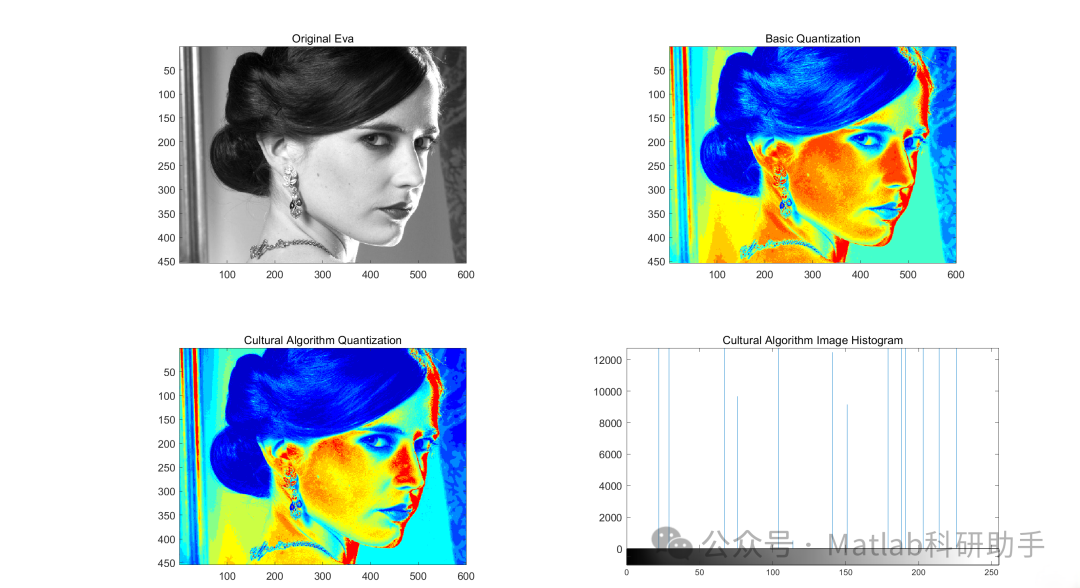
⛳️ Operation Results
🔗 References
[1] Wu Jiansheng, Qin Fajin. Program Design of Particle Swarm Optimization Algorithm Based on MATLAB[J]. Liuzhou Normal University Journal, 2005, 20(4):4. DOI:10.3969/j.issn.1003-7020.2005.04.028.
[2] Liang Liang, Lü Wenge. Image Enhancement Method Optimized by Competitive Algorithm[J]. Electromechanical Engineering Technology, 2009(04):75-77. DOI:10.3969/j.issn.1009-9492.2009.04.027.
[3] Mei Yan, Yin Zhi, Zhou Zhenghao. Application of Stochastic Search Optimization Algorithm in Cultural Tourism Route Optimization[J]. Statistics and Decision, 2018(15):3. DOI:10.13546/j.cnki.tjyjc.2018.15.022.
📣 Partial Code
🎈 Some theoretical references are from online literature; please contact the author for removal if there is any infringement.
👇 Follow me to receive a wealth of Matlab e-books and mathematical modeling materials
🏆 Our team specializes in customized MATLAB simulation guidance in various research fields, helping to realize research dreams:
🌈 Various intelligent optimization algorithm improvements and applications
Production scheduling, economic scheduling, assembly line scheduling, charging optimization, workshop scheduling, departure optimization, reservoir scheduling, 3D packing, logistics site selection, cargo location optimization, bus scheduling optimization, charging pile layout optimization, workshop layout optimization, container ship loading optimization, pump combination optimization, medical resource allocation optimization, facility layout optimization, visual domain base station and drone site selection optimization, knapsack problem, wind farm layout, time slot allocation optimization, optimal distributed generation unit allocation, multi-stage pipeline maintenance, factory-center-demand point three-level site selection problem, emergency supply distribution center site selection, base station site selection, road lamp pole arrangement, hub node deployment, transmission line typhoon monitoring devices, container scheduling, unit optimization, investment portfolio optimization, cloud server combination optimization, antenna linear array distribution optimization, CVRP problem, VRPPD problem, multi-center VRP problem, multi-layer network VRP problem, multi-center multi-vehicle VRP problem, dynamic VRP problem, two-layer vehicle routing planning (2E-VRP), electric vehicle routing planning (EVRP), hybrid vehicle routing planning, mixed flow shop problem, order splitting scheduling problem, bus scheduling optimization problem, flight shuttle vehicle scheduling problem, site selection path planning problem, port scheduling, port bridge scheduling, parking space allocation, airport flight scheduling, leak source location.
🌈 Machine learning and deep learning time series, regression, classification, clustering, and dimensionality reduction
2.1 BP time series, regression prediction, and classification
2.2 ENS sound neural network time series, regression prediction, and classification
2.3 SVM/CNN-SVM/LSSVM/RVM support vector machine series time series, regression prediction, and classification
2.4 CNN|TCN|GCN convolutional neural network series time series, regression prediction, and classification
2.5 ELM/KELM/RELM/DELM extreme learning machine series time series, regression prediction, and classification
2.6 GRU/Bi-GRU/CNN-GRU/CNN-BiGRU gated neural network time series, regression prediction, and classification
2.7 Elman recurrent neural network time series, regression prediction, and classification
2.8 LSTM/BiLSTM/CNN-LSTM/CNN-BiLSTM long short-term memory neural network series time series, regression prediction, and classification
2.9 RBF radial basis function neural network time series, regression prediction, and classification
2.10 DBN deep belief network time series, regression prediction, and classification
2.11 FNN fuzzy neural network time series, regression prediction
2.12 RF random forest time series, regression prediction, and classification
2.13 BLS broad learning system time series, regression prediction, and classification
2.14 PNN pulse neural network classification
2.15 Fuzzy wavelet neural network prediction and classification
2.16 Time series, regression prediction, and classification
2.17 Time series, regression prediction, and classification
2.18 XGBOOST ensemble learning time series, regression prediction, and classification
2.19 Transform various combinations time series, regression prediction, and classification
Directions cover wind power prediction, photovoltaic prediction, battery life prediction, radiation source identification, traffic flow prediction, load prediction, stock price prediction, PM2.5 concentration prediction, battery health status prediction, electricity consumption prediction, water body optical parameter inversion, NLOS signal identification, subway parking accurate prediction, transformer fault diagnosis.
🌈 In the field of image processing
Image recognition, image segmentation, image detection, image hiding, image registration, image stitching, image fusion, image enhancement, image compressed sensing.
🌈 In the field of path planning
Traveling salesman problem (TSP), vehicle routing problem (VRP, MVRP, CVRP, VRPTW, etc.), drone three-dimensional path planning, drone collaboration, drone formation, robot path planning, grid map path planning, multimodal transport problems, electric vehicle routing planning (EVRP), two-layer vehicle routing planning (2E-VRP), hybrid vehicle routing planning, ship trajectory planning, full path planning, warehouse patrol.
🌈 In the field of drone applications
Drone path planning, drone control, drone formation, drone collaboration, drone task allocation, drone secure communication trajectory online optimization, vehicle collaborative drone path planning.
🌈 In the field of communication
Sensor deployment optimization, communication protocol optimization, routing optimization, target location optimization, Dv-Hop location optimization, Leach protocol optimization, WSN coverage optimization, multicast optimization, RSSI location optimization, underwater communication, communication upload and download allocation.
🌈 In the field of signal processing
Signal recognition, signal encryption, signal denoising, signal enhancement, radar signal processing, signal watermark embedding and extraction, electromyography signals, electroencephalography signals, signal timing optimization, electrocardiogram signals, DOA estimation, encoding and decoding, variational mode decomposition, pipeline leakage, filters, digital signal processing + transmission + analysis + denoising, digital signal modulation, bit error rate, signal estimation, DTMF, signal detection.
🌈 In the field of power systems
Microgrid optimization, reactive power optimization, distribution network reconstruction, energy storage configuration, orderly charging, MPPT optimization, household electricity.
🌈 In the field of cellular automata
Traffic flow, crowd evacuation, virus spread, crystal growth, metal corrosion.
🌈 In the field of radar
Kalman filter tracking, trajectory association, trajectory fusion, SOC estimation, array optimization, NLOS identification.
🌈 In workshop scheduling
Zero-wait flow shop scheduling problem (NWFSP), permutation flow shop scheduling problem (PFSP), hybrid flow shop scheduling problem (HFSP), zero idle flow shop scheduling problem (NIFSP), distributed permutation flow shop scheduling problem (DPFSP), blocking flow shop scheduling problem (BFSP).
👇