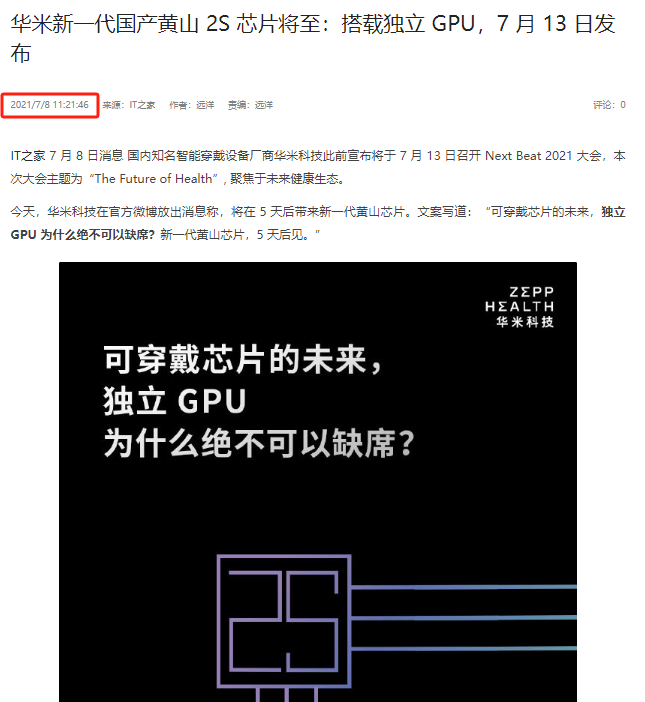
Yes, it’s the Huami that makes sports watches.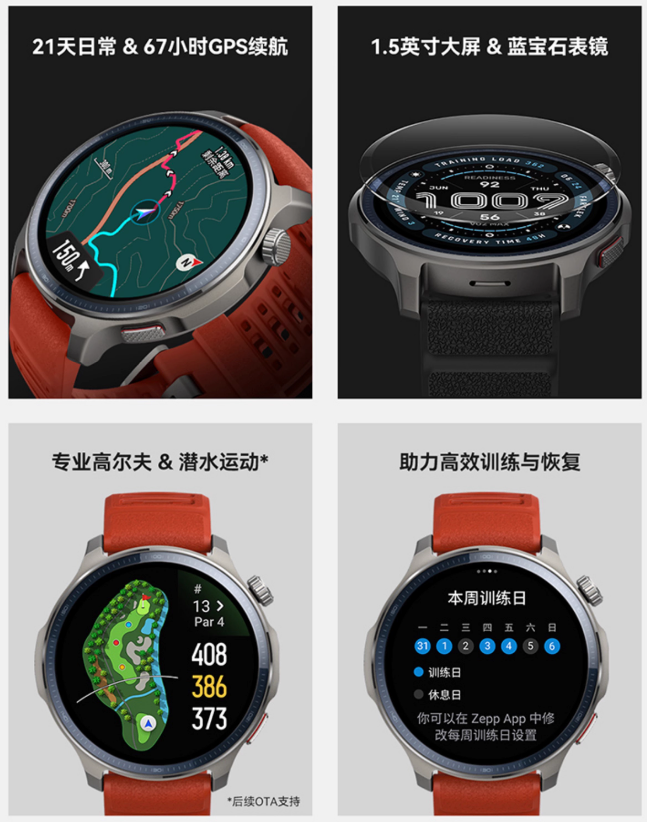 Here I specifically emphasize that it is the “first stock in RISC-V chip applications“, not the “first stock in RISC-V chips”, after all, Huami’s main business is not as a chip company.Many people may not know that Huami is one of the early investors in SiFive, a leading RISC-V IP company, and is also a platinum member of the RISC-V International Foundation.In June 2019, the globally leading smart wearable company Huami Technology (ZEPP) officially joined the RISC-V Foundation, becoming a platinum member of the fund.Huami established its artificial intelligence laboratory as early as 2017, initiating preliminary research on RISC-V chips.In 2018, Huami released its first self-developed RISC-V chip, Huangshan No. 1, which features a 55nm process, a single-core RISC-V, and operates approximately 1/3 more efficiently than the ARM M4, integrating an AI neural network acceleration unit, and has been genuinely applied in its own watches and bands.This chip’s product mass production time was more than 2 years earlier than the establishment of most domestic RISC-V chip companies.In the following years, they launched the dual RISC-V core Huangshan 2S with a 55nm process and the 40mm Huangshan 2.Moreover, Huangshan 3 has already arrived. Huangshan 3 is an industry-leading ultra-low power RISC-V SoC optimized for wearable devices, supporting a 2.5D GPU, and features an innovative multi-core heterogeneous chip, meeting various application scenarios such as wearables and IoT, and highly coordinated with ZeppOS, providing a smooth user experience for wearable devices.
 How many chip companies have iterated their RISC-V chips to the fourth generation now? Even professional chip companies cannot achieve this. Huami is the only company I have seen that lists “RISC-V architecture chips” as a selling point on the introduction page of its consumer products. They have truly leveraged the lightweight and customizable characteristics of the RISC-V architecture to meet product functionalities, and their target audience is relatively high-end, consisting of tech elites who run marathons.Note – Here I emphasize that it is consumer-grade products, because in some industrial products that require autonomy and control, RISC-V architecture is often mentioned, but I have not seen it in consumer-grade products. Although Huami’s sales have been declining after trying to move away from Xiaomi in recent years, breaking free from dependence on Xiaomi is a necessary path for its growth.Subjectively, making profits as an IDH in the Xiaomi ecosystem is too slim, and in the long run, it will definitely be unsustainable; they must develop into a mid-to-high-end independent brand.Objectively, Xiaomi’s intention to reclaim the watch and band business for itself is unstoppable.

 Moreover, Xiaomi’s willingness to reclaim the watch and band business indicates that this segment of the smart wearable market has a sufficiently large market and imaginative space. Therefore, after Huami announced a 30% revenue growth in the second quarter, the market responded very positively.Currently, the company’s price-to-book ratio is around 0.82, and it also holds shares in a listed company, Yitong Technology, which provides significant imaginative space.Academia often discusses the disruptive impact of the RISC-V instruction set architecture on business models, such as chip design companies being able to independently create main control IP companies, easier access to CPU IP, and the price of IP being driven down, etc., but I believe these are still just quantitative changes rather than qualitative changes, as they are essentially a reorganization of the division of labor in the chip design field. However, Huami’s development of RISC-V chips is different; its essence is that downstream terminal brand manufacturers directly intervene in chip research and development.In this regard, Huami can be considered a pioneer among domestic companies, while Apple was the first to do this overseas. Later, mobile phone companies and automotive companies entering chip manufacturing are just subsequent developments.