




Harmo
Collaborative Robots and Welding Robot Controllers
HARMO ROBOTICS

The controller, as one of the three core components of industrial robots, is also the brain of the industrial robot, and its performance directly affects the robot’s precision, stability, and operational efficiency. HarmoRobot RC Series Controllers, developed based on proprietary technology, aims to promote continuous breakthroughs in core robotic technologies.
RC Series Controllers / HM Controller Series
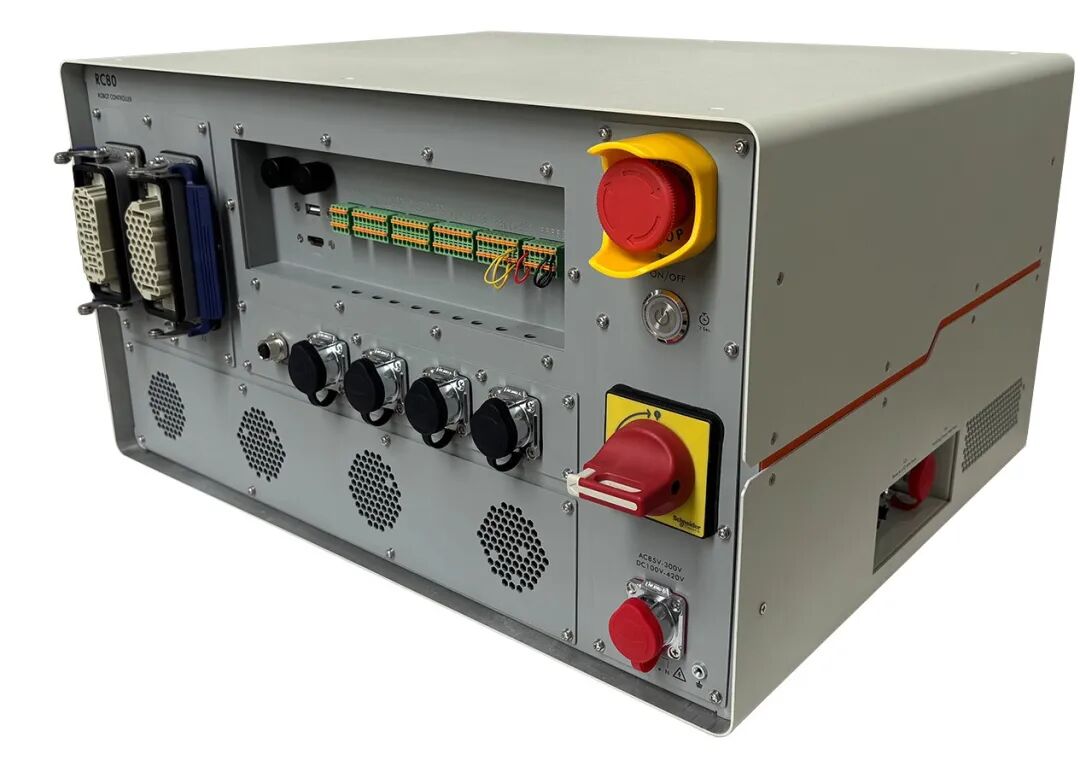
RC80 Controller
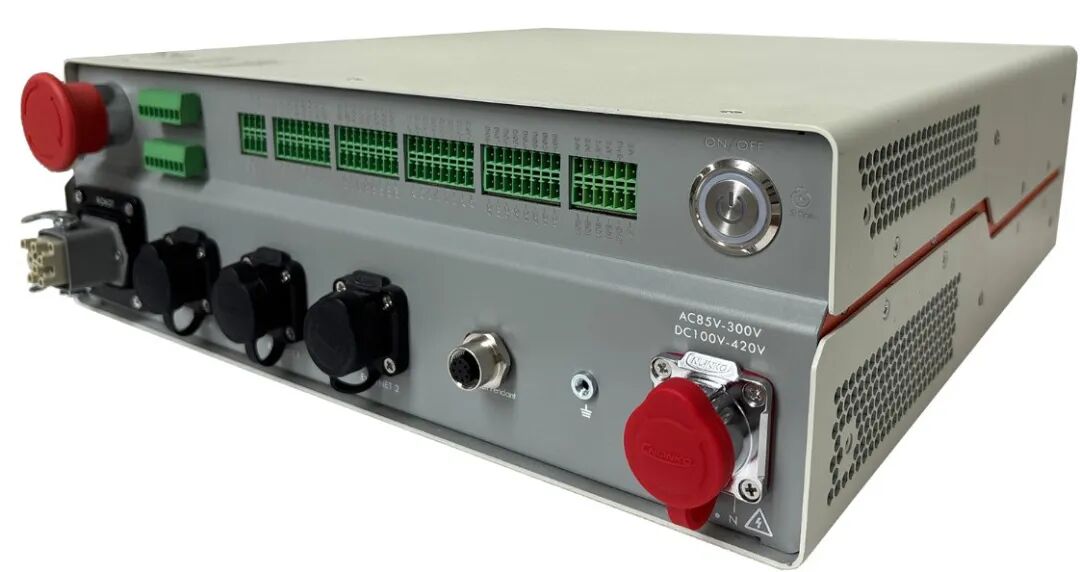
RC40 Controller
To meet the stringent requirements of industrial robotic arms for millisecond-level real-time collaboration and communication stability, Harmo Robotics has developed the Synchron real-time operating system based on the Linux kernel. This system provides a precise and stable operating environment for robotic movements through deeply optimized motion planning and control modules, with core features including:

System response time of <20μS
Support for SMP-RPC real-time trajectory control
Support for Topic data stream processing and intelligent decision-making
Support for multi-core heterogeneous system scheduling
Distributed computing environment
High-response real-time industrial bus protocol
Leveraging its technological accumulation in motion control and drive, Harmo Robotics integrates key technologies such as servo drives, motion controllers, and vision systems, providing open interfaces and SDKs. The HM series controllers exhibit excellent comprehensive performance,aiming to provide complete motion control technology solutions for robotic technology and various automation devices.
As a new generation of intelligent controllers, the RC series controllers demonstrate significant advantages in welding applications, intelligently assisting in finding optimal welding conditions and applying them in actual operations. In traditional welding, different positions often require manual setting of various conditions; the RC series controllers simplify the setting process significantly throughgraphical programming interfaces,reducing the learning curve and achieving partial automation of processes. Besides welding, this controller is also suitable for fields such as painting and precision machining, where fine adjustments to the end effector’s movements are required.
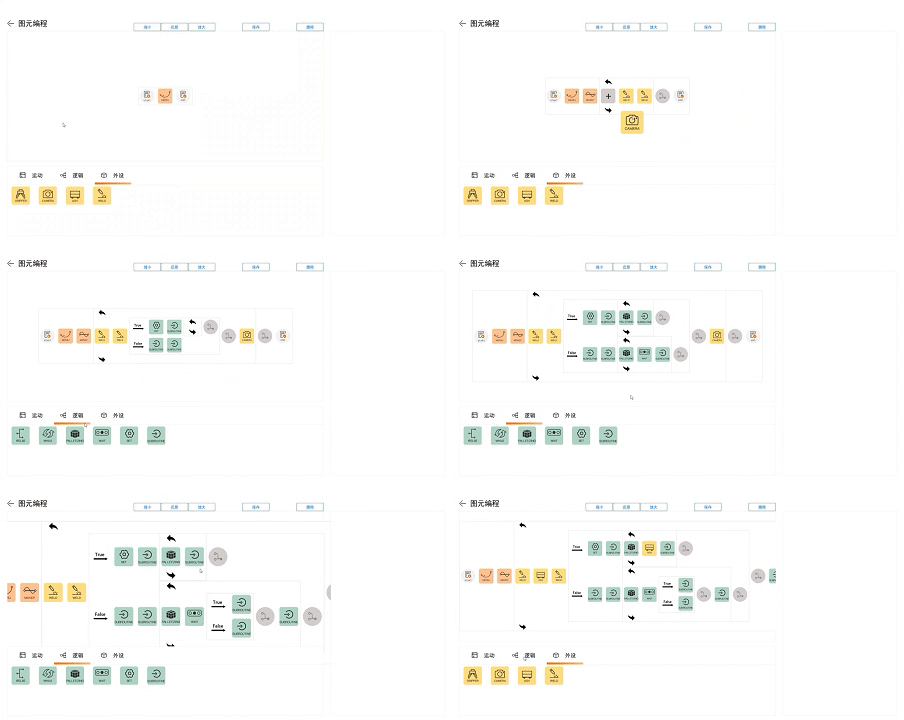
(Graphical programming interface)
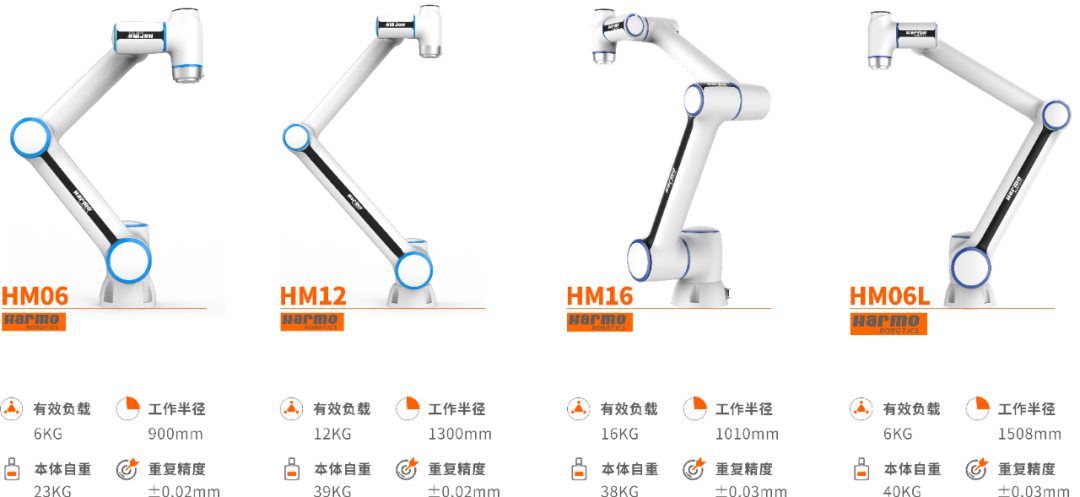
RC series robot controllers are compatible withHM series robots.
At the same time, the core technologies of the robot controllers are optimized in reverse for specific industry processes and performance requirements, such as:
Addressing singularity issues in Cartesian coordinate systems, eliminating robot G-points, expanding the effective working range of robots, and enhancing operational flexibility.
Using vector algorithm technology instead of the widely used circular interpolation in the industry, allowing robots to achieve smoother, more stable, and more efficient global motion trajectories.
Unique robot joint self-locking technology enhances the stability and safety of robots operating in confined spaces.
The RC series controllers adhere to the product development design philosophy ofopenness,efficiency, anddata standardization, with a highly integrated system architecture. It integrates core modules such as safety control, robot control, motion control, logic control, and process control, ensuring high computational performance and flexibility based on a unified data foundation.
At the same time, the RC series controllers are equipped with rich external expansion interfaces:
Independent ECT interface: supports nine-axis synchronous and asynchronous control
Multiple EIP interfaces: compatible with various peripherals such as industrial cameras and welding power supplies
Standard industrial interfaces: provide standard CANopen and RS485 interfaces
Graphical device controls: support rapid integration of cameras, welding machines, AGVs, ground rails, grippers, and other devices
The Harmo Robotics RC series controllers are a robot control system development platform that integrates multi-modal technology and deep reinforcement learning technology. It can deeply process and fuse multi-source data information such as images, videos, force perception, speed, and pose, providing high-precision data for system decision-making through learning, training, and continuous optimization, and updating models in real-time. This endows the robot control system with stronger autonomy and adaptability, such as optimizing operational efficiency through predictive maintenance or enhancing flexibility in dealing with complex environments using adaptive algorithms.