In the rapidly evolving landscape of Large Language Models (LLMs), how to efficiently adapt models to specific tasks or domains has become a core concern for every AI developer and enterprise. Fine-tuning has emerged as a crucial method for enhancing model performance, leading to various technical paths in recent years. Among them, Full Fine-tuning and LoRa Fine-tuning have become the two most discussed approaches.
This article will provide a clear comparison of these two fine-tuning methods, helping you make a more informed choice in your practical projects.
1. What is Fine-tuning?
Fine-tuning, simply put, is the process of further training model parameters using domain-specific data based on a pre-trained large model, enabling it to perform better on specific tasks (such as customer service Q&A, legal text generation, medical diagnosis, etc.).
Large models (like LLaMA, ChatGLM, Qwen, etc.) are typically pre-trained on vast amounts of general data, possessing broad language understanding capabilities, but to become “specialized,” fine-tuning is necessary.
2. Full Fine-tuning: Traditional but Expensive
Full Fine-tuning, as the name suggests, involves updating all parameters of the model. It follows the traditional training methods of deep learning, and the results are usually very significant.
✅ Advantages:
- High Performance Ceiling: All parameters can be adjusted, allowing the model to deeply adapt to the target task, often yielding the best results.
- Strong Flexibility: Suitable for various complex tasks, especially in scenarios with large data volumes and significant task differences.
❌ Disadvantages:
- Extremely High Computational Cost: For a model with 7 billion parameters, full fine-tuning requires multiple high-end GPUs (like A100), with training costs often reaching thousands or even tens of thousands of dollars.
- High Storage Overhead: Each fine-tuning generates a complete model copy, making it difficult to manage multiple task model versions.
- Long Training Cycle: Requires a significant amount of time and resources, making it unsuitable for rapid iteration.
📌 For example: If you train a 7B model for financial customer service, after full fine-tuning, the model’s performance improves by 15%, but you spent 3 days and 20,000 yuan, and cannot simultaneously maintain models for legal, medical, and other fields.
3. LoRa Fine-tuning: Lightweight and Efficient “Plug-in” Upgrade
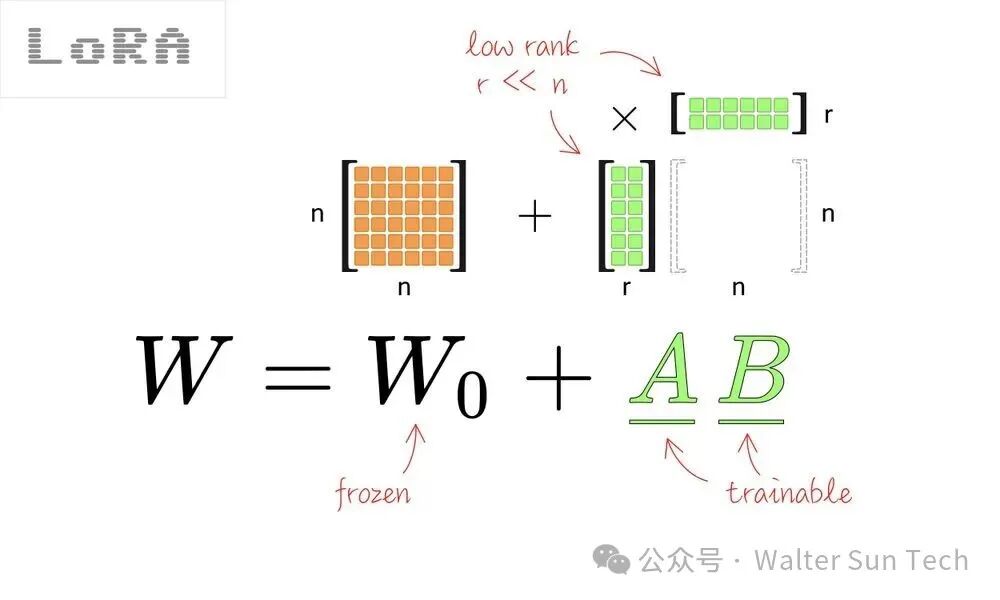
LoRa (Low-Rank Adaptation) is a parameter-efficient fine-tuning method proposed by Microsoft in 2021. Its core idea is: instead of directly modifying the original model parameters, it introduces a small number of trainable low-rank matrices as “plug-in modules” to adjust model behavior.
✅ Advantages:
- High Parameter Efficiency: Only 0.1% to 1% of the parameters need to be trained (for a 7B model, only hundreds of thousands to a few million parameters), significantly reducing computational resource requirements.
- Fast Training Speed: Typically completed in a few hours on a single card (like 3090/4090).
- Low Storage Cost: Only the LoRa weights (usually tens of MB) are saved, which can be “combined” with the original large model, saving a lot of storage space.
- Supports Multi-task Parallelism: The same base model can load different LoRa modules, achieving “one model for multiple uses.”
❌ Disadvantages:
- Performance Slightly Inferior to Full Fine-tuning: In some complex tasks, it may not reach the ceiling of full fine-tuning.
- Dependent on Base Model Quality: If the pre-trained model itself is not strong, the improvement from LoRa is limited.
📌 Similarly, for a 7B model used for financial customer service, using LoRa fine-tuning, you might only spend 800 yuan and 6 hours, achieving a 90% performance improvement, and easily switch to legal or e-commerce scenarios.
4. Core Comparison: Understanding Differences at a Glance
| Dimension | Full Fine-tuning | LoRa Fine-tuning |
|---|---|---|
| Training Parameter Amount | 100% | 0.1% ~ 1% |
| Memory Requirement | High (multiple A100 cards) | Low (single 3090/4090 card) |
| Training Time | Several days | Several hours |
| Storage Cost | High (several GB per model) | Extremely low (LoRa weights tens of MB) |
| Performance | Optimal | Close to optimal |
| Multi-task Support | Requires multiple complete models | One base model + multiple LoRa modules |
| Suitable Scenarios | Large data volumes, complex tasks, pursuing excellence | Rapid iteration, limited resources, multi-task parallelism |
5. How to Choose? Decide Based on Scenarios
✅ Recommended Scenarios for Full Fine-tuning:
- Your tasks are very complex (e.g., code generation, multi-hop reasoning)
- You have ample labeled data and computational resources
- You pursue ultimate performance and are willing to invest costs for results
✅ Recommended Scenarios for LoRa Fine-tuning:
- Small to medium enterprises or individual developers with limited budgets
- Need to quickly validate multiple business directions
- Need to support multiple verticals (e.g., customer service, marketing, education)
- Want to achieve lightweight deployment of “Model as a Service”
6. Trends: LoRa is Becoming Mainstream
As the ecosystem of large models matures, Parameter-Efficient Fine-tuning (PEFT) technologies (such as LoRa, Adapter, Prefix-tuning) are becoming mainstream. Platforms like Hugging Face, Alibaba Cloud, and Baidu have all natively supported LoRa training.
LoRa not only lowers the threshold for AI applications but also makes the implementation of “large models + small data” possible. In the future, we may see more architectures of “base models + plug-in fine-tuning,” truly achieving modularity and composability in AI.
7. Conclusion: There is No Best, Only the Most Suitable
Full fine-tuning and LoRa fine-tuning are not opposing but complementary.Full fine-tuning is the “heavy artillery,” pursuing ultimate performance; LoRa fine-tuning is the “special forces,” flexible and efficient, achieving much with little.
In today’s resource-limited and fast-paced environment, LoRa fine-tuning is undoubtedly the first choice for most teams. However, when you truly need to “compete on performance,” full fine-tuning remains the ultimate weapon.
The choice of which method to use depends on your goals, resources, and pace. The key is: to let technology serve the business, rather than being constrained by technology.