

Think Tank Highlights #GlobalDefenseDynamics #USMilitaryDynamics #RussianMilitaryDynamics #TaiwanNews #WeChatStoreOnSale
#SouthKorea #Raytheon #Japan #ElectronicWarfare #NortheastAsiaMilitaryDynamics #Unmanned
1. Background
2. Concepts
Currently, various Air Navigation Service Providers (ANSPs) are collecting data either independently (e.g., through radar devices) or from third parties (e.g., meteorological information). These ANSPs process the collected data internally and provide air navigation services (ANS) to airspace users.
In this way, ANSPs currently play the roles of both Air Traffic Management Data Service Providers (ADSP) and Air Traffic Service Providers (ATSP), where ATSP consists of Air Traffic Service Units (ATSU), including Air Traffic Controllers (ATCO). Virtualization is achieved by providing services independent of infrastructure location, such as remote tower deployments.
The future concept of virtualization is associated with data service provision by providers who are organizationally and/or physically separated from the entities generating the data and the end-users (controllers working in ATSU). Therefore, virtualization involves not only the separation of infrastructure location and service provision but also potential organizational separation.
Furthermore, future air traffic management services can be envisioned as combinations of services with different granularities (providing data for each single data type, such as flight trajectories, flight plans, conflict detection, etc.), relying on a cloud infrastructure with high availability, fault tolerance, and reliability. This article identifies different scenarios for cloud infrastructure management and ownership:
① From a market perspective,managing external/public cloud infrastructure through external providers. In this case, providers choose to focus on service development and outsource all maintenance work to solution providers. Due to performance limitations in Service Level Agreements (SLA), this may not be suitable for ANSPs for security and safety reasons. Additionally, laws in some countries may prevent data sharing across different countries/regions (for security/safety reasons). This situation is not unique to the air traffic management field; it occurs in many other fields as well.
② Locally/privately managed cloud infrastructure by ANSPs.In this case, the configuration and maintenance of the cloud infrastructure are managed by the ANSP itself.
③ A hybrid environment using a combination of local and external cloud infrastructure, where providers must meet operational/security requirements.
Some ANSPs receive broadcast Automatic Dependent Surveillance-Broadcast (ADS-B) tracking data from the global surveillance service provider Aireon. This service provides ANSPs with a high-fidelity, low-latency source of positioning data that is located either within or outside the ANSP’s own Flight Information Region (FIR) or Area of Responsibility (AoR), without the need to sign data-sharing agreements with neighboring countries.
In this context of “on-demand capacity,” the following operational scenarios are considered:
① Allocating air traffic services for specific airspace blocks based on traffic load: Sharing controller resources between different ATSU facilities or different ATSUs to meet demands during high or low traffic periods.
② Allocating air traffic services for specific airspace blocks in the event of a failure: Providing continuity of service in the event of a decrease/loss of airspace capacity due to equipment or facility failures.
③ Optimizing the use of tower operation resources: Optimizing controller resources for low traffic flow towers.
From a technical perspective, virtualization technology allows for the complete separation of the hardware and software providing applications from the location providing the service, which can be in the same building, thousands of miles away, or anywhere in between. When meeting various demands, software can also be deployed on cloud infrastructure. Deploying this technology in the field of air traffic management can separate the devices hosting applications from the locations providing services to airspace users.
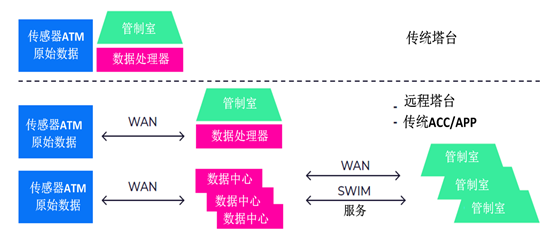
Remote Towers and Virtual Towers:Air traffic controllers can provide services to airspace users at one or more airports (located in different locations), supported by software applications hosted in a data center at another location, collecting data from sensors located at the airport (e.g., cameras) or other locations. All locations must be interconnected through reliable and secure IP infrastructure to share different types of data among these locations. The required wide-area network IP infrastructure can be leased from national operators with appropriate service level agreements or established by the ANSP itself. Regardless of the solution chosen, it is essential to ensure that resilient communication networks can be managed for availability, integrity, and quality of service.
Virtual Center: Air traffic controllers will provide services to airspace users in one or more sectors of their country or another country, supported by software applications hosted in data centers at the same or different locations, collecting data from sensors located at some point in that country. Similarly, in this case, all locations will be interconnected through reliable and secure IP infrastructure hosted by national operators or the ANSP itself, ensuring the reliability of communication services provided to end-users.
Moreover, for future organizational approaches that separate air traffic management data collection and processing from air traffic control centers, the technical concepts will remain unchanged, with different organizations responsible for data collection/distribution and data processing. This requires consideration of security and interoperability at the boundaries of different networks to ensure data integrity and consistency, such as introducing several layers of firewalls and Session Border Controllers (SBC) at network boundaries.
The following diagram illustrates the main features of virtualization technology in tower and Area Control Center (ACC) control room environments.
3. Potential Applications in Aviation
To manage airline operations, airline executives can view the provided virtualization technology at flight operations centers and interact with each crew member and all stakeholders, such as meteorological (MET) service providers, airport authorities, and ANSPs. Furthermore, general aviation flight management services will benefit from virtualization in a manner similar to ANSPs with virtual centers.
Nevertheless, virtualization can become the foundation for air traffic management-related services. In the future, virtualization will play a role in other areas such as Unmanned Traffic Management (UTM) and Advanced Air Mobility (AAM). Ultimately, entirely new business areas may emerge:
① Pure data service providers: Installing sensors, collecting data, and providing it to ANSPs or any other organizations, such as for weather, surveillance, geographic information, and flight information;
② Air Traffic Management Cloud Providers: Hosting collected data and sharing it with ATSU or any other organizations;
③ New air traffic management services may be developed in the future, combined with automation or artificial intelligence, to facilitate access to all data.
Reprint Statement
This article is sourced from publicly available information on the internet or has been reprinted with authorization from the original public account. All copyright belongs to the original author. The content of the article does not represent the views of this platform or its responsibility for its authenticity. The purpose of reprinting is to convey information and for online sharing. If there are copyright issues, please contact us promptly, and we will delete it at the first time.