Introduction
This course is a classic video tutorial set for microcontroller learners, aimed at beginners, teaching you microcontroller programming from scratch with hands-on guidance. It systematically introduces the theoretical explanations and practical development of experimental projects, focusing on the most popular 51 microcontroller C programming!
The highlight of this tutorial is that it analyzes the cognitive patterns of beginners based on the teaching experience of frontline teachers from key universities in China, while also referencing the writing techniques of classic foreign textbooks. It provides a systematic and detailed introduction to the fundamental knowledge of the 51 microcontroller application. This course breaks the traditional model of microcontroller teaching and adopts a modular approach to instance production, integrating the necessary theoretical knowledge of microcontroller, the introduction of components used in the module, the explanation of peripheral circuit design, and the detailed programming of the software functions to be realized in the module. It cleverly incorporates the principles and applications of microcontrollers, peripheral circuit design, and C language programming knowledge into various module projects, not only broadening the application vision of microcontrollers but also enriching the knowledge required from fundamentals to applications. This allows scholars to learn while practicing the production of the module, enabling efficient and systematic learning while improving hands-on skills.
Through multi-angle and multi-faceted instance explanations, readers not only master the basic skills of microcontroller system development but also broaden their vision of popular microcontroller applications. Therefore, this course is suitable for all 51 microcontroller application developers, electronics enthusiasts, students from related majors in colleges and universities, and engineering technicians. It can also serve as a short-term training course, representing a classic curriculum for microcontroller enthusiasts from beginner to advanced levels.
Course Details:
This course mainly introduces the process, methods, techniques, and design concepts of 51 microcontroller application system development through typical examples, focusing on system design with the 51 microcontroller, combining software and hardware, and presenting it in a simple and understandable manner. It comprehensively explains various technologies involved in microcontroller development through 30 module examples, including microcontroller interface expansion, memory expansion, input/output and display technologies, practical electronics production, sensor control technology, electrical drive and control technology, microcontroller communication technology, typical devices and application technology, peripheral circuit design, software programming, and more. This set of courses is based on the Changxue 51 development board. It includes: Introduction to 51 microcontroller, register settings and usage, hardware testing, principles and usage of various application module components, peripheral circuit design, and 51 microcontroller C language programming.
This course is aimed at microcontroller design users from various fields, especially those who have mastered the theoretical knowledge of microcontroller development but lack practical experience, making it particularly instructive. It can also be used as a course textbook for various college-related majors and social training classes.
The CEPARK Changxue series multifunctional development learning board experimental box is designed by the electronic park technical team based on years of development practice experience and combines dozens of development boards for various MCUs such as 51, AVR, PIC, MSP430, ARM, STM32, CAN, USB, etc., along with dozens of peripheral application modules. After gathering existing functions and expanding them, the Changxue series multifunctional development learning board experimental box was developed. The Changxue series adopts an original plug-and-play combination structure, where the functional baseboard and core board can be used separately or combined together. This open plug-in mode greatly shares basic resource function modules and peripheral common accessories, supports various chips, and allows for endless expansion.
Table of Contents:
Lesson 1 Introduction to Changxue 51 Development Learning Board (1). Introduction to Changxue 51 experimental box; (2). Components of Changxue 51 development board; (3). Changxue multifunctional baseboard; (4). 51 microcontroller core board; (5). Introduction to peripheral accessories of the development learning board; (6). Programmer/simulator. Lesson 2 How to Use the Changxue 51 Development Learning Board (1). Preparation work; (2). Hardware connection; (3). Installation of CP2102 driver; (4). Downloading and burning program process; (5). Download operation video; (6). Download common problems and solutions; Lesson 3 Hardware Testing of Changxue 51 Microcontroller Development Learning Board 1. Test instructions 2. Single color flowing light test 3. Color flowing light test 4. Two-color light test 5. Eight-digit digital tube test 6. One-digit digital tube test 7. Two-color dot matrix test 8. LCD1602 test 9. LCD12864 test 10. OLED test 11. TFT color screen display test 12. TFT color screen touch test 13. 8 independent key test 14. 16-key matrix test 15. 5-way joystick test 16. DS18B20 test 17. 2-way DC motor test 18. Stepper motor test 19. 2-way relay test 20. Serial communication test 21. DS1302 test 22. Passive buzzer test 23. AT24C02 test 24. Serial-to-parallel module test 25. Parallel-to-serial module test 26. 3-to-8 decoder test 27. 74HC573 test 28. Infrared transmission and reception test 29. Infrared decoding test 30. SD card module test 31. PCF8591 module test 32. Sensor module test 33. MAX485 test 34. Hardware test conclusion Lesson 4 Introduction to 51 Microcontroller (1). Introduction to microcontroller; (2). Introduction to 51 microcontroller; (3). Introduction to AT microcontroller; (4). Introduction to STC microcontroller; (5). Selection of STC12C series; (6). Minimum system of 51 microcontroller. Lesson 5 Installation and Use of KEIL (1). Introduction to Keil C51; (2). Installation of Keil C51; (3). Creating a project; (4). Project settings; (5). Compilation, linking; (6). Common debugging commands in Keil; (7). Keil debugging window. Lesson 6 Explanation of 8-bit Monochrome LED Module (1). Introduction and principle of LED light; (2). Types of LED lights and positive and negative poles; (3). Explanation of hardware circuit; (4). Lighting up LED – bit control; (5). Lighting up LED – byte control; (6). Lighting up LED – lookup table; (7). LED light flashing; (8). Lighting up LED – shift display; (9). LED light displays binary addition; (10). Pattern flowing light. Lesson 7 Explanation of 6-color and 1-color LED (1). Introduction to color LED; (2). Introduction to two-color LED; (3). Circuit analysis; (4). Color pattern light; (5). Two-color light display. Lesson 8 Explanation of 1-digit Digital Tube Module (1). Introduction to digital tube; (2). Structure of 1-digit digital tube; (3). Explanation of hardware circuit; (4). Digital tube coding; (5). Digital tube segment display; (6). Digital tube static display numbers; (7). Digital tube dynamic display numbers; (8). Display special symbols. Lesson 9 Explanation of 8-digit Digital Tube Module (1). Principle of 4-in-1 digital tube; (2). Circuit analysis; (3). Introduction to 74HC595 chip; (4). Working principle of 74HC595; (5). Cascading of 74HC595; (6). Coding; (7). Display data at specified position; (8). Static scanning; (9). Dynamic scanning; (10). Moving display. Lesson 10 Explanation of OLED LCD Display (1). Introduction to OLED; (2). Advantages of OLED; (3). Applications of OLED; (4). CEPARK OLED technical parameters; (5). Character display principle; (6). Division of OLED display area; (7). Character display function; (8). Chinese character display principle; (9). Chinese character formatting software and settings; (10). Chinese character display function; (11). Memory optimization. Lesson 11 Explanation of LCD1602 LCD Display (1). Introduction to LCD; (2). Introduction to LCD1602; (3). Technical parameters of LCD1602; (4). Character display principle; (5). LCD1602 controller instructions; (6). LCD1602 timing control; (7). Several notes on 1602; (8). LCD1602 – static display program; (9). LCD1602 – dynamic display program; (10). LCD1602 – scrolling display program; (11). LCD1602 – cursor blinking right shift program; (12). LCD1602 – character blinking program. Lesson 12 Explanation of LCD12864 LCD Display (1). Introduction to LCD; (2). Introduction to LCD1602; (3). Technical parameters of LCD1602; (4). Character display principle; (5). LCD1602 controller instructions; (6). LCD1602 timing control; (7). Several notes on 1602; (8). LCD1602 – static display program; (9). LCD1602 – dynamic display program; (10). LCD1602 – scrolling display program; (11). LCD1602 – cursor blinking right shift program; (12). LCD1602 – character blinking program. Lesson 13 Explanation of 8×8 Red and Green Two-color Dot Matrix (1). Introduction to dot matrix screen; (2). Introduction to 8*8 red and green two-color dot matrix; (3). Introduction to 74HC595 chip; (4). Two-color dot matrix – green column scanning program; (5). Two-color dot matrix – red column scanning; (6). Two-color dot matrix – two-color column scanning; (7). Introduction to formatting software; (8). Two-color dot matrix – static display of a character; (9). Two-color dot matrix – alternating display of two static characters; (10). Two-color dot matrix – two-color alternating display; (11). Two-color dot matrix – two-color display of special symbols; (12). Two-color dot matrix – scrolling display of a character; (13). Two-color dot matrix – scrolling display of multiple characters; (14). Two-color dot matrix – pattern display; (15). Two-color dot matrix – simulating elevator up and down. Lesson 14 Explanation of 8 Independent Key Module (1). Introduction to independent keys; (2). Classification of keys; (3). Key debounce; (4). Independent key experimental design; (5). Independent key scanning; (6). Controlling flowing lights experiment; (7). Four-in-one digital tube display independent keys; (8). Independent keys on LCD1602; (9). OLCD display independent keys. Lesson 15 Explanation of 4X4 Matrix Keyboard (1). Introduction to matrix keyboard; (2). Detection of matrix keyboard; (3). Bounce and debounce; (4). Experimental design of matrix keyboard; (5). Row-column scanning; (6). Inversion method 1; (7). Inversion method 2; (8). Inversion method 3. Lesson 16 Explanation of 5-way Joystick Key (1). Introduction to 5-way joystick; (2). 5-way joystick experimental design; (3). Key debounce; (4). Independent key scanning; (5). Lighting up LED; (6). Controlling digital tube pattern display; (7). Digital tube displays key value; (8). OLED display; (9). Control dot matrix display. Lesson 17 Explanation of Timer Experiment (1). Structure of timer; (2). Working principle of timer; (3). Clock cycle; (4). Initial value calculation for four working modes; (5). Timer interrupt; (6). Timer 0 experiment; (7). Timer 1 experiment; (8). Generating 1ms square wave; (9). Generating 200ms square wave; (10). Generating multiple different frequency square waves; (11). Key controlled PWM dimming. Lesson 18 Explanation of Buzzer (1). Introduction to buzzer; (2). Classification of buzzers; (3). Experimental design of buzzer; (4). Buzzer emits long sound; (5). Buzzer emits ticking sound; (6). Buzzer emits alarm sound; (7). Buzzer emits police car sound; (8). Buzzer emits ambulance sound; (9). Buzzer emits fire truck sound; (10). Buzzer emits music sound. Lesson 19 Explanation of External Interrupt (1). Overview of interrupts; (2). Interrupt response process; (3). Introduction to interrupt registers; (4). External interrupt 0 – level triggered; (5). External interrupt 0 – falling edge triggered; (6). External interrupt 1 – level triggered; (7). External interrupt 1 – falling edge triggered; (8). T0 external counting interrupt; (9). T1 external counting interrupt. Lesson 20 Explanation of DC Motor Control (1). Introduction to DC motor; (2). Working principle of DC motor; (3). Introduction to ULN2003; (4). Characteristics of DC motor; (5). Key control of DC motor; (6). Key speed control of DC motor; (7). Direction control of DC motor. Lesson 21 Explanation of Relay (1). Introduction to relay; (2). Classification of relays; (3). Main technical parameters of relay; (4). Introduction to ULN2003; (5). Experimental design; (6). Relay switch; (7). Relay simulating washing machine rotation. Lesson 22 Explanation of Stepper Motor Control (1). Introduction to stepper motor; (2). Technical parameters of stepper motor; (3). Reaction stepper motor; (4). Permanent magnet stepper motor; (5). 28BYJ-48 stepper motor; (6). ULN2003; (7). Stepper motor rotates unidirectionally; (8). Stepper motor rotates in both directions; (9). Stepper motor direction control with single key; (10). Stepper motor acceleration and deceleration; (11). Digital tube display; (12). Dual key speed control; (13). Triple key speed control and direction. Lesson 23 Explanation of Serial Communication (1). Basic knowledge of serial communication; (2). RS-232 standard; (3). RS-232 interface; (4). Baud rate doubling settings; (5). Serial control register SCON; (6). Pulse settings; (7). Baud rate settings; (8). Multi-machine communication; (9). Experimental design; (10). Serial communication. Lesson 24 Explanation of Serial-to-Parallel (1). Shift register; (2). Introduction to 74HC164; (3). Function introduction of 74HC164; (4). Experimental design; (5). 74HC164 lights up LED. Lesson 25 Explanation of Parallel-to-Serial (1). Shift register; (2). Introduction to 74HC165; (3). Function introduction of 74HC165; (4). Experimental design; (5). 74HC165 lights up LED. Lesson 26 Explanation of 3-to-8 Decoder (1). Introduction to decoders; (2). Function introduction of 74LS138; (3). Decoder expansion; (4). Experimental design and 74LS138 lights up LED. Lesson 27 Explanation of Latch (1). Introduction to latches; (2). Introduction to 74HC573; (3). Function introduction of 74HC573; (4). Experimental design; (5). 74HC573 lights up LED. Lesson 28 Explanation of DS18B20 Temperature Detection (1). Introduction to DS18B20; (2). Introduction to DS18B20 pins; (3). Internal structure of DS18B20; (4). Timing of DS18B20; (5). Working principle; (6). Experimental design; (7). Digital tube displays temperature value. Lesson 29 Explanation of ADDA Conversion (1). A/D conversion; (2). D/A conversion; (3). PCF8591 read operation; (4). PCF8591 write operation; (5). Introduction to PCF8591; (6). Hardware connection; (7). Upper computer communication. Lesson 30 Explanation of AT24C02 Storage Module (1). Introduction to EEPROM; (2). AT24C02XX series; (3). Introduction to AT24C02 chip; (4). Introduction to IIC bus; (5). Start and stop signals and acknowledgment signals; (6). Write operation; (7). Read operation; (8). AT24C02-LCD1602 display. Lesson 31 Explanation of DS1302 Clock Module (1). Introduction to real-time clock; (2). Introduction to DS1302 chip; (3). DS1302 registers; (4). DS1302 timing control; (5). DS1302-OLED display time program. Lesson 32 Explanation of SD Card (1). Introduction to SD card; (2). Working principle of SD card; (3). SPI working mode; (4). Circuit analysis; (5). SD card initialization; (6). Introduction to file system; (7). Use of file system; (8). SD card read and write operations; (9). Main function of the program. Lesson 33 Explanation of Infrared Emission and Reception (1). Introduction to infrared; (2). Infrared remote control system; (3). Integrated infrared reception; (4). Infrared transmission protocol; (5). Encoding; (6). Infrared encoding and decoding; (7). Infrared emission and reception; (8). LCD1602 displays infrared remote control key values. Lesson 34 Explanation of TFT Touch Color Screen (1). Basic knowledge of TFT color screen; (2). Pixels and resolution; (3). Color position; (4). CEPARK TFT color screen; (5). Control pin settings; (6). TFT initialization function; (7). TFT block display; (8). TFT displays text; (9). TFT displays images; (10). XPT2046 principle; (11). Color screen touch screen. Lesson 35 Explanation of 485 Communication (1). Basic knowledge of serial communication; (2). RS-485 interface standard; (3). MAX485 chip; (4). Typical application circuit; (5). Baud rate doubling settings; (6). Serial control register SCON; (7). Clock selection; (8). Baud rate settings; (9). 485 communication between slave A and slave B. Lesson 36 Explanation of Photo-sensitive Flame Hall Sensor Module (1). Introduction to LM393 chip; (2). Photo-sensitive diode; (3). Photo-sensitive resistor; (4). Flame sensor; (5). Hall sensor. Lesson 37 Explanation of SST89E6 Online Simulation (1). Introduction to true knowledge; (2). Introduction to SST89E516RD; (3). Hardware connection; (4). Project settings; (5). Simulation. Lesson 38 Introduction to C Language for Microcontroller (1). Introduction to computer languages; (2). Data types in C language; (3). Constants and variables; (4). Operators and expressions; (5). C51 programming; (6). Functions; (7). Interrupt service functions and register groups; (8). Storage methods of variables; (9). Keil C and ANSI C. Lesson 39 Introduction to Modular Programming (1). Introduction to modular programming; (2). Source file *.C (read as: star point C); (3). Header file *.h; (4). Steps of modular programming. Lesson 40 Explanation of Programming Standards (1). Comments; (2). Naming; (3). Formatting; (4). Macro definitions; (5). Program structure.
Course Details:
This set of courses is based on the Changxue 51 microcontroller development learning experimental box, detailing the foundational knowledge of the 51 microcontroller and common peripheral modules as well as their practical development applications. It combines theory with practice and is based on instance development explanations. This video course is a high-definition version with a clear directory structure and detailed graphic explanations. Below are screenshots of some video pages.
Explanation of Microcontroller Principles:
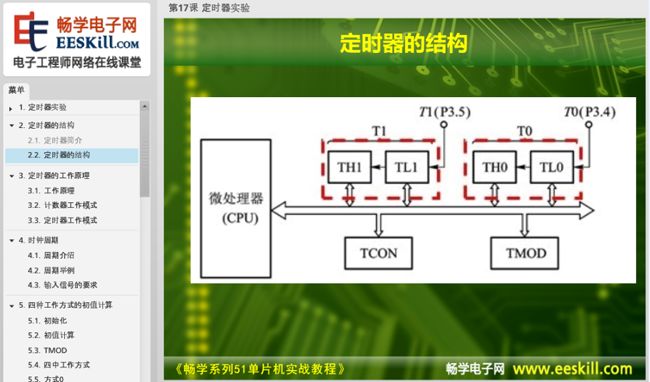
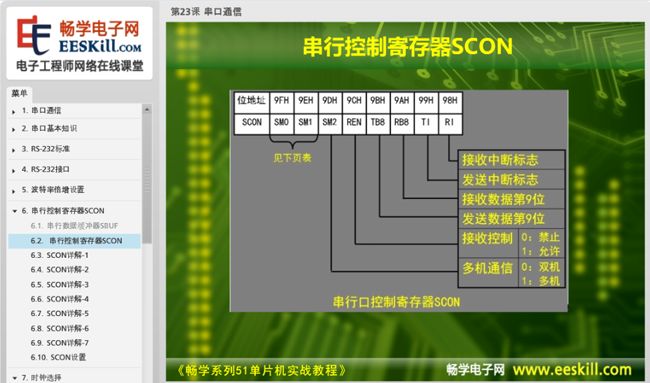
Kind Reminder:
Click the link: http://www.eeskill.com/course/id/1
Or “Read the Original Text” to log in to the Changxue Electronics website to order online and start learning!


To facilitate better learning for everyone, Changxue Electronics has specially added a public account for microcontroller and EDA, pushing related knowledge daily, hoping to assist your studies!