 Click the above“blue text” to subscribe
Soil is the natural environment for plant growth, containing a rich pore structure. As a substitute for soil, hydrogels can directly provide water, nutrients, air, and support for root systems. However, hydrogel growth media lack a fine pore structure. Recently, Researcher Men Yongjun from the School of Materials Science and Engineering at Donghua University and the National Key Laboratory of Advanced Fibers achieved a breakthrough by using3D printing technology to construct a new strategy for the pore structure of hydrogel plant growth media.This strategy employs direct ink writing (DIW) 3D printers and polyethylene glycol/carbomer composite ink to print structures with adjustable and precisely distributed pores, with planting experiments showing enhanced effects on plant growth. This strategy not only provides a practical solution for the pore structure of soil-free hydrogel growth media but also opens new avenues for the application of3D printing technology in agriculture or plant fields.

The related work was published in the “3D-printed hydrogel substrates with tailored pore architectures enhance root development and elicit species-specific growth responses” in the Chemical Engineering Journal. The first author is Li Junfu, a master’s student from the School of Materials Science and Engineering at Donghua University, class of 2022.
3D printed hydrogel substrates with customized pore structures promote root development and induce species-specific growth responses
Pores not only provide a suitable living environment for soil animals and microorganisms but also serve as transport channels for gases, water, and nutrients. Recently reported hydrogel plant growth media often use small spheres to construct pores, providing a breathable structure for plant root growth. However, stacked pores lack precise dimensions and control, so researchers utilizedDIW 3D printing technology with polyethylene glycol/carbomer (PC) hydrogels to print plant growth media structures with precise pore sizes. ThisDIW printer has the advantages of low cost and ease of operation, reducing the cost of this strategy.PC hydrogel material has a low solid content (minimum content of2.23%), excellent rheological properties, and a crosslinking method through freeze-thaw cycles, ensuring the accuracy of the printed structure. Importantly, compared to non-porous structures, this“porous” hydrogel growth medium increased the number of root tips of tomato roots by86.7% and root length by140%.
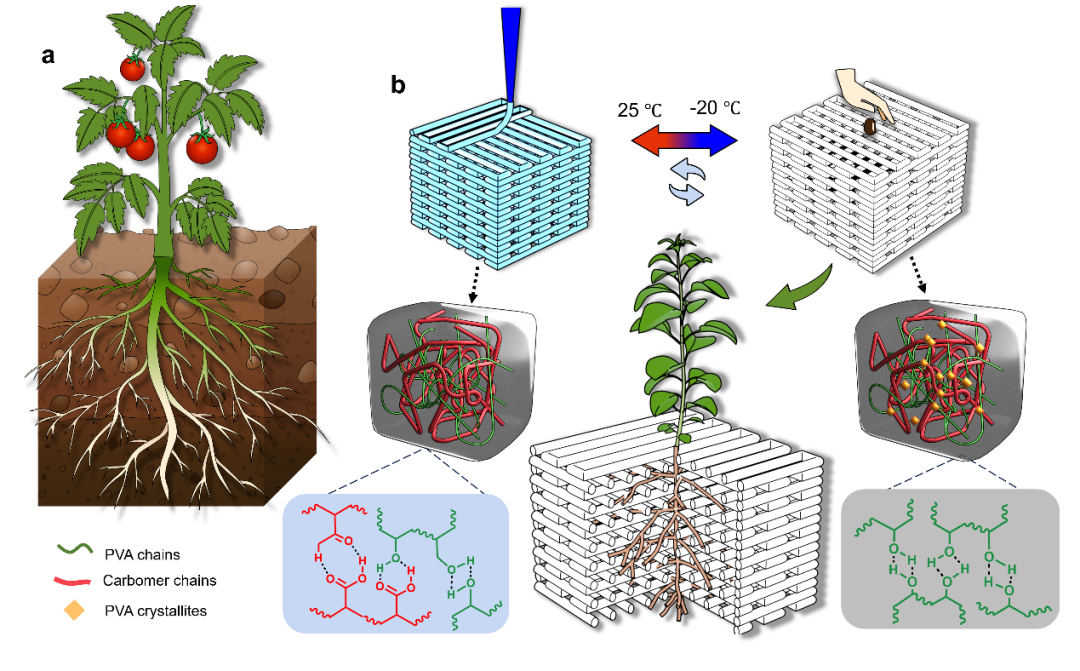
Figure 1 (a) Tomato plants growing in traditional soil; (b) Schematic of PC hydrogel printing, crosslinking, and plant cultivation process.
Rotational rheometer and actual printing performance tests demonstrated the excellent printing performance ofPC ink. Rheological performance tests showed thatPC ink has the advantages of shear-thinning, yield stress, and thixotropy, indicating thatPC ink is a non-Newtonian fluid with yield characteristics. In actual printing tests, compatibility tests showed thatPC ink can maintain its non-fusion advantage even at close distances. Suspension tests indicated thatPC ink lines can remain stable at a spacing of16mm.PC ink successfully passed through different diameter nozzles, and the excellent printing structure demonstrated the outstanding printing performance of this ink.
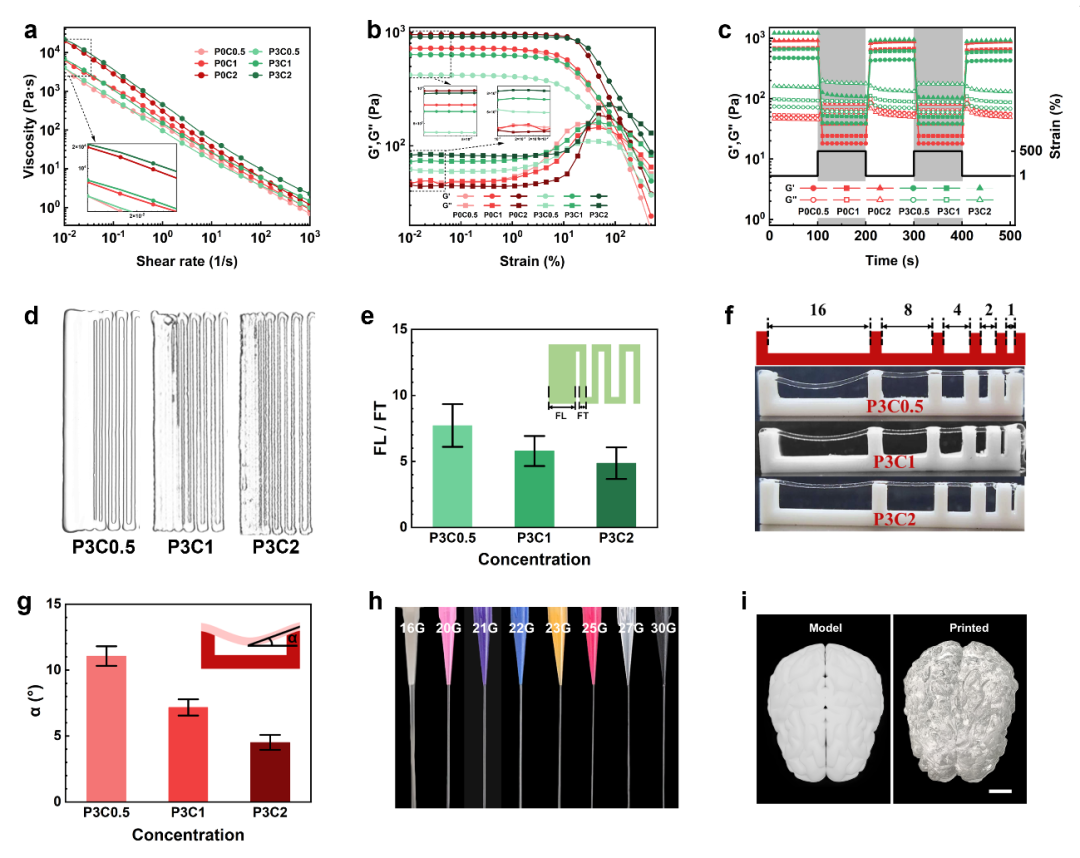
Figure 2 (a) Viscosity of inks with different carbomer contents as a function of shear rate; (b) G’ and G’ as functions of shear strain; (c) Thixotropic characteristics under step shear strain; (d) Printing patterns of inks with different carbomer contents, and (e) Measurement methods and results of fusion performance of printed patterns; (f) Collapse test results of PC inks with different carbomer contents, and (g) Measurement of deflection angle α at a spacing of 16 mm; (h) Extrusion performance of P3C1 ink through nozzles of different diameters; (i) Human brain model (left) and 3D printing results (right).
Compression performance tests demonstrated thatPC hydrogels have a wide range of mechanical properties (15.4~218 kPa). Both changing the formulation of the material and increasing the number of freeze-thaw cycles can adjust the mechanical properties ofPC hydrogels. Additionally, two post-treatment methods further increased the range of mechanical property adjustments. Tests such as swelling rate, water content, XRD, and FT-IR revealed thatPC hydrogels are a type of single-crosslinked interpenetrating network hydrogel.
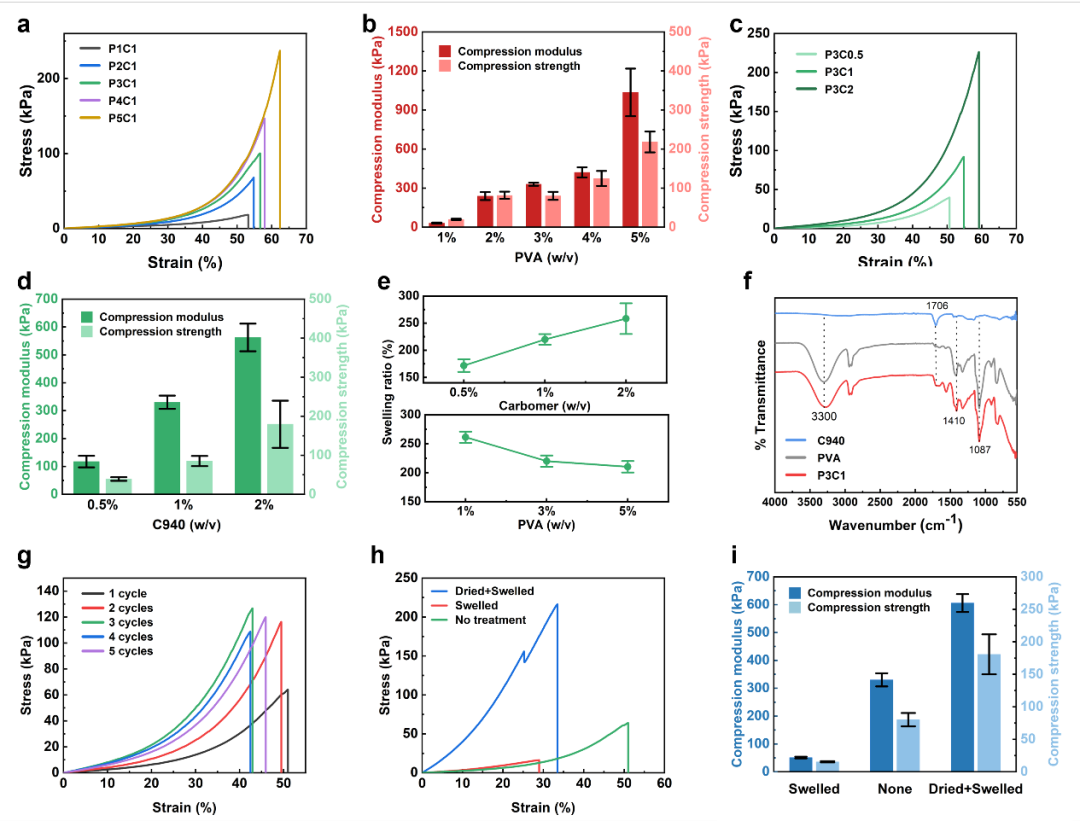
Figure 3 (a) Compression curves of hydrogels with differentPVA contents, and(b) Corresponding compression modulus and strength; (c)) Compression curves of hydrogels with different carbomer contents, and(d)) Their compression modulus and strength; (e)Expansion rates of different hydrogels (n=3); (f)) Fourier transform infrared spectra of Carbomer, PVA, and P3C1 hydrogels; (g)Compression curves of P3C1 hydrogels after different freeze-thaw cycles; (h)Compression curves of P3C1 hydrogels after various post-treatments (swelling or drying and re-swelling), and(i) Compression modulus and compression strength.
To study the effects of different pore sizes on plant growth, researchers designed four models with different pore sizes. Patterns printed at a height of1 mm showed excellent fidelity of the printed structure, with internal pore sizes remaining nearly the same before and after crosslinking of the hydrogel structure, approximately0,1,2 and3 mm. Swelling inevitably affects the pore size of the printed structure, with the pore size of structure III increasing from2.11 mm to3.48 mm, but the pore content remained around23% before and after swelling.
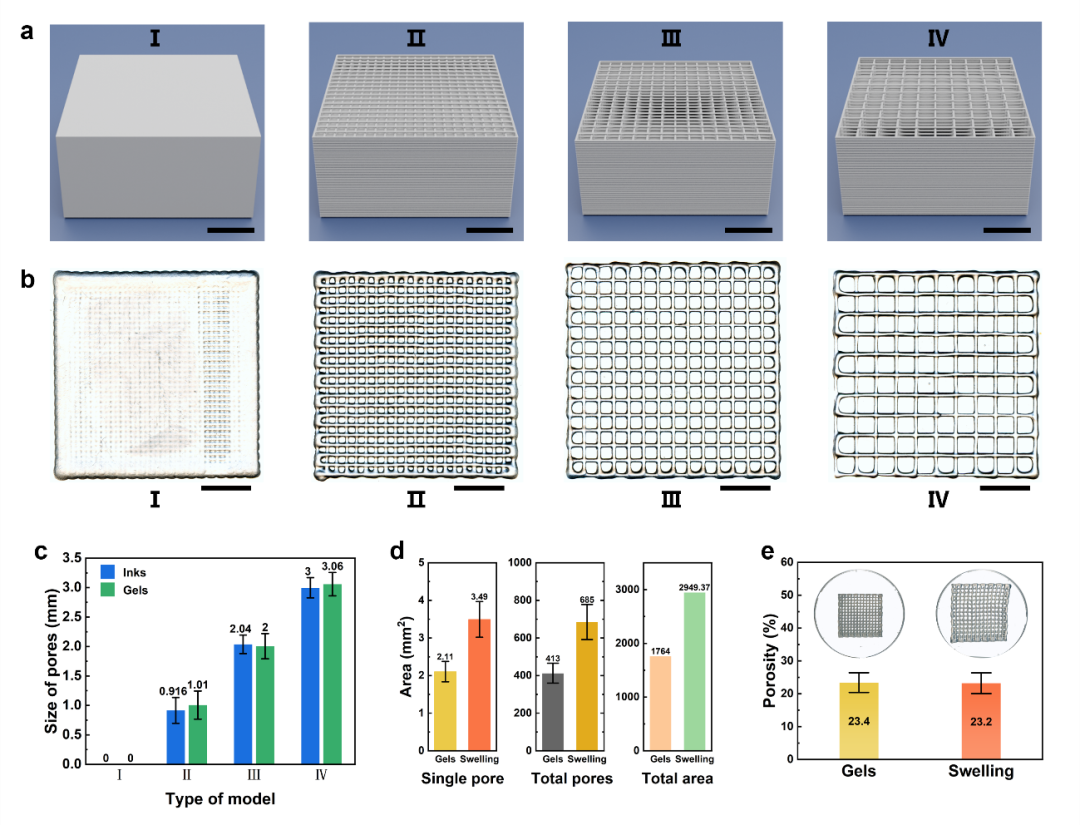
Figure 4 (a) Models with different pore structures; (b) Photo of printed patterns; (c) Average pore diameter of different structures; (d) Effect of swelling on pore size; (e) Pore rates before and after swelling.
Tomato seedling planting experiments after 14 days showed that the growth condition of tomato seedlings on non-porous and structure IV hydrogel growth media was poor, while the growth condition was best in structure III. The number of root tips for structure III was31, which is an increase of86.7% compared to the root tip number of non-porous structure (16.6); the total root length was8.6 cm/cm3, which is 2.4 times that of the non-porous structure.This demonstrates that the 3D printed “porous” PC hydrogel plant growth medium has an enhancing effect on plant growth.
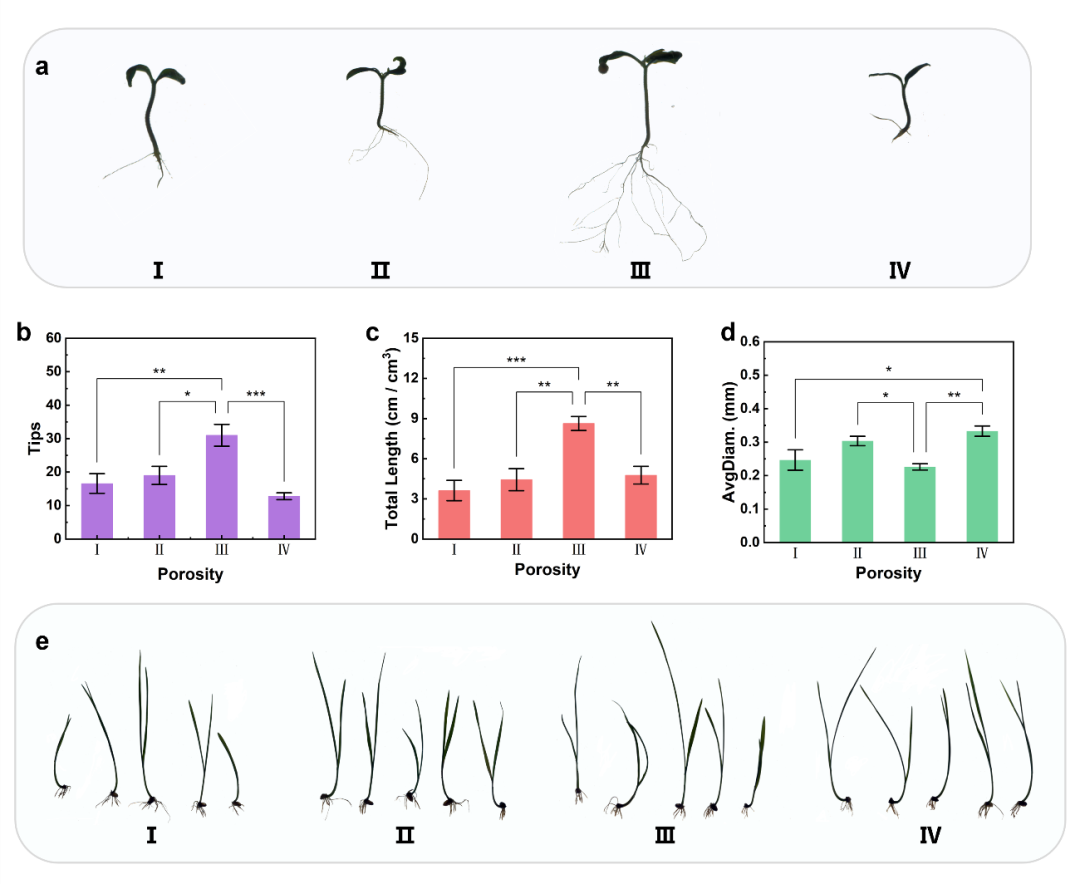
Figure 5 (a) Photo of tomato seedlings after 14 days of growth; (b) Effect of pore structure on the number of root tips; (c) Effect of pore structure on root length; (d) Effect of pore structure on root diameter(n = 5; *P ≤ 0.05, **P ≤ 0.01, ***P ≤ 0.001); (e) Photo of barley seedlings after 14 days of growth.
Author Biography:
Men Yongjun, Distinguished Researcher and PhD Supervisor at the National Key Laboratory of Advanced Fiber Materials, School of Materials Science and Engineering, leading the National Key R&D Program for Young Scientists, Shanghai Overseas Leading Talent, and member of the Innovation Development Working Committee of the Chinese Nonferrous Metals Society. He obtained his PhD from the Max Planck Institute of Colloids and Interfaces in Germany in 2014, under the supervision of Academician Markus Antonietti and Dr. Jiayin Yuan (currently a tenured professor at Stockholm University, Sweden), focusing on functional materials of polyelectrolyte liquids. From April 2014 to October 2021, he conducted research in supramolecular system chemistry with the support of Academicians Jan C.M. van Hest, Daniela A. Wilson, and Professor Rienk Eelkema at Radboud University and Delft University of Technology in the Netherlands. Since November 2017, he has joined the startup Novioponics B.V. as CTO, dedicated to commercializing a thermoresponsive supramolecular hydrogel. He has published over 40 SCI papers in international journals such as Nature Chemistry, Angew Chem, ACS Nano, and Nano Letters, and has been granted and transformed one international patent, with products sold in Europe.
Literature link:
https://doi.org/10.1016/j.cej.2025.162425
Related Progress
Professor Luyi Sun’s team at the University of Connecticut Matter: 3D printing and self-organization to construct multi-scale energy-saving wrinkled surfaces
Sun Yat-sen University Zhang Zeping/Ruan Wenhong/Rong Minzhi/Zhang Mingqiu AM: Dynamic covalent bond-assisted 3D printing of integrated porous cathodes/composite polymer electrolytes – achieving ultra-long life solid-state lithium metal batteries
Qingdao University Yang Wenjun/Sun Qikun team Adv. Mater.: Multicolor, 3D printable ultra-long room temperature phosphorescent PLA materials

This is an original article from Polymer Science and Technology. Personal forwarding and sharing are welcome. For reprints by publications or media, please contact: [email protected]

Call for Submissions
Experts and scholars are welcome to submit manuscripts (papers, project introductions, new technologies, academic exchanges, unit news, conference information, recruitment, and enrollment, etc.) to [email protected], and please provide detailed contact information. Polymer Science and Technology® will promptly push and publish on the China Polymer website.
Welcome to join WeChat groups To meet the needs of colleagues in the polymer industry, we have opened dozens of special discussion groups, including a group for polymer experts and scholars, covering various fields such as polymer industry technology, entrepreneurs, PhDs, graduate students, media journals, and exhibition associations, gathering thousands of top experts, scholars, technicians, and entrepreneurs from domestic and foreign universities and research institutes.
To apply for group entry, please first add the review WeChat accountPolymerChina (or long press the QR code below), and please be sure to indicate:Polymer + Name + Unit + Title (or Degree) + Field (or Industry), otherwise, it will not be processed. Qualification will be reviewed before entering the relevant professional group.

Click
here to “read the original text” for more information