
Compared to CPUs and GPUs, which have shipment volumes in the tens of billions and a market scale reaching hundreds of billions of dollars, FPGAs seem somewhat “niche”— their global market size is only about ten billion dollars.
However, in the journey of domestic chip independence, this seemingly inconspicuous chip carries significant weight, often becoming the focus of public discussion.
 01FPGAs: A Battleground
This year marks the 40th anniversary of the first commercial FPGA. At that time, it introduced the concept of reprogrammable hardware for the first time. By creating “hardware as flexible as software,” the reprogrammable logic of FPGAs has completely changed the landscape of semiconductor design.
FPGAs have three main characteristics:high programmability and flexibility,short development cycles, and parallel computing.
First, unlike ASICs with fully customized circuits, FPGAs belong to semi-custom circuits. Theoretically, if the gate circuit scale provided by the FPGA is large enough, it can implement any logic function of ASICs and DSPs through programming. Additionally, programming can be repeated, unlike ASIC designs which are fixed and cannot be modified after completion. Therefore, FPGAs also have higher flexibility.
Secondly, the manufacturing process of ASICs includes multiple steps such as logic implementation, routing, and tape-out, while FPGAs do not require routing, masks, and custom tape-out, simplifying the chip development process. The average design cycle for traditional ASICs and SoCs is between 14 to 24 months, while using FPGAs can reduce development time by an average of 55%. The world’s largest FPGA manufacturer, Xilinx, believes that being faster is more important than being cheaper; launching a product six months late can result in a 33% profit loss within five years, equating to a 14% market share loss every four weeks.
Finally, FPGAs belong to parallel computing, allowing multiple instruction algorithms to be executed simultaneously. In contrast, traditional ASICs, DSPs, and CPUs are serial computing, processing only one instruction set at a time. Therefore, in certain special tasks, the parallel computing efficiency of FPGAs is higher than that of serial computing.
The rise of FPGAs is not a single breakthrough but the result of three technological revolutions: mobile communication, artificial intelligence, and industrial internet.
5G commercialization has become the first explosion point. The number of channels that 5G networks need to process is more than 10 times that of 4G, and it needs to support flexible bandwidth adjustments and multi-standard compatibility. Using FPGAs for base station baseband processing can significantly shorten the R&D cycle and greatly reduce early deployment costs.
The rise of AI edge computing has elevated FPGAs to a new level. Cloud training relies on the massive parallel computing of GPUs, but real-time inference at the edge emphasizes low latency and low power consumption. For example, FPGAs are particularly suitable for AI inference acceleration in IoT devices such as smart cameras and sensors.
Industrial digital transformation opens up long-term growth space. Industrial robots, smart sensors, and other devices need to process a large amount of non-standard data and have strict reliability requirements. The radiation resistance and wide temperature characteristics of FPGAs make them an ideal choice for industrial control..
02High-End FPGAs: Crowded with Leading Companies
In the FPGA market landscape, the strong position of American companies has long been embedded in the industry DNA.Xilinx and Altera have built a dual-monopoly high wall, while Lattice and Microchip follow closely behind, together consuming over 90% of the market cake.
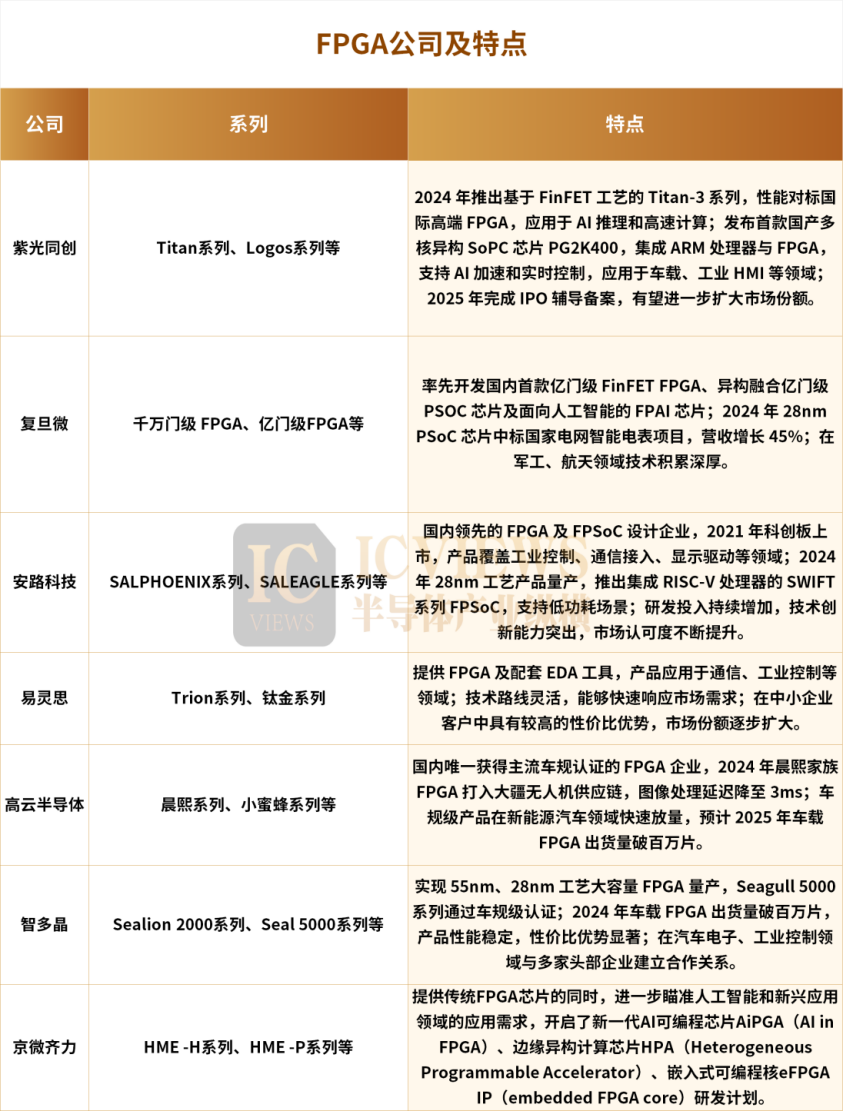
In the domestic market, Unisoc, Fudan Microelectronics, and Anlogic Technology form the first tier, striving to catch up in the race.
From communication equipment to high-definition video processing, from data centers to industrial control, high-performance FPGAs are key nodes that cannot be overlooked. They are not only flexible reconfigurable “universal controllers,” but also the “throat of the system” that controls efficiency, data throughput, and security isolation.
However, in terms of specific FPGA product classification, the mid-to-high-end market is almost still the exclusive territory of international giants, and domestic solutions always lack the “hardcore strength” to compete directly.
So what are the criteria for evaluating mid-to-high-end FPGAs? How are international manufacturers progressing??
Process technology is the standard for distinguishing generations of FPGAs and is the first indicator to consider when evaluating FPGAs. As a type of digital chip, FPGAs follow Moore’s Law, with new generations of products launched every 2-3 years on average. Using more advanced processes can reduce power consumption, shrink chip size, and lower unit costs, making the performance of the new generation of FPGAs typically superior to that of the previous generation. Therefore, the process must be considered first when evaluating FPGAs.
-
Currently, Xilinx’s most advanced product, “Versal,” uses TSMC’s 7nm FinFET process.
-
Altera’s Agilex 3 series FPGAs are based on Intel’s 7nm process.
The number of logic units represents the basic capacity of FPGAs and is currently the unified metric for evaluating the basic capacity of FPGAs. The minimum functional unit of an FPGA is called a basic logic unit, which includes one LUT and one register. The programmability of FPGAs is based on the LUT, which can implement combinational circuits, and combined with registers can complete sequential circuits, meaning that a logic unit has the capability to perform all digital circuit functions. Therefore, the more logic units there are, the larger the capacity of the FPGA, and the larger and more complex the circuits that can be constructed. Large-capacity FPGAs directly reflect the technical capabilities of manufacturers. Because the number of logic units in large FPGAs is generally above 1kk, when the number of logic units exceeds 1kk, changes need to be made to the FPGA architecture, including LUTs, CLBs, and interconnections; otherwise, power consumption and delay will directly spike. In addition, supporting EDA tools and layout routing algorithm iterations are also required. Currently, among the top five FPGA manufacturers globally, only Xilinx and Altera have the capability to continuously provide large-capacity FPGA product lines.
-
Currently, the largest capacity FPGA in the world is AMD’s VP1902 (Versal Premium), launched in June 2023, with a logic unit count of up to 18,507k (18kk).
-
In April of this year, Altera announced the official mass production of the Agilex 7 M series FPGAs, which are the industry’s first high-end FPGAs integrated with high-bandwidth memory (HBM2E) and supporting DDR5/LPDDR5 technologies, providing disruptive computing power support for AI inference, 5G communication, and 8K video processing scenarios.
In terms of process, the most advanced domestic FPGAs currently operate at 14/16nm.
In terms of capacity, Chinese manufacturers have developed relatively mature technology for low-capacity FPGAs. Low-capacity FPGAs refer to FPGA products with logic units below 100k. In fact, most low-capacity FPGAs have logic units within 10k, mainly used in consumer electronics, such as LED displays, bridging, and some reserved or functional expansion scenarios. Currently, domestic low-capacity FPGA processes mainly focus on the three nodes of 55nm,40nm, and 28nm, most of which were launched in 2019 and earlier, often being the first-generation products of local FPGA manufacturers.
For example, the Logos series from Unisoc was launched in 2017, featuring a low-power, low-cost FPGA at 40nm, with logic units ranging from 12-102k. Anlogic Technology’s 55nm Eagle4 was launched in 2016, with 20k logic units, mainly used in servo control and high-speed image interface conversion; and the 55nm FPGA LittleBee from Gaoyun Semiconductor, launched in 2016, is the company’s first-generation product with logic units ranging from 1-8k.
In the 28nm mid-to-low capacity market, Chinese FPGA manufacturers also have mature products. Mid-capacity FPGAs mainly refer to FPGA products with logic units between 100k-500k, with applications concentrated in the air interface of wireless communication, industrial, automotive, and A&D fields. The mid-capacity market does not pursue the highest performance; performance and power consumption are equally important, and there are certain cost requirements. For example, Unisoc, Anlogic Technology, and Zhiduo Crystal all launched 28nm FPGA products in 2020, mainly targeting Xilinx’s 7 series products.
Additionally, some manufacturers have launched 22nm FPGAs to correspond to some 28nm mid-to-low capacity FPGAs. For example, Gaoyun launched the Aurora V in September 2022, which is its 22nm FPGA product with a logic unit count of 138k..
Currently, high-capacity FPGAs are a challenge for domestic production.
03High-End FPGAs: An Important Opportunity
The global high-end FPGA market is mainly occupied by Xilinx and Altera, with representative products including Xilinx’s 7nm ACAP Versal, 16nm Virtex Ultrascale+, and Altera’s 10nm (Intel 7) Stratix 10 and Agilex. These products are expensive and represent the highest level of FPGA performance, density, and integration.
High-end FPGAs are not only the core carriers of profit and competitiveness but also a necessity for technological iteration.
On one hand, the low-end market has a lower threshold, leading to overcrowded competition that compresses profit margins and makes it difficult to form stable advantages. In contrast, the high-end market, with its high added value, has become the “main battlefield” for manufacturers. For example, Altera’s high-end Stratix series accounts for over 50% of its revenue. This structural profit distribution determines that if a company wants to dominate the industry, it must make breakthroughs in the high-end field. At the same time, the technical barriers of high-end products can effectively block new entrants, providing support for building long-term competitive advantages.
On the other hand, high-end FPGAs are a “necessity” for adapting to the upgrading of emerging industries. With the rapid development of fields such as 5G communication, artificial intelligence, and autonomous driving, higher requirements are placed on chip performance, integration, and flexibility. High-end FPGAs adopt 20nm and more advanced processes, with logic unit counts exceeding one million, integrating heterogeneous components such as CPUs and high-speed interfaces, meeting the needs for high-frequency data processing and complex scenario collaborative computing, which are difficult for low-end products to achieve.
Domestic FPGAs still have a gap in the high-end market, but domestic companies have initially entered this field.
In terms of process, FPGAs are currently accelerating towards 16nm and more advanced nodes, with the competitive advantages brought by technological generational differences becoming increasingly apparent. Domestic FPGA companies have already achieved results related to 16nm and below. Yilingsi launched the 16nm FPGA Titanium series in July 2020, with a maximum logic unit count of 176k, becoming the first domestic FPGA product in the 16nm field. According to news from Unisoc’s official website, Unisoc has initiated the R&D of 14nm billion-gate high-end FPGAs. Fudan Microelectronics began R&D on 14/16nm products in 2021, and in 2023, its 1xnm process billion-gate FPGAs completed small batch trial production, entering the user trial phase and achieving small-scale sales.
High-capacity FPGAs above 500K remain a challenge for domestic production. Fudan Microelectronics’ 28nm billion-gate FPGA is the first in the country, containing about 700K logic units, integrating SerDes (up to 13.1Gbps), DDR4, hard-core ARM, and AI acceleration modules, targeting Xilinx’s Zynq series, and applied in fields such as communication core networks, medical devices, and automotive electronics.
Wuxi Zhongwei Yixin specializes in high-performance FPGA R&D, with products including YX5F200T, used in industrial control and aerospace; in 2024, the 16nm FPGA trial production was successful, with a logic unit density of 500K..
The localization of FPGAs is a challenging task that requires steady progress. As an important part of the digital hardware field, its significance in the localization process is not diminished by the market scale being smaller than that of CPUs and GPUs.