Committed to the research and development of digital twin technology
Benefiting humanity through solutions and engineering applications
Source: Aerospace Defense Observer
Author: Li Liang
Introduction:
“The eT-7A Red Hawk trainer has successfully achieved virtualization in its development, creating hundreds of e-planes digitally, optimizing physical assembly. Using virtual design, the new intercontinental ballistic missile explored 6 billion variants of e-missiles in just a few months. The sixth-generation aircraft is also an e-plane, adopting the practices of Formula 1 racing to surpass development in a digital century series.”
—— Dr. Will Roper, former Assistant Secretary of the Air Force for Acquisition, Technology, and Logistics
At the end of 2020, then-Assistant Secretary of the Air Force Will Roper released “No Spoon Yet: The Reality of Digital Acquisition,” calling for a disruptive and agile new paradigm for digital acquisition through digital engineering to maintain competitiveness in an ever-evolving global security landscape. The document proposed the e-series concept, or the Digital Century Series (abbreviated as eSeries).
In early 2021, Roper released “Bending the Spoon: A Guide to Digital Engineering and the e-Series,” further clarifying the digital engineering implementation ideas for e-series equipment, to guide the digital transformation of equipment acquisition and development. Both documents referenced the famous sci-fi movie The Matrix, using the metaphor of the spoon that can be bent by thought in the virtual world of the movie to illustrate digital engineering. To this day, the Air Force’s acquisition officials, software project teams, and digital project teams still regard Roper’s two strategic documents as a guiding principle, demonstrating that discussions inevitably revolve around the spoon and actions inevitably learn from digital practices. This article translates and reinterprets parts of “Bending the Spoon.”
1. Digital Acquisition and Basic Principles of Digital Engineering
“Digital Trinity” — digital engineering and management, agile software development, and modular open system architecture are the key forces supporting the U.S. military’s significant paradigm shift against the backdrop of deep integration of new-generation information technology and military technology, and are considered by the U.S. military as the main means to disrupt traditional defense acquisition. This paradigm shift can not only build better systems but also enable faster design, seamless capability integration, and iteration.
The question is, what are digital engineering and the e-series? Is modernization of equipment necessary? What criteria should be followed? How far should related changes go?
Many large-scale applications of change and innovation face resistance at the outset, such as the electric light, which will inevitably replace oil lamps, was also rejected by many at the beginning. The current transformation towards the future faces the same issue, where details are the devil.
The transition from traditional acquisition to digital acquisition is very tricky. Open architecture and agile software development are somewhat easier, as they only differ in usage. Digital engineering is more challenging, as it must also consider adjustments in application intensity and depth. Not everything related needs to be digitized; it is necessary to judge which aspects have digital value.
Digital engineering is both a science and an art. What exactly is this art, and what are its criteria? The strict definitions of these are also very challenging. Art has basic, widely recognized principles that often change over time; digital engineering is no different. The first principle that digital engineering must follow is: the authoritative level of virtualization that digital engineering must achieve, allowing it to replace, automate, or simplify activities originally conducted in the real world, especially in the e-series.
2. Digital Engineering as Both Science and Art
The sustainability of U.S. military equipment development is increasingly poor, characterized by constantly delayed plans and rising costs, in stark contrast to developments in commercial industries, which are very lackluster.
In this situation, the new technology of digital engineering brings magical hope to equipment acquisition in a practical way.
Virtual reality computer technology applications are just part of the e-series formula. The real art comes from observations of the real world. Just as architects study civil structures, digital engineers study physical systems, conducting virtualization processes, virtual learning, and perfecting these systems to automate the processing, thus executing originally expensive trials and errors on computers.
The effects of virtualization feedback have greatly impacted the real world. For example, the eT-7A trainer designed digitally required only 36 months for the design and manufacturing process, which has never been achieved since the development of third-generation fighters in the 1950s. The same digital methods have also been applied to the most advanced sixth-generation fighter program, with its demonstration aircraft completed years ahead of schedule.
Digital engineering technology is also an art, a new method of analyzing and capturing the real world. If misused, it can lead to terrible results. Like construction engineering, the safety and success of a project depend on reliable methods to ensure that designs can truly translate into reality. Just as we trust the role of architectural design when entering a newly built building, the methods required for digital engineering and the e-series are similar to those in architectural design: how to ensure that the equipment built through digital design is trustworthy.
Looking back at history, the method of designing before building in architecture has developed in conjunction with technologies that improve engineering execution. Filippo Brunelleschi used mirrors and geometry to generate perfect linear perspective 3D drawings. Leonardo da Vinci studied physics to create modern technical drawings for complex systems. Frank Gehry uses computer-aided design to complete his architectural challenges. In science fiction, artificial intelligence uses neural interactive computer simulations to build the “Matrix” (the virtual world in The Matrix).
Although it is not yet possible to model like in the “Matrix,” digital engineering has indeed elevated computer innovation technologies to a new level, capable of not only virtually rendering complex system designs but also rendering assembly, environments, and even physical performance to a higher level in virtual reality. The famous modern architect Mies van der Rohe once pointed out that “whenever technology is truly practical, it will leap into architectural design.” Digital engineering is leaping into four-dimensional architectural design — a three-dimensional design system plus a time-driven process architecture, managing their virtual realities long before physical twins appear.
When transitioning from planning to implementation, the relationship between architectural design and engineering implementation is worth studying. An early typical success case is Brunelleschi’s design of a new engineering marvel to complete the 150-foot (about 46 meters) long dome of Florence when building the world’s largest brick dome in 1420: using two domes to avoid buttresses, bricklaying in a novel self-supporting pattern, and even inventing very sophisticated cranes and pulleys, which were later studied by da Vinci.
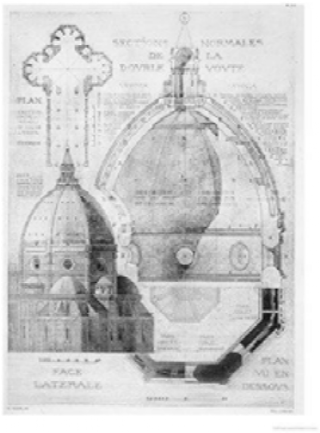 Brunelleschi’s design of the world’s largest brick dome in 1420
Some projects, however, ended in disaster. The disaster caused by the cracking of the St. Francis Dam, the collapse of the Tacoma Narrows Bridge, and the falling windows of the John Hancock Tower are all cautionary examples of architectural design, providing insights into the reality of engineering. Even with extensive use of computer modeling, MIT’s Stata Center did not account for drainage, mildew, snow load, etc. Even future artificial intelligence may not succeed in building the “Matrix” on the first attempt. Thus, Brunelleschi said, in architecture, “only practical experience can teach us the rules we should follow.” Even with computers, true real-world analysis remains challenging.
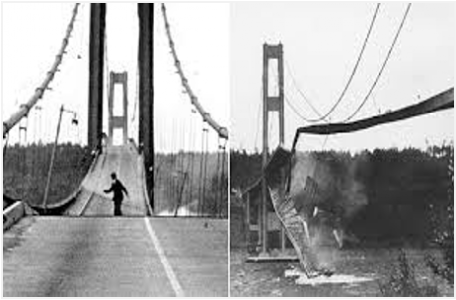 The Tacoma Narrows Bridge, once the third largest in the world, collapsed due to twisting from high winds four months after its completion, becoming a classic case study in architecture, physics, and mechanics
Until recently, industries like automotive have taken the lead in using digital technologies for design and manufacturing practices. Since the 1960s, computer-aided design tools have been widely used but have never replaced physical prototypes and testing in the design-to-realization process. Since then, with a billionfold increase in computer processing power, early blueprint tools have evolved into today’s powerful digital engineering models — the so-called digital threads and digital twins — replacing physical prototypes and testing with authoritative virtual truths.
A great example is Formula 1 racing, where there are currently no physical prototypes. Every function of the car and its reliance on physical reality, including the contact of rubber tires with the road, has been determined and virtualized through rigorous testing data. The advantage is that currently, designers explore improvements to hundreds of digital cars every season, optimizing for individual tracks without needing to bend a piece of metal. Real-world racing competitions validate the authority of these “e-cars.” Military e-series can achieve the same effect.
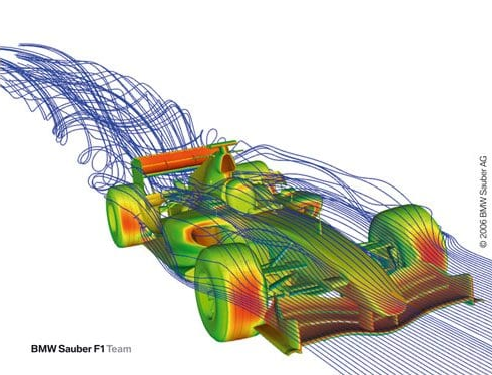 Airflow around a Formula 1 car, image from BMW F1 Team
3. How to Achieve — Bending the Spoon
The eT-7A Red Hawk trainer has successfully realized virtualization in its development, creating hundreds of e-planes digitally, optimizing physical assembly. Using virtual design, the new intercontinental ballistic missile explored 6 billion variants of e-missiles in just a few months. The sixth-generation aircraft is also an e-plane, adopting the practices of Formula 1 racing, surpassing development in a digital century series.
All these practices that utilize digital technology to refine physical designs indicate that the application of digital engineering technology is revolutionary for both equipment and even nations.
So, how to start? Given that the primary principle of digital engineering is authoritative virtualization, it must be defined and the digital foundation built.
1. Establishing a Digital Foundation
Like any new architecture, it must start from the foundation it is built upon. The digital foundation we need must support the infrastructure, policies, training, and culture for digital acquisition, digital engineering, and the e-series.
A strong digital foundation itself requires independent guidance. The Air Force’s Acquisition Command and Space Systems Command have already begun this work. The foundational work includes: providing tools and connectivity through comprehensive departmental infrastructure, formulating policies to ensure data and digital tool sharing after foundational technology changes, conducting training for effective tool use, and building a culture to achieve these goals. Without them, there can be no establishment of a digital foundation. Like physical entities, digital architectures must be based on a solid digital foundation.
Once the digital foundation is established, core components can be created for digital engineering and the e-series: authoritative virtualization.
2. Authoritative Virtualization
Authoritative virtualization is a systematic digital model that renders calculations of its inputs, operational environment, internal functions, and behaviors, while containing digital models of all subsystems necessary to achieve these rendering calculations, forming verifiable predictive outputs.
This definition contains many elements that require further explanation and includes several important principles to ensure that virtually bending the spoon can produce the same results in the real world.
First, because inputs affect outputs, according to this definition, it may also imply that inputs must be authoritatively virtualized, which may indeed be the case in many complex systems. However, certain input characteristics can also be explained using physical data (such as environmental impacts as inputs) or empirical data (such as manufacturing part tolerances or software run times). The key principle is that every system virtualization has a starting point, which can also be referred to as the basic building block of the system, and these basic building blocks must be quantifiably explainable. Otherwise, your digital thread is not digital from the outset.
For acquisition projects related to existing systems, it is not that digital art cannot be applied; rather, its virtualization starting point is an existing system that needs to be analytically determined. For example, for the B-52 engine upgrade project, the starting point is the digital engine “connected” to the physical wing’s pylon base, as well as the measured center of gravity and airflow characteristics of the jet engine. For the A-10 wing replacement project, the entire wing, or even the entire aircraft, must be digitally presented, as the original manufacturer’s drawings (the authoritative source of truth) have been lost. For countless condition-based maintenance projects carried out by the Rapid Repair Office, the starting point is not the original aircraft but rather the digitized maintenance data, allowing modeling and predicting when parts will fail and training maintenance personnel. Each of these is a form of authoritative virtualization, as they reduce or simplify the time-consuming work in the real world through verifiable predictive modeling.
No matter what project, there will be some form of related digitalization case. Just understanding the digital starting point and the expected return on investment will clarify the significance of digitalization.
Second, as previously mentioned, virtualization also includes the environment. Whether internal or external, if the operating environment impacts outcomes or performance, it must be modeled based on physical rules (like gravity) or explained using empirical data. This is similar to handling inputs; it must be analyzable and understandable, so that digital threads and digital twins can be applied in a practically usable digital world.
Third, regardless of what is being virtualized, if it contains internal units that affect outputs, these internal units must also inherit the same analytical principles, requiring authoritative modeling or the use of anchored data verification. Continuously applying this principle until the output matches reality will ultimately form a truly virtual reality like the “Matrix,” not an illusion. Digital twins and digital threads are by no means digital panels that obscure internal simulation logic.
This does not mean that everything in the system must be modeled, nor does it mean that all sub-models must have the same fidelity. As long as the final error line confirms that the virtual can replace reality, success is achieved.
Do not be bound by inaccuracies or unknown errors. When building or testing physical systems, statistical distributions need to be created rather than perfectly cloning all components or tests. Apply sigma, 2 sigma, and higher-order effects to quantify risks to ultimately prove that the system can operate. Models must accurately reflect these distributions (if distributions are available); otherwise, replication of the real world is still necessary. This is why virtualization requires formal standards and methodologies, as replacing physical actions with virtual behaviors can introduce new acquisition risks, which can be significant. Setting and following explicit digital “construction specifications” for authoritative virtualization can ensure that the Air Force and Space Force can understand and manage this risk.
Moreover, once such virtualization is achieved, many root causes of these statistical distributions can be effectively addressed. (Think about how deterministic assembly technologies eliminate the scrap, rework, and maintenance statistics of the eT-7A.) The ultimate goal is not to replicate yesterday’s reality but to create a more successful tomorrow, just like in Formula 1 racing.
3. Digital Construction Specifications
Fourth, just as architects and engineers adhere to government-certified building codes, digital models and infrastructure must also comply with similar “digital construction specifications,” which are certified by the Air Force and Space Force. This is the core of “owning a technology stack” and is crucial because, apart from cost, the model determines the safety and success of the mission.
Just as building codes can ensure safety for new constructions, digital construction specifications must ensure that the real physical systems produced by the model are reliable upon first use.
Currently, digital construction specifications require project-by-project assessments. To “own a technology stack,” there must at least be government reference architectures for building foundational models and software. From the perspective of software and automation, it is best to provide the digital environment itself, which is the best way to implement digital construction specifications, especially after scaling.
Digital construction specifications have a long way to go. With the development of foundational technologies, pioneering projects will need to continue to help explore the right tools and technologies for a considerable time in the future. We must learn from practice, which can sometimes be challenging, but only by doing so can enterprise-level practices be achieved.
“Digital construction specifications” apply to all new acquisition projects as well as significant improvement projects for existing systems. Exemptions from the milestone decision authority are required not to apply this specification; otherwise, it will effectively lead to an invasion of the existing “Matrix.”
The milestone decision authority will simultaneously use the e-series design standards scorecard and digital construction specifications in e-series designs. These are equivalent to the checklists used by building inspectors, with the milestone decision authority acting as the inspector. Acquisition projects should undergo verification of digital engineering methods during their acquisition strategy reviews while evaluating whether they belong to the e-series.
4. Automation, Government-Provided Technology Stack
Fifth, automation is a special case of virtualization, with a unique ability to accelerate digital acquisition.Although nearly all functions within the project lifecycle can be virtualized, not all functions can currently be automated. Robotics may have revolutionized the automotive industry and even entered the defense sector like digital engineering, but the manufacturing of stealth fighters and satellites is still far from such a high level of automation.
However, many things can be automated, and some are already automated. Especially in software factories, such as Kessel Run, Kobayashi Maru, Cloud One, and Platform One technology stacks. Cybersecurity checks and operational authorizations, which were originally performed by humans using paper checklists, now form digital checklists set by the technology stack itself, establishing “as a service” aaS (for example, Software as a Service SaaS, Platform as a Service PaaS, Infrastructure as a Service IaaS, etc. — translator’s note) (not one-off, but continuous). Although integrated development, security, and operations (DevSecOps) software development has become a major acquisition driver, automation technology can further accelerate other lifecycle functions.
The question should be “What cannot be automated?” Design reviews, contract drafting and definitions, selective testing, documentation writing, etc., most things can all or partially be turned into aaS scripts. In fact, this approach has great potential to save a lot of time, and thus, high-survivability air operations centers are leading the charge on “automation phase” projects. Companies will propose measures to improve the automation of the technology stack as a means to accelerate delivery while reducing costs and risks. (No one thinks that after the digital revolution, the acquisition stages will remain the same, right?)
As long as no human judgment or critical thinking is required, anything that can be turned into a computer checklist can be automated. It is not enough to manually complete these checklists for single projects; necessary preliminary technical stack abstraction work should be conducted before creating automated checklists, and this additional preliminary work will continue to play a role. Imagine the benefits that widespread automation could bring to project and functional acquisitions!
Even if human resources are still needed to supervise the outputs of automation, the net savings in human resources can be game-changing. Commercially, automation has allowed increasingly smaller development teams to manage larger and more complex product lines, and it is expected that similar trends will emerge in defense projects. When the previous Cold War task personnel systems broke down large tasks into subtasks, support units, and sub-units, ultimately completed by a group of people at human speed, this approach also fragmented long-term competitiveness. This is the loss of human speed. Authoritative automation is the opportunity to change the status quo.
This raises the second question: “How to make automation authoritative?” Here, a government-provided technology stack is required. Providing a “government aaS” layer enables the entire industry to better manage and control projects, especially those with clear delivery timelines. From any legal perspective, authoritative automation can reflect government intentions, replacing today’s human paperwork. Just like in the “Matrix,” if this is to be done, it means strict configuration control and validation testing, which will pose a significant risk challenge for the government in accepting automation.
This does not mean that the industry does not need its own technology stack; these technology stacks should be designed for seamless interoperability, realizing digital construction specifications. However, in the foreseeable future, the industry’s IT technology stack will not be granted the same legal status as the government technology stack.
Therefore, if authoritative virtualization is to be conducted, a technology stack design must be possessed; however, if we want to achieve automation through official “government aaS” functions, a technology stack must be provided, at least also requiring a technology stack for the automation layer to be provided to the industry to overcome legal mechanism issues.
This challenges previous IT procurement and government IT positioning, responsibilities, and concepts. This is a crossroads, where it can be seen that the previous method of outsourcing to the industry at the lowest price technically feasible has no future. Whether now or in the future, information technology (IT) is both operational systems and infrastructure. Utilizing code, data, and artificial intelligence to build automation capabilities can achieve machine speed on the battlefield, creating war advantages. Therefore, it cannot be regarded as a commercially viable technical product but must be oriented towards procurement that transcends.
Using this infrastructure capable of winning wars to conduct automated procurement for winning great power competition is a win-win for both government and industry. The impressive automation achieved in the commercial sector through Fourth Industrial Revolution technologies is crucial for defense to keep up with this technological trend, even a matter of life and death. Like artificial intelligence, automation technology is also accelerating development.
5. Testing, E-Series Artifacts, and Digital Transformation
Sixth, once the digital code construction of the model is completed, whether it can be used for predictions is closely related to the testing data, which varies significantly between different projects and functions. The virtualized business and contract processes after validation testing have nothing to do with predictions (but do not underestimate their role!). Derivative models based on tested designs may require additional testing to determine performance envelopes. New physical countermeasure combat systems like hypersonic weapons will certainly require ground and flight tests to validate the models.
The second principle here is that no matter how much testing is required, the testing in digital acquisition must revolve around digital transformation. Previously, systems upgraded from models through physical testing; now systems are upgraded to digital models through testing. The operational environment has transformed into a digital environment, as real as the physical environment, or even arguably more real.
Seventh, once the mysterious predictive capabilities are confirmed, preparations can be made to implement the second part of the main principles of digital engineering and the e-series: replacing, automating, or significantly simplifying real-world activities. The art truly begins to play a role, and its impact is unstoppable.
Designs can be virtualized to simplify integration activities, virtualized integrations can replace the convoluted learning processes of the real world, virtualized training can shorten the required time, simulated software updates can avoid lengthy regression tests, and virtualized contract deliverables can reduce the time lag of original paperwork processes… and much more.
Only imagination, digital tools, and training can limit the development of virtualization. Once a project has replaced, simplified, or automated real-world activities through virtualization (the artifacts formed by digital engineering), it will be directly evaluated by the milestone decision authority as an e-series. Art is generally evaluated by the audience, but this art is based on objective, measurable standards. Therefore, if a project changes procurement rules based on digital considerations, it is likely to be named as an e-series.
But why name it? Aside from the safety and mission dependencies on virtualization, conducting e-series certification will drive the Air Force and Space Force’s transformation from simulation to digital. Just as the dial-up internet transformed into the Internet of Things over the past decade, with phones, homes, and cars being labeled as “smart” to guide a new paradigm of interconnected development, allowing designers and users to reset their purposes. Nowadays, almost all power-consuming devices are smart. As it has developed, people have mentioned the “smart” prefix less and less; it has completed its role in countless commercial technology transformations.
The Air Force and Space Force are at the early stage of modular transformation. Every new e-system requires resetting its acquisition and usage methods. A few years later, when most projects achieve digitization and seamless interconnection, the term e-series will be discarded. But like “smart,” this term will promote the procurement system towards a more competitive direction, accelerating the upgrades of equipment required by combatants.
Speaking of the “smart” prefix, joint all-domain command and control (JADC2) and advanced battle management systems (ABMS) also exhibit similar trends. In the first version of the advanced battle management system, the smart refueling aircraft was reset to provide not only fuel on the battlefield but also serve as a data processing and relay node based on the Internet. Subsequently, smart fighters, smart bombers, smart satellites, and smart weapons will inevitably develop, like becoming commercial standards, smart will ultimately become military standards.
With the birth of the advanced battle management system “IoT.mil” and the first demonstration of artificial intelligence on military platforms, the era of algorithmic warfare is beginning. Establishing a truly digital force is crucial, from digital foundations to authoritative virtualization, to e-series projects, and ultimately to intelligent combat systems, cultivating winning algorithms for war at the required speed of digitization, achieving relative or even absolute advantages.
We must pave the way to the future step by step, together.
4. The Next E-Series
According to the standards for bending the spoon outlined above, in addition to the eT-7A, the following projects also meet the e-series requirements: Next Generation Air Dominance (NGAD), A-10 wing replacement project, B-52 commercial engine replacement project (CERP), and Ground-Based Strategic Deterrent (GBSD, the next generation land-based nuclear weapon). Authoritative virtualization can directly replace or simplify real-world activities and achieve performance enhancements through paradigm shifts!
Some space projects, such as those from the Space Rapid Capabilities Office, have also begun to initiate toward e-satellites. We have learned a lot from aviation, and in the future, we will learn a lot from aerospace.
Additionally, the Condition-Based Maintenance Plus (CBM+) project is likely to be named as an e-series, as it has expanded to the Air Force fleet. If this project utilizes authoritative virtualization to transform previously extensive unscheduled maintenance work into predictive maintenance work, it meets all conditions. Of course, it does not necessarily have to become a platform of the e-series.
This leads to the Agile DevSecOps software of the Air Force and Space Force: these are inherently e-series. However, “e-software” seems redundant and unnecessary. Instead, it is necessary to track progress on software development aimed at winning algorithmic warfare within these projects: (i) Agile DevSecOps in process, (ii) containerization in technology and craftsmanship, (iii) machine learning in training and data interaction.
Although these initial e-series projects are not perfect in digitization and will never be, they will all have an impact on the real world.
5. Some Insights
1. The digital transformation of the Trinity will yield enormous benefits. Agile software development can bring automation and standardization to military software development, security, and operations, freeing the software development and application process from human speed constraints, improving software efficiency and effectiveness. The U.S. military views it as the foundation for coordination, interoperability, and reuse of software and artificial intelligence technology applications across services and even the Department of Defense; open system architecture can create a more flexible and easily upgradable system, fostering innovation, expanding the adoption of mature technologies, optimizing the cost, speed, and performance curves of equipment acquisition and application; digital engineering can replace, automate, or simplify real-world engineering activities through authoritative virtualization.
2. Digitization is the foundation for automation upgrades. Only after completing the digitization of the operational objects can the related business automation be advanced. In the environments of books, offices, commerce, and finance, automation started earlier because the digitization of its operational objects (books, documents, currency information, product information) was relatively easy to achieve. Currently, the U.S. military is fully promoting the digitization of equipment acquisition and development, which is more challenging, but once successful or reaching a certain level, it can bring greater automation potential. As mentioned in the article, the manufacturing of stealth fighters and satellites could reach a new level of automation using robotic technologies, similar to automotive manufacturing.
3. The digital transformation of equipment requires refined design implementation procedures and continuous innovation summaries. The digital transformation based on IT and virtualization technologies can significantly reduce real-world activities and also bring many potential risks. Therefore, it is necessary to face history, acknowledge development laws, learn lessons from the digital transformation of the construction and automotive industries, formulate detailed implementation procedures, and continuously innovate and summarize trial and error during the equipment digital transformation process to improve the maturity of related digital technologies.

Video Account “Treading Snow Forum”
Digital Twin is the New Pinnacle of Simulation
The above video is sourced from the video account
Follow “Treading Snow Forum” for more exciting content

Digital Twin Technology White Paper (2019)
On December 27, 2019, the Digital Twin Laboratory and Ansys Asia Pacific jointly released the “Digital Twin Technology White Paper (2019).”
It is hoped that this white paper can provide a reference for industry peers and promote the development and application of digital twin technology in China.
—————- Access Method —————-
1)Follow the Digital Twin Laboratory public account
(DigiTwinLab)
2) Reply to the public account: 2019 White Paper
to obtain the complete 150-page white paper