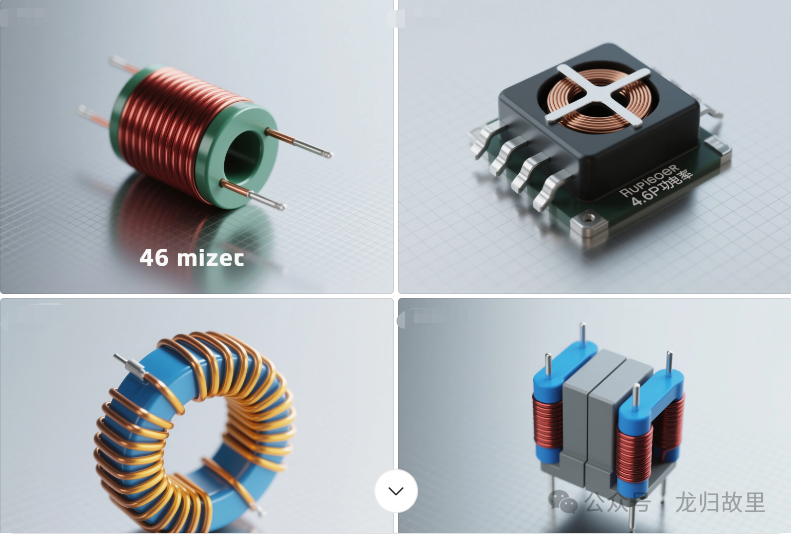
In the current rapid development of IoT technology, inductive components play a crucial role as important electronic components in various IoT devices. They have multiple functions such as filtering, energy storage, oscillation, and delay, with different appearances and connection methods suitable for various IoT application scenarios.
Main Uses of Inductive Components
The core use of inductive components is filtering, which effectively prevents AC signals from passing through while allowing DC signals or AC signals of specific frequencies to be transmitted smoothly, thereby purifying the signals in the circuit and reducing interference. In terms of energy storage, inductive components can convert electrical energy into magnetic field energy for storage and release when needed, commonly used in power circuits to stabilize voltage output. Additionally, inductive components can form oscillation circuits in conjunction with capacitors, generating signals of specific frequencies to provide a stable frequency source for clock circuits in IoT devices. They can also achieve signal delay functions to meet the timing requirements of certain circuits.
Inductive Components in Different Application Scenarios
Smart Home Scenario
In smart home devices, such as temperature and humidity sensors and smart switches, surface mount inductors are commonly used. Surface mount inductors are compact in appearance, rectangular or circular, without leads, and are directly mounted on the surface of the circuit board. Their connection method uses surface mount soldering, connecting the ends of the inductor to pads on the circuit board with solder. This connection method features a small size, high installation density, and good shock resistance, making it very suitable for the miniaturization and lightweight design requirements of smart home devices. In temperature and humidity sensors, surface mount inductors are mainly used for filtering, removing high-frequency interference mixed into the signals collected by the sensors, ensuring that the signals transmitted to the control center are accurate and reliable.
Types of Inductors:
U-Shaped Inductor
It is an improved version of the flexible lead surface mount inductor, where the baffle effectively enhances energy storage capacity, alters the direction and magnitude of EMI, and can also reduce RDC. It can be seen as a compromise between signal communication inductors and power inductors.
Color Ring Inductor:
The color ring inductor is the simplest form of rod-shaped inductor processing, mainly used for signal processing. It does not differ significantly from the characteristics of rod-shaped inductors, except that it has some fixed components and added colors for easier identification of inductance values. Due to its low cost, it is still widely used in electronic products that do not prioritize size and can still use through-hole components. However, being through-hole and quite traditional, it is only a matter of time before it is phased out by the times.
Air Core Inductor:
Air core inductors are mainly used for signal processing, such as resonance, reception, and transmission. Air can be applied in very high-frequency products, so many products with less stringent requirements still use them, as air is not the best material for fixed coils. Therefore, their development is limited in the trend of increasingly strict product requirements.
Toroidal Inductor:
The toroidal inductor is an ideal shape in inductor theory, with a closed magnetic circuit that minimizes EMI issues. It fully utilizes the magnetic circuit, is easy to calculate, and almost all theoretical benefits belong to the toroidal inductor. However, it has a significant drawback of being difficult to wind, and the manufacturing process often requires manual handling.
Keywords: Internet of Things (IoT), Industrial Internet of Things (IIoT), Consumer Internet of Things, Smart City, Digital Twin, Cyber-Physical Systems (CPS), Smart Home, Smart Agriculture, Smart Healthcare, Smart Transportation / Vehicle Networking, Smart Logistics, AIoT (Artificial Intelligence + IoT), Blockchain + IoT, Passive IoT, Satellite IoT
Industrial IoT Scenario
Industrial IoT devices often require high stability and reliability, such as industrial sensors and data acquisition modules, which commonly use through-hole inductors. Through-hole inductors come in cylindrical and U-shaped forms, with two leads. The connection method is through-hole soldering, where the leads are inserted into the through-holes of the circuit board and then soldered in place. This connection method is firm and can withstand significant mechanical stress and vibration, adapting to the harsh conditions of industrial environments. In the power circuits of industrial sensors, through-hole inductors are used for energy storage and filtering, stabilizing power output and ensuring that sensors perform stably over long periods, accurately collecting various data during industrial production processes.
Smart Transportation Scenario
In smart transportation devices, such as in-vehicle navigation systems and traffic flow monitoring equipment, toroidal inductors are used. Toroidal inductors are ring-shaped, consisting of a magnetic core and a coil wound around it, with a compact structure. Their connection method can be surface mount or through-hole soldering, depending on the design requirements of the device. In in-vehicle navigation systems, toroidal inductors have excellent electromagnetic interference resistance, capable of filtering out strong electromagnetic interference generated by car engines, ensuring that navigation signals are received and transmitted without interference, thus ensuring the accuracy of the navigation system’s positioning and signal stability. In traffic flow monitoring equipment, toroidal inductors are used in oscillation circuits to generate stable frequency signals, providing an accurate clock reference for signal processing and data transmission.
In summary, IoT inductive components, with their diverse uses, different appearances, and connection methods, are widely applied in various fields such as smart homes, industrial IoT, and smart transportation. Understanding the usage characteristics of inductive components in different scenarios helps in better selection and application of inductive components, improving the performance and reliability of IoT devices.