Author | Yazhou Zhou
Source | Tech Walker
In today’s fiercely competitive and highly saturated global automotive industry—especially in the Chinese automotive market—Advanced Driver Assistance Systems (ADAS) are rapidly transitioning from a luxury feature exclusive to high-end vehicles to a critical factor determining the success of mainstream models.
However, in this brutal war concerning “technological inclusivity” and “cost limits,” automotive companies are generally faced with a profound question: How can they integrate a system that is originally expensive into everyday family cars without sacrificing safety and user experience?
Recently, Qualcomm released a technical white paper titled “Snapdragon Ride: A Solution to Promote the Adoption of ADAS Among Chinese Automakers and Consumers,” which may systematically address this core issue and reveal how Qualcomm leverages its deep mobile technology expertise to become a problem solver in the highly regulated automotive industry.

However, the transition from consumer electronics to automotive electronics is not an easy task. How does Qualcomm accurately address the core pain points of Chinese automakers and consumers?
 Pain Points and Opportunities: Why is China the Ultimate Testing Ground for ADAS?
To understand Qualcomm’s strategy, one must first understand the Chinese market.
The white paper begins by highlighting the uniqueness and importance of the Chinese market with data: “In 2024, China’s automotive production is expected to exceed 31 million units, three times that of the United States. It is projected that by 2035, the penetration rate of L2 to L3 level driving assistance functions in new vehicles will exceed 50%.” The Chinese market is undoubtedly the main driving force behind this trend.
However, behind the numbers lies a complex reality intertwined with opportunities and challenges. Chinese consumers are perhaps the most discerning and technologically savvy group globally; they crave the latest safety and convenience features but are extremely price-sensitive. The traffic environment in China, with its complex road conditions and ever-changing scenarios, poses a nightmare-level test for any ADAS system. Not to mention, local automakers are in a “bloodbath,” urgently needing solutions that can be quickly deployed, cost-effective, and provide an excellent user experience to stand out in fierce competition.
In short, the Chinese market demands a perfect answer that encompasses “wanting, needing, and desiring.” Qualcomm’s approach is not merely to sell a powerful chip. A thorough reading of the white paper reveals that it offers a complete “combination punch” from hardware to software, tools, and ecosystem.
 The Three Axes of Victory: A Comprehensive Analysis of the Snapdragon Ride Platform
The protagonist of our story today—the Snapdragon Ride platform—is a core tool born from the Snapdragon digital chassis, specifically designed to tackle ADAS challenges. Its core advantages can be summarized as three sharp axes: extreme hardware scalability, revolutionary cockpit integration architecture, and forward-looking software-defined capabilities.
First Axe: Seamless Hardware Scalability from Entry-Level to Flagship.
In the past, automakers developing different levels of ADAS systems often needed to switch between different hardware platforms, which not only increased R&D costs but also slowed down the time to market. Qualcomm provides a highly flexible solution.
1. Snapdragon Ride Platform.Snapdragon Ride is an advanced platform built for ADAS within the Snapdragon digital chassis, integrating high-performance computing, AI, and sensor technologies, supporting multiple levels of driving assistance. Qualcomm refers to it as the “scalable hardware foundation for ADAS.”
As a foundation, it employs advanced technology nodes (currently at 4nm) and a heterogeneous computing architecture, cleverly integrating CPU, GPU, and NPU, functioning like an efficient command center that allocates various computing tasks reasonably. It can support everything from basic single-camera multi-radar solutions to mainstream 11-camera, 7-radar systems, meeting the needs of L2 and above level ADAS applications.

2. Snapdragon Ride Ultimate Platform.This is undoubtedly Qualcomm’s showcase of “muscle.” It can support over 40 multi-modal sensors, including cameras, radars, LiDAR, and ultrasonic sensors, and can even run large visual language models (VLM) and end-to-end Transformer networks. This not only meets the highest-level driving assistance needs but also leaves ample room for future technological evolution.
3. Snapdragon Ride Flex Platform.If the “Ultimate” version is Qualcomm’s technical ceiling, then the “Flex Platform” is its killer tool for penetrating the mainstream market. Snapdragon Ride Flex introduces an integrated platform that combines cockpit infotainment and ADAS functions into a centralized computing architecture driven by a single SoC.(We will analyze this in detail later)
This kind of “flexible hardware layout” is of great significance to automakers. It means that they can develop a full range of models, from cost-effective family sedans to luxury flagship vehicles, on the same underlying architecture by adding or reducing sensors and software functions. It’s like LEGO blocks, where the basic modules are unified, but various forms can be built, greatly reducing development complexity and supply chain costs.
Second Axe: Snapdragon Ride Flex—The “Barrier Breaker” of Cost and Experience.
What is the biggest obstacle to the widespread adoption of ADAS? Cost is undoubtedly a mountain that cannot be avoided.
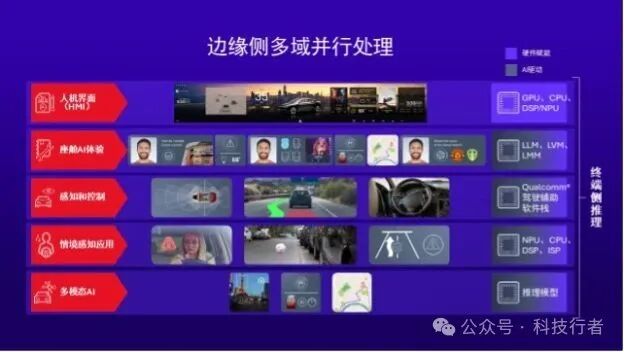
In traditional vehicles, smart cockpits and driving assistance are two independent domains controlled by different ECUs (Electronic Control Units) and SoCs (System on Chips). It’s like a household where watching TV and using the air conditioner requires two separate control systems, which is not only expensive but also inefficient.
The emergence of Snapdragon Ride Flex completely breaks down this wall. The white paper defines it as the “key to driving ADAS into the mainstream market.” Its revolutionary aspect lies in integrating cockpit and ADAS functions into a single SoC.
What does this mean?
Imagine you are a cost-conscious architect. The Snapdragon Ride Flex solution is like designing an open-plan “kitchen-living-dining area” instead of having separate living and kitchen spaces. You save on the material and construction costs of a wall, and the flow between the two spaces becomes shorter and smoother (reducing system latency and improving data throughput).
More importantly, this powerful SoC employs advanced virtualization technology, effectively creating two completely isolated and non-interfering areas within a single physical space. Even if the entertainment cockpit system experiences lag or crashes, it will never affect the operation of the life-critical ADAS system. This “fault-tolerant” (FFI) design ensures extreme safety.
For Chinese automakers struggling with cost lines, the appeal of Snapdragon Ride Flex is fatal. It directly reduces hardware costs, simplifies the vehicle’s electronic and electrical architecture, and shortens development cycles.
As mentioned in the white paper: “Chinese automakers need solutions that balance cost-effectiveness and rapid development cycles. Snapdragon Ride Flex is designed to meet this need. This platform supports the development of highly reliable, high-performance systems that meet strict safety standards and are budget-controlled.”
Third Axe: Software and Data—Building an Invisible “Moat.”
If hardware is the skeleton, then software and data are Qualcomm’s true soul and flesh. The white paper dedicates a significant portion to elaborating on Qualcomm’s deep accumulation in this area.
1. “Mapless ADAS” Capability: This may be the most disruptive concept in the white paper. Traditional high-level driving assistance heavily relies on high-precision maps, which not only means high costs for map collection and updates but also strategically binds automakers to map providers.
However, the software stack of Snapdragon Ride can reconstruct complex urban scenarios like intersections and dynamically generate real-time maps without relying on high-precision maps through powerful real-time perception capabilities. This is of practical value for rapidly changing urban networks in China, granting automakers unprecedented autonomy and flexibility.
2. Integration of Generative AI: Qualcomm has not stopped at traditional perception and control. The white paper reveals that the platform has begun to utilize generative AI to enhance the driving experience.
It is no longer just cold machine instructions; it can converse with you in natural language and make personalized adjustments based on your driving habits as an “intelligent co-pilot.” It can even predict potential emergency maneuvers like sudden lane changes based on your historical behavior and intervene in advance. This gives the ADAS system a sense of “warmth” and “emotional intelligence” for the first time.
3. Data and Simulation Factory: This is Qualcomm’s “secret weapon.” Since 2016, the Snapdragon Ride platform has undergone nearly a decade of validation in over 60 countries and regions, accumulating a catalog covering over 6 million kilometers of unique road scenarios, with a total testing mileage exceeding an astonishing 482 million kilometers. This is like an experienced driver who has seen far more than the average person.
This vast database, combined with AI simulation capabilities that can generate various extreme scenarios, forms a powerful “digital dojo.” Automakers can rigorously train and validate algorithms here, significantly shortening development cycles and ensuring system robustness.
4. Comprehensive Toolchain Support: Having powerful software and vast data is not enough; how to enable automakers’ engineers to use them efficiently is key. To this end, Qualcomm provides a complete set of “nanny-level” development toolchains, completely alleviating automakers’ concerns.
This is no longer just about “giving a fish” but “teaching to fish, with a full set of top-notch fishing gear included.”
First, Qualcomm offers a complete set of “turnkey” development kits. From hardware development boards to basic software stacks and cloud-based continuous integration environments, developers can start working immediately without wasting valuable time on setting up the basic environment.
Second, for the core aspects of AI development, Qualcomm has launched the QNN (Qualcomm AI Engine Direct) toolchain. This may sound technical, but you can think of it as a “universal translator and optimization master for AI algorithms.” Whether your algorithm model is based on TensorFlow or PyTorch, QNN can seamlessly convert it into a format that runs efficiently on Snapdragon hardware. More importantly, it can automatically perform quantization (“slimming” the model to reduce power consumption) and performance optimization (streamlining internal processes to enhance speed), making AI algorithm deployment unprecedentedly simple and efficient.
Finally, to ensure that this advanced “brain” can communicate perfectly with the vehicle’s existing “nervous system” (such as CAN and LIN buses), Qualcomm also provides a series of integration and deployment tools. These ensure seamless integration of new and old technologies, allowing automakers to smoothly incorporate this advanced ADAS system into existing models.

Summary of the Third Axe: Qualcomm not only provides a smart “brain” (software algorithms) and rich “memory” (vast data) but also a complete set of “tools” (development toolchain), which lowers the development threshold and cycle for automakers, allowing them to focus more on creating differentiated upper-layer user experiences. This “developer moat” built by software, data, and toolchains is Qualcomm’s deepest and most difficult-to-replicate core competitiveness in the ADAS field.

The Power of Ecosystem: A Market Restructuring in Progress
The success of a company is inseparable from a thriving ecosystem. Qualcomm understands this well, and the white paper clearly demonstrates its ecological layout in the Chinese market.
First, there is a vast global network of automotive “friends.” The white paper clearly states that over 20 automakers have announced or are developing models based on the Snapdragon Ride platform. This long list includes international giants like BMW, General Motors, and Volkswagen, as well as many mainstream Chinese automakers like BAIC, Chery, FAW, and Leap Motor. This broad recognition is the strongest proof of the platform’s maturity and competitiveness.
Secondly, there is deep integration with local Chinese partners. Qualcomm has not attempted to do everything alone but has formed close partnerships with Chinese Tier-1 suppliers and solution providers (such as Zhaoyu Technology, Momenta, Yuanrong Qixing, Desay SV, etc.). These local partners provide cameras, radars, ECUs, and key driving strategy software stacks, and they understand Chinese roads, regulations, and consumers better.
This ecological model creates a powerful synergy, making Snapdragon Ride not just an external solution but deeply integrated into the blood of the Chinese automotive industry chain, capable of quickly responding to market changes and providing truly localized ADAS products.

After reading the entire white paper, we can draw a conclusion: Qualcomm’s rapid development in the ADAS field is not accidental. The core competitiveness of the Snapdragon Ride platform lies not in a single dimension of leadership but in its systematic, highly integrated comprehensive advantages.
First, it meets the full product line needs of automakers from low to high through hardware scalability; secondly, it directly addresses the biggest pain point of ADAS adoption—cost—through the Ride Flex architecture; next, it provides continuous evolution capabilities through software-defined and data-driven capabilities; finally, it unites all possible forces in the decisive Chinese market through an open and win-win ecological strategy, achieving a precise “cross-border empowerment” of the automotive industry.
According to the white paper, the Snapdragon digital chassis has covered flagship models to mainstream models priced at 80,000 to 100,000 yuan. As more models equipped with the Snapdragon Ride platform roll off the production line, we have reason to believe that this driving assistance revolution initiated by Qualcomm has just begun.
· FIN ·
Produced by the Tech Walker Team



Dialogue with SUSE APAC CTO Vishal Ghariwala: Using Open Source to Break Down the “Invisible Walls” of Enterprise AI
 Dialogue with Qorvo’s Yu Shikun: UWB + Matter, Unlocking the Internet of Everything