Automotive electronics represent the integration of electronic information technology with traditional automotive technology, and are now widely used in automotive engine control, chassis control, body control, fault diagnosis, as well as audio, communication, and navigation systems, significantly enhancing the overall performance of vehicles. With the continuous acceleration of the integration of the new generation of information technology and the automotive industry, the intelligent automotive industry and vehicle networking technology have achieved rapid development. The automated driving assistance systems, as an important manifestation of this development, require continuous enhancement of automotive data processing capabilities and high-energy-efficient computing architectures, while ensuring system power consumption, costs, and safety are also issues that automotive manufacturers and solution providers need to consider.
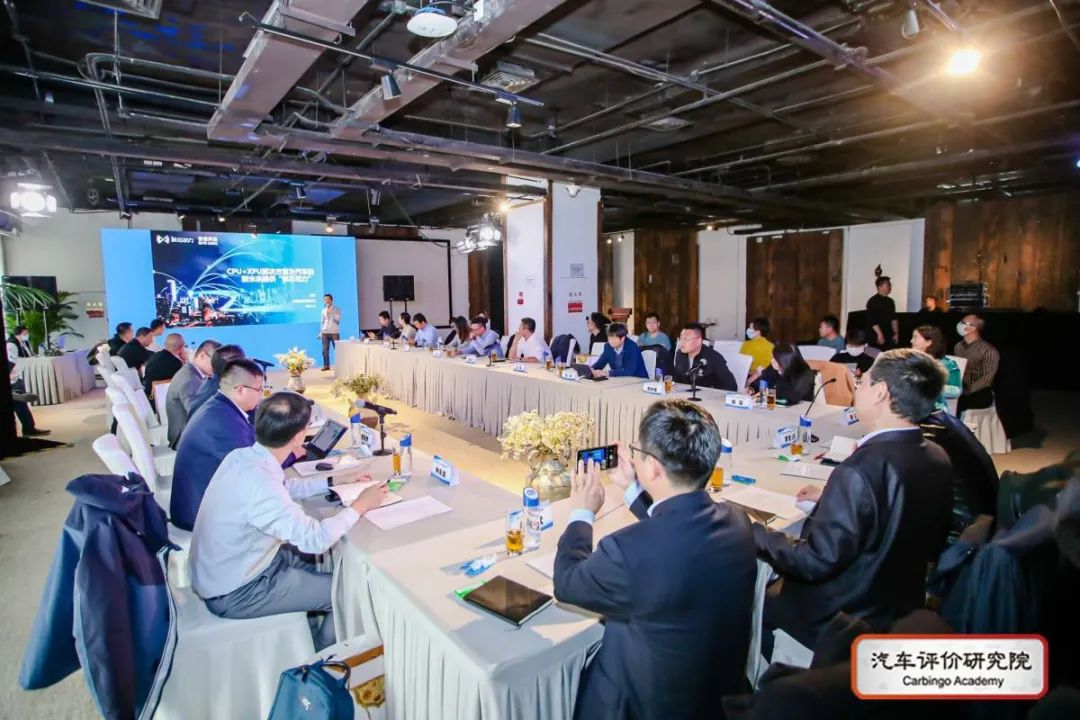
Recently, at the “Data Security Seminar in the Era of Intelligent Vehicles” hosted by the Automotive Evaluation Research Institute and supported by Arm China, Arm’s Chief Technology Officer You Hua delivered a speech titled “CPU+XPU Solutions Provide Core Power for the Future of Automotive,” introducing Arm’s technical accumulation and leading advantages in the field of automotive electronics, how to build a security defense system from the chip IP layer, and how Arm can create an onboard computing platform through the “CPU+XPU” solution in response to the new requirements of the intelligent computing era.
You Hua stated that the most significant change brought by the Internet of Everything is the explosive generation and growth of data, which means that computing power must continuously improve. In addition to artificial intelligence, automated driving also presents challenging propositions for the entire industry.
In automated driving scenarios, the demand for computing power is increasing from sensing, perception, decision-making to execution. At the same time, various related functions of automated driving vehicles require many control units to manage them, and the computing power requirements differ for each control unit. For example, the control computing power for cockpit instruments needs to reach 50K DMIPS, while semi-automated driving requires approximately 350K DMIPS, and for higher levels of automated driving, the computing power requirements will be even greater.
Arm chips are ubiquitous in automated driving
“From traditional power system control, chassis control, and body control to ADAS/IVI, Arm architecture almost covers the entire automotive system,”You Hua said. Currently, in the IVI field, 85% of processors use Arm architecture; in the ADAS field, over 60% of application processors use Arm architecture. Arm’s application processors (Cortex-A), real-time processors (Cortex-R), and small low-power microprocessors (Cortex-M) each handle different areas in automated driving. By adopting a universal architecture and supported by a leading tool ecosystem, automotive manufacturers and suppliers can rapidly innovate hardware and software, which will revolutionize safety, reduce energy consumption, and enhance the driving experience.
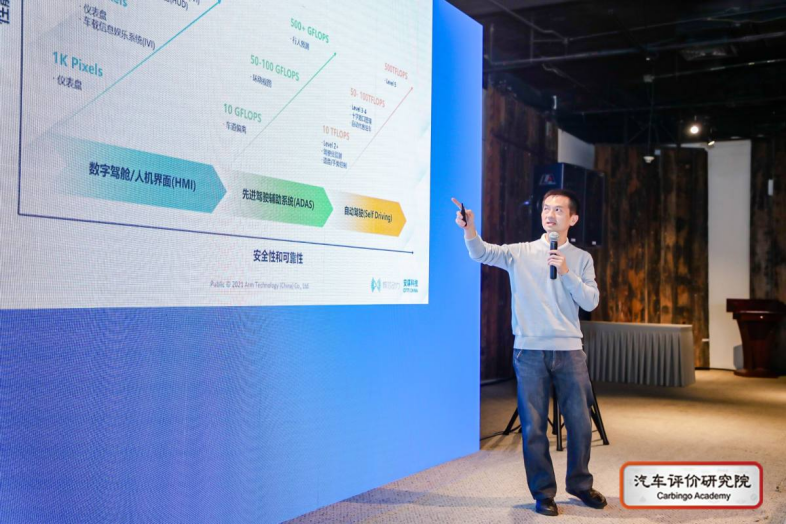
Arm’s Chief Technology Officer You Hua
“For the future development of the automotive industry, we not only hope to improve computing power but also want to fully consider safety from the chip IP level. This can help partners or chip designers to incorporate functional safety early in the design process, reducing time costs for subsequent work,”You Hua stated. Among them, Arm’s “Safety Ready” program provides a one-stop solution for software, tools, components, certification, and standards, with strict functional safety processes supporting ISO 26262 and IEC 61508 technical standards, giving customers a first-mover advantage in safety.
Additionally, the new open-source automotive software architecture SOAFEE is a scalable open architecture aimed at embedded edge computing, providing a new software architecture and open reference implementation that meets both real-time and safety requirements of automotive applications, while leveraging the advantages of cloud-native development to help automotive companies achieve a software-defined future more quickly.
CPU+XPU Provides Core Power for Automated Driving
It is well known that CPU processors were once the core of the computing industry. However, in recent years, the evolution of computing power driven by CPU architecture and process improvements has become increasingly slow and is no longer able to meet the rapidly growing demand for diverse computing power in new scenarios. Beyond CPUs, the importance of computing units such as NPU, ISP, VPU, and GPU is becoming more pronounced.
In the face of new requirements in the intelligent computing era, how to create a dedicated computing architecture for vehicles? Arm has provided its answer to this question.
In August this year, Arm announced a “dual-driven” strategy, promoting the localization and ecological development of Arm CPU architecture on one hand, and focusing on independent research and development on the other, launching a new business brand “Core Power” to develop independent architecture XPU products and a diversified ecosystem. By combining the innovative development of the independent architecture XPU with traditional computing IP, Arm aims to provide diversified, customized computing elements that meet the needs of the Chinese industry and market.
You Hua stated: “During Arm’s exploration of the Chinese market over the past few years, it has been found that the demand for highly customized IP is increasing, especially as terminal manufacturers in fields like automotive begin to delve into chips, they wish to find suitable IP for their custom chips to help shorten the chip development cycle.”
XPU defines a new integrated computing architecture, known as the super-domain architecture (xDSA), providing a platform foundation for intelligent data stream processing. It is important to note that the XPU proposed by Arm is not the CPU or GPU architecture we usually understand, but rather refers to an open intelligent data stream integrated computing platform. The main products of XPU are Arm’s self-developed IP business, including NPU, ISP, VPU, SPU, etc.
Among them, in the NPU field, Arm has the “Zhouyi” NPU, which was its earliest non-CPU independent architecture; in the multimedia field, there are the “Linglong” ISP and VPU, which process images and videos, respectively. Of course, in the Internet of Things field, the processing capabilities of just ISP and NPU are insufficient; the Internet of Everything raises higher demands for security certification, authentication, and data security for all devices. The “Shanhai” SPU (Security PU) was born to address this need, and has already evolved through two generations of products, E10/E20 and S12. The XPU based on the super-domain architecture (xDSA) can configure different solutions by combining computing units that handle AI, video, and image functions to address the efficiency and power consumption issues of processing massive intelligent data streams, meeting diverse customer needs.
For example, automated driving chips typically have a “CPU+XPU” multi-core architecture, with L3+ vehicle central computing platforms requiring over 500+ TOPS of computing power. Chips equipped solely with CPU processors cannot meet this demand, so automated driving SoC chips typically need to integrate one or more XPUs alongside CPUs for AI computations. By building a collaborative system of automotive-grade CPU and XPU units, XPUs can better support the technological evolution of the entire automated driving industry.
Additionally, Arm is actively building a global XPU ecosystem. In July this year, Arm, along with industry leading companies, initiated the “Intelligent Computing Industry Technology Innovation Consortium” (ONIA), jointly releasing the world’s first open-source NPU instruction set architecture (NPU ISA), which will support more developers and users entering the open-source ecosystem, reducing redundant investments and internal friction in the industry, and promoting the construction of the XPU ecosystem. At this year’s Wuzhen World Internet Conference, Arm also won the “World Internet Leading Scientific and Technological Achievement” award for its NPU ISA.
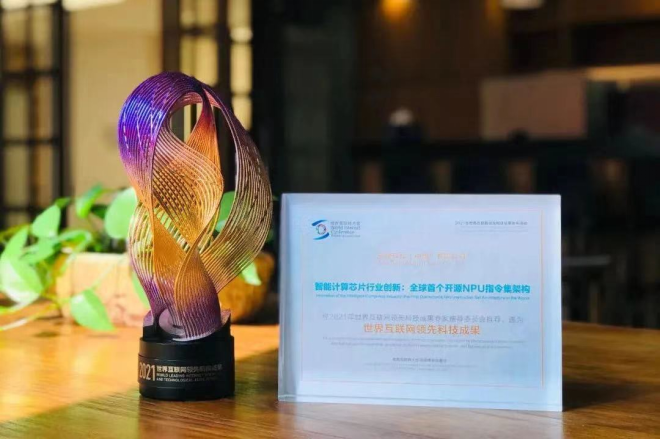
(Image source: Arm)
“Arm hopes to build ecosystems and share results through an open model. In the automotive sector, including automated driving, we hope to work together with everyone to build an ecosystem that includes IP layer, subsystem layer, and software layer, providing ‘core power’ for the future of automotive,” You Hua emphasized at the end.
About the Green Computing Industry Alliance
Since its establishment in 2016, the Green Computing Industry Alliance aims to collaboratively build a green, open, independent, and shared ecological system, dedicated to promoting the development of the green computing industry, building a platform for industry communication and cooperation, to enhance cooperation and win-win in areas such as PCs, servers, storage, operating systems, databases, etc. It has now become a global alliance with the most complete Arm infrastructure server chip partners, including Kunpeng, Feiteng, Ampere, Marvell, and others.