Today, Musk invested1 billion USD to increase his stake in Tesla stocks, reflecting his optimism about autonomous driving and robotics. I would like to share with you themain suppliers of sensors for Tesla’s humanoid robot, Optimus. The sensing system is key to its perception of the environment and achieving precise operations.
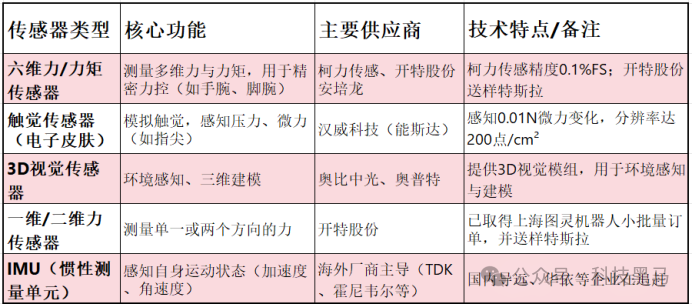
To help you quickly understand, the following image summarizes the main types of sensors and their core suppliers:
1. Detailed Explanation of Various Sensors
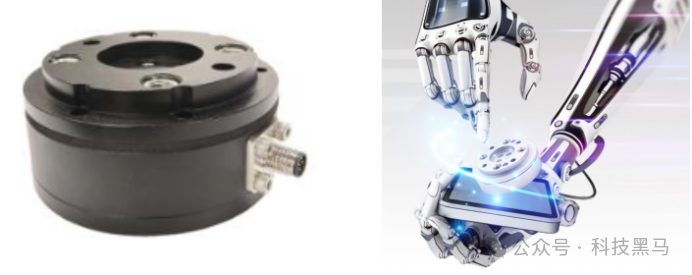
1. Six-Dimensional Force/Torque Sensors: These are crucial for achieving precise force control and adaptive operations. For example, when assembling parts or handling fragile items, it needs to accurately sense and control the force. Keli Sensor and Amperex are domestic companies capable of mass-producing six-dimensional force sensors. Kete Co., Ltd. is also expanding its six-dimensional force sensor capabilities with the support of external technical teams and has already sent samples to Tesla.
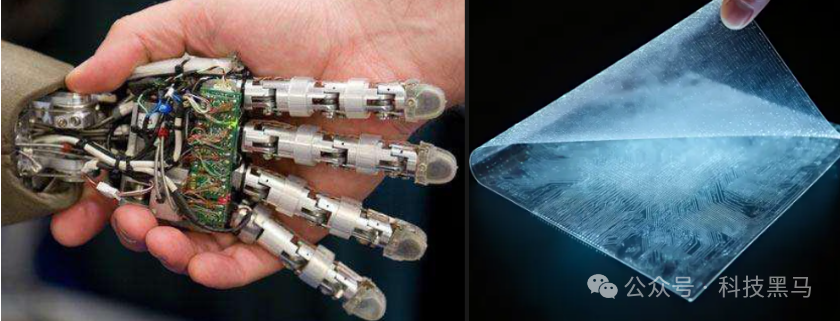
3. Tactile Sensors (Electronic Skin): Allowing Optimus’s “fingertips” to sense minute pressure changes, enabling it to perform more delicate tasks. Hanwei Technology (through its subsidiary Nengsida) has been listed by several analysis agencies as a core supplier of flexible tactile sensors, with leading technical parameters..
3. 3D Vision Sensors: These are the “eyes” of the robot, helping it recognize objects, perceive the three-dimensional environment, and perform positioning and navigation. Orbbec is a well-known supplier of 3D vision sensors in the industry, also providing products for other robot brands..
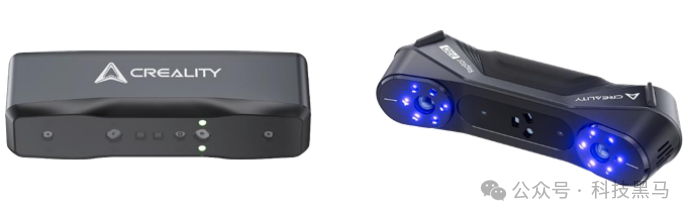
4. Other Sensors
: The robot also requires IMU (Inertial Measurement Unit) to perceive its own posture and motion state. Currently, this market is mainly dominated by overseas manufacturers such as TDK and Honeywell, while domestic companies like Huayi Technology and Xindong Lianke are striving to catch up..
2. Focus on Mass Production and Performance Contribution: Even if entering the supply chain, it is important to pay attention to whether their products are in the validation stage, small batch supply or large-scale mass production. Only large-scale mass production can truly contribute significantly to the company’s performance.
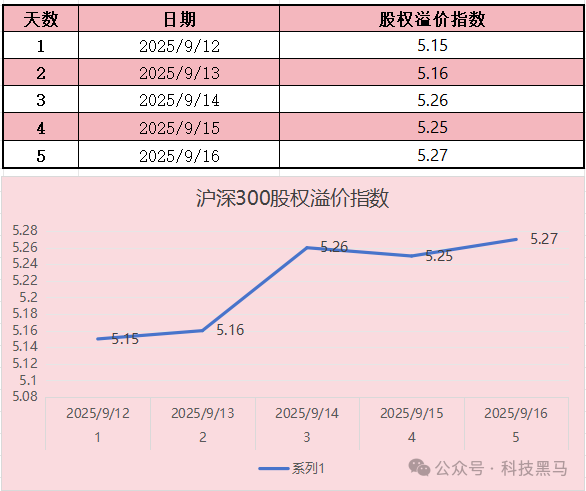
The latest Shanghai-Shenzhen 300 equity premium index: (Bull Market Progress Chart)
Data greater than 6 indicates that stocks are in a highly cost-effective stage, between 5-6 indicates good cost-effectiveness, between 4-5 indicates average cost-effectiveness, and below 4 indicates high stock prices with significant risks requiring reduction in positions.
This Week’s Major Events Overview: