Click the blue “One Bite Linux” in the upper left corner, and select “Set as Favorite“
Get the latest technical articles first

☞【Technical Content】Learning Path for Embedded Driver Engineers
☞【Technical Content】Linux Embedded Knowledge Points - Mind Map - Free Access
☞【Employment】A Comprehensive IoT Project Based on Linux for Your Resume
☞【Employment】Resume Template
Embedded systems are ubiquitous in fields such as smart homes, industrial control, and autonomous driving. However, developers often face a critical question:Should we use a Real-Time Operating System (RTOS) or go for bare-metal programming directly?
The former is like a team equipped with a “smart scheduler,” while the latter is a minimalist mode of “solo combat.” Today, we will explore the pros and cons of these two approaches from five core dimensions, including real-time performance, development efficiency, and resource usage, using practical cases like FreeRTOS to help you choose the right project solution!
1. Real-Time Performance: Deterministic Response vs. Ultimate Efficiency
The “Priority Magic” of RTOS
The core advantage of RTOS is itsdeterministic real-time response. It uses priority preemptive scheduling, allowing high-priority tasks to “cut in” for execution. For example, in an industrial temperature control system, when a sensor detects an over-temperature condition, the RTOS will immediately pause the low-priority display task to prioritize cooling control, with a response time controllable within milliseconds (FreeRTOS context switching takes only 84 CPU cycles). This mechanism is crucial in safety-critical areas such as automotive electronics and medical devices—imagine the consequences if an emergency braking task in autonomous driving is delayed.
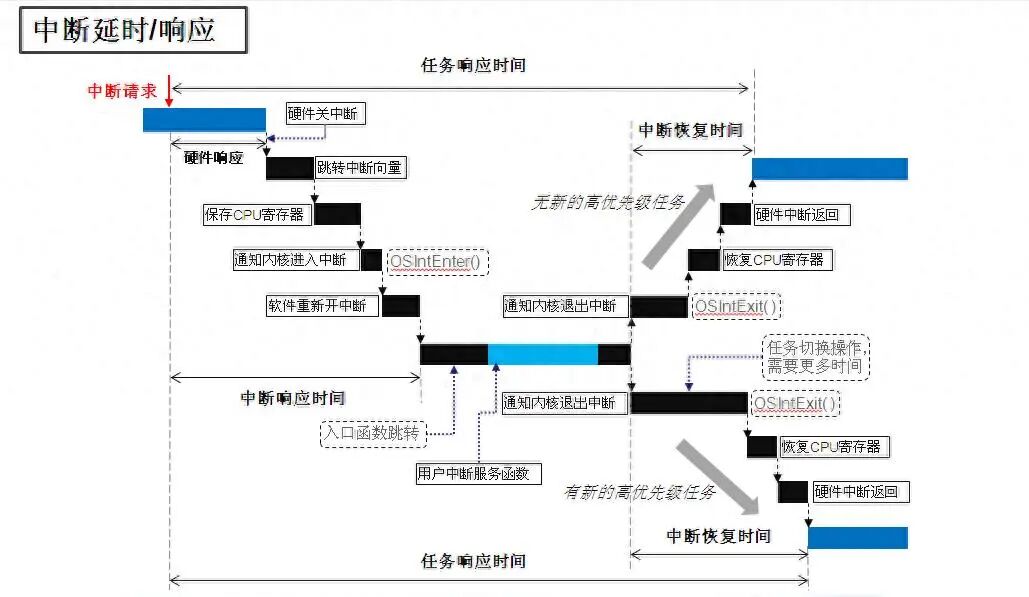
Task Scheduling Diagram
Figure: RTOS task scheduling flow diagram, where high-priority tasks can preempt low-priority tasks (Source: CSDN Blog)
The “Interrupt Dependency” of Bare-Metal
A bare-metal system relies on developers to manually write Interrupt Service Routines (ISRs) and state machines, with real-time performance entirely dependent on code quality. In simple scenarios (like LED blinking or single sensor acquisition), bare-metal can achieve microsecond-level response through interrupts; however, it can “drop the ball” in complex tasks. For instance, in a system handling button inputs, sensor acquisition, and data uploading simultaneously, bare-metal may block one task, causing delays in responding to other events, potentially missing critical signals.
Case Comparison:
• RTOS Solution: An industrial PLC using FreeRTOS separates motor control (priority 3), data uploading (priority 1), and human-machine interaction (priority 0), ensuring that the motor control task’s response time remains stable within 2ms (Source: CSDN Blog).
• Bare-Metal Solution: A simple temperature controller samples temperature every 100ms using timer interrupts, which meets the requirements, but when adding an LCD display function later, the entire state machine needs to be restructured, extending the development cycle by 30% (Source: Embedded Development Practice).
2. Development Efficiency: Modular Division vs. Low-Level Control
RTOS’s “Building Block Development”
RTOS breaks the system into independent tasks, each task acting like a “module,” allowing developers to focus less on low-level scheduling. For example, in a smart home control center, tasks like “light control,” “temperature and humidity collection,” and “WiFi communication” can be split into three tasks, enabling three team members to develop in parallel, ultimately stitching them together through queues and semaphores. FreeRTOS also provides ready-made middleware (like TCP/IP stacks and file systems), saving time on reinventing the wheel—after introducing FreeRTOS, the development time for network functionality was reduced from two weeks to three days (Source: 51CTO Blog).
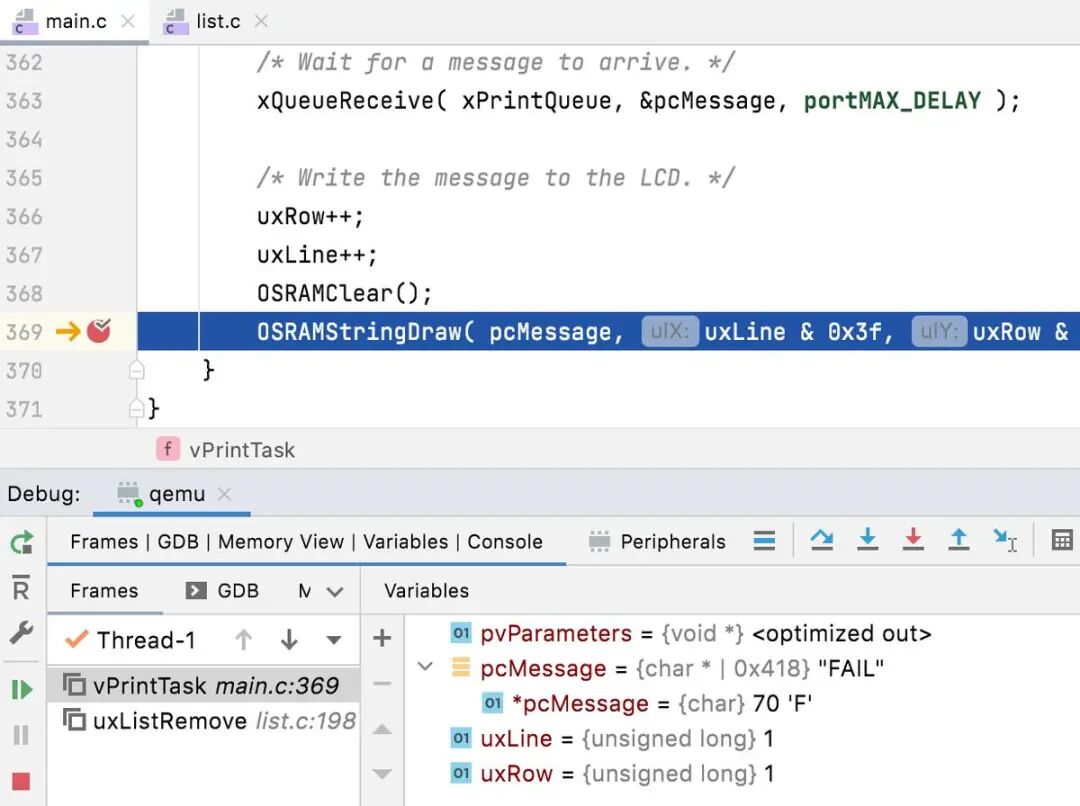
FreeRTOS Code Example
Figure: FreeRTOS task creation code example, creating tasks and starting the scheduler through xTaskCreate (Source: JetBrains CLion Documentation)
The “From 0 to 1 Wheel Creation” of Bare-Metal
Bare-metal development requires manual management of all hardware details: initializing registers, writing interrupt service routines, and designing state machines. Simple projects (like infrared remote controls) may be completed in half a day, but complex systems (like multi-sensor data fusion) can become “a chain reaction.” An engineer shared that in a bare-metal environmental monitoring system, adding a new sensor led to a week of debugging due to state machine logic conflicts (Source: Embedded Technology Revolution).
Key Data:
|
Dimension |
RTOS (FreeRTOS) |
Bare-Metal System |
|
Multi-Task Development Efficiency |
Modular parallel development, efficiency increased by 40% |
Serial development, complex system cycles extended by 2-3 times |
|
Function Reusability |
Tasks can be directly ported to other projects |
Need to rewrite over 70% of the low-level code |
3. Resource Usage: Kernel Overhead vs. Extreme Minimalism
RTOS’s “Resource Threshold”
RTOS itself consumes hardware resources: the FreeRTOS kernel requires 5-10KB of ROM and 236 bytes of RAM, with each task additionally consuming 64 bytes (task control block) + stack space (usually 128-512 bytes). This means thatthe MCU needs at least 8KB of RAM and 32KB of ROM to run smoothly (Source: FreeRTOS Official Website). For low-end chips like the STM32F0 series (8KB RAM), it may not even be able to run basic tasks.
The “Zero Overhead Advantage” of Bare-Metal
Bare-metal systems have no kernel, and all resources are directly controlled by the developer. In a certain electronic scale project using STM32L051 (4KB RAM), the bare-metal code only occupied 1.2KB of RAM, extending battery life by 20% compared to the RTOS solution (Source: CSDN Blog). For simple devices like remote controls and smoke detectors, bare-metal is the “king of cost performance.”
Practical Suggestions:
• If MCU RAM < 8KB, ROM < 32KB, prioritize bare-metal (like 8-bit MCUs, STM32F0);
• If multi-tasking or future function expansion is needed, even with tight resources, consider lightweight RTOS (like FreeRTOS with a minimum configuration requiring only 1KB of RAM).
4. Multi-Task Processing: True Parallelism vs. Pseudo-Parallelism
The “Multi-Task Magic” of RTOS
RTOS allows multiple tasks to “appear to run simultaneously” through time-slicing or priority scheduling. For example, in a drone flight control system, FreeRTOS can manage “attitude calculation” (executed every 10ms), “remote control signal reception” (executed every 1ms), and “motor driving” (executed every 5ms) simultaneously, with tasks passing data through queues without interference. This “true parallelism” is irreplaceable in complex systems—an agricultural drone project using RTOS reduced task response delays by 60% (Source: Embedded Development Practice).
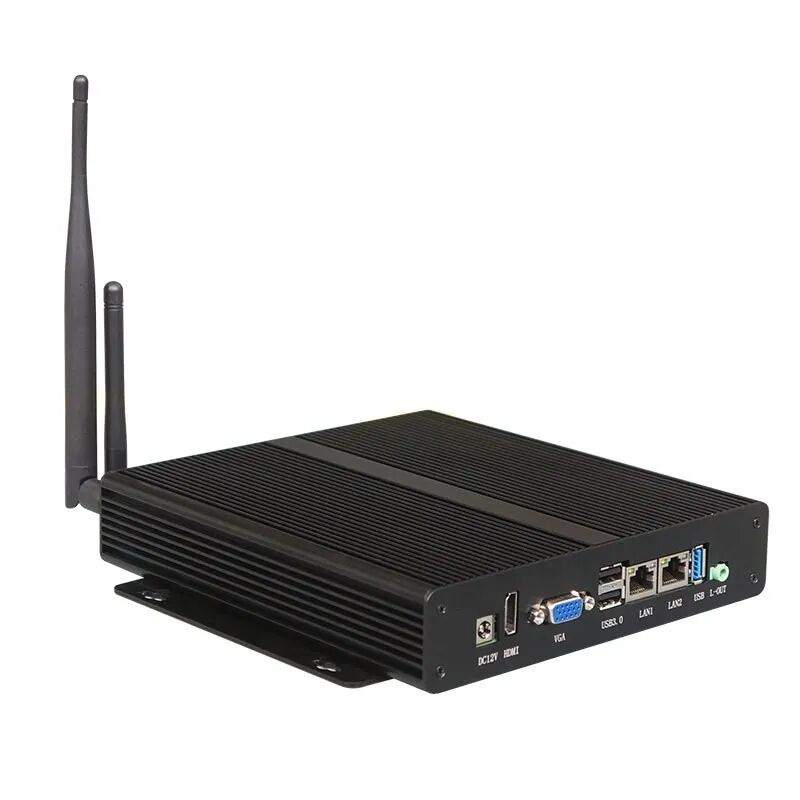
Industrial Controller Application
Figure: Industrial controller using RTOS, supporting multi-task parallel processing (Source: 1688 Industrial Equipment Database)
The “State Machine Dilemma” of Bare-Metal
Bare-metal simulates multi-tasking through a “super loop” (while(1)), which is essentially “pseudo-parallelism.” For example, in a system handling buttons, LEDs, and sensors simultaneously, the code may look like this:
// c
while(1) {
if(button pressed) handleButton();
if(LED timer reached) toggleLED();
if(sensor ready) readData();
}
The more tasks there are, the more complex the nested loops become, leading to issues like “LED stuttering after button press.” An engineer complained: maintaining a bare-metal system with 10+ tasks is like “spaghetti logic”; changing one line of code requires global testing (Source: 51CTO Blog).
5. System Complexity: Standardization vs. Customization
The “Rule Constraints” of RTOS
RTOS provides standardized task management and synchronization mechanisms (semaphores, mutexes), but it also brings a learning curve: developers need to understand concepts like “priority inversion” and “deadlock.” A certain team, when using RTOS for the first time, spent three days debugging due to incorrect use of mutexes, which led to two tasks competing for the I2C bus (Source: CSDN Blog).
The “Freedom and Risk” of Bare-Metal
Bare-metal has no rule constraints, allowing developers to customize code freely, but it also means “relying entirely on self-discipline.” Simple systems (like LED chasers) have clear code, but complex projects can easily lead to issues like “global variables everywhere” and “confused interrupt nesting.” A certain medical device project had maintenance costs exceeding twice the development costs due to high coupling in bare-metal code (Source: Embedded Technology Revolution).
Decision Guide: 3 Steps to Choose the Right Solution
1. Assess System Complexity:
◦ Single-task/simple state machine (like remote controls, electronic scales) → Bare-metal;
◦ Multi-tasking/needs priority management (like smart homes, industrial control) → RTOS.
2. Assess Hardware Resources:
◦ RAM < 8KB, ROM < 32KB → Bare-metal;
◦ Ample resources or future expansion needed → RTOS.
3. Assess Team Experience:
◦ Beginners/small teams → Start with bare-metal, transition to RTOS after familiarization;
◦ Complex projects/multi-person collaboration → Directly use RTOS (like FreeRTOS, which has a mature ecosystem and abundant resources).
There is No Silver Bullet, Only the Most Suitable
RTOS is not a “panacea,” nor is bare-metal a “backward representation.” In resource-constrained simple devices, the “streamlined efficiency” of bare-metal is irreplaceable; while in multi-tasking, high-reliability complex systems, the “standardized scheduling” of RTOS can significantly reduce development risks. As MCU costs decrease (32-bit MCUs are now as low as $1) and AIoT develops, RTOS is becoming the mainstream choice—but remember:the core of technology selection is always “matching project needs,” not blindly chasing trends.
(End of article interaction: Have you encountered pitfalls with RTOS or bare-metal in your projects? Share your experiences in the comments!)
All basic knowledge and example codes of C language compiled by One Bite are organized into a PDF document【Regularly Updated】
end
One Bite Linux
Follow, reply with 【1024】 to receive a wealth of Linux materials
Collection of Wonderful Articles
Article Recommendations
☞【Album】ARM☞【Album】Fan Q&A☞【Album】All Originals☞【Album】LinuxIntroduction☞【Album】Computer Networks☞【Album】Linux Drivers☞【Technical Content】Learning Path for Embedded Driver Engineers☞【Technical Content】All Knowledge Points of Linux Embedded – Mind Map