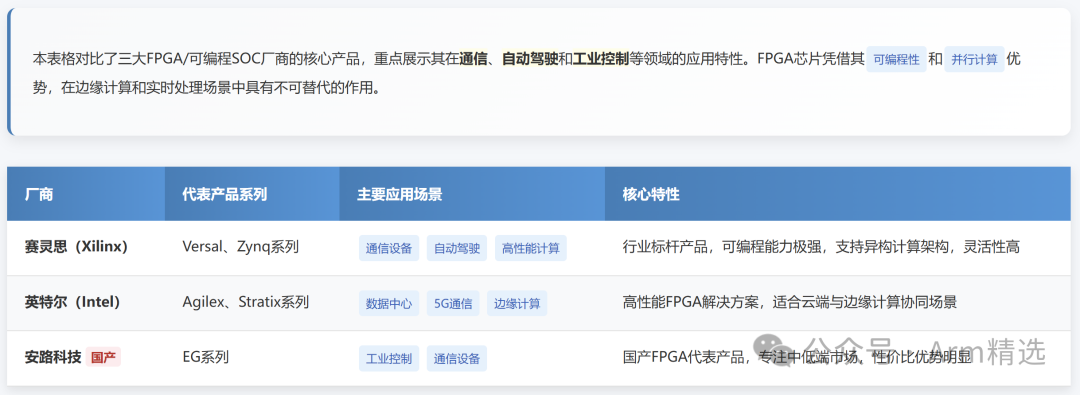
FPGA and programmable SoC chips are important components in modern technology, playing a critical role in various fields such as communication, autonomous driving, and industrial control. Their unique programmability and parallel computing capabilities provide irreplaceable advantages in edge computing and real-time processing scenarios. Below is a detailed analysis of the core products from three major manufacturers.
Xilinx is a benchmark enterprise in the industry, with representative products including the Versal and Zynq series. These products are widely used in communication devices, autonomous driving, and high-performance computing. The core advantage of Xilinx chips lies in their strong programmability, supporting heterogeneous computing architectures, and offering high flexibility to meet the demands of applications requiring high performance and customization.
Intel‘s Agilex and Stratix series products excel in data centers, 5G communication, and edge computing. Intel’s high-performance FPGA solutions are particularly suitable for collaborative scenarios between cloud and edge computing, with a comprehensive technology ecosystem that supports large-scale deployment needs, providing strong support for complex applications.
Andes Technology, as a representative of domestic FPGA, focuses its EG series products on industrial control and communication devices. Andes Technology specializes in the mid-to-low-end market, becoming an ideal choice for cost-sensitive projects due to its significant cost-performance advantage. With continuous improvement in technical capabilities, Andes Technology is gradually promoting the process of domestic substitution.
The programmability and parallel computing capabilities of FPGA chips demonstrate unique value in edge computing and real-time processing. Whether it is Xilinx’s high-performance architecture, Intel’s cloud collaboration solutions, or Andes Technology’s domestic path, each manufacturer is continuously expanding the application boundaries of FPGA technology. With the rapid development of 5G, artificial intelligence, and autonomous driving technologies, the future application prospects of FPGA will be even broader.