The U.S. semiconductor containment strategy escalates: a game of technology, negotiation, and strategic resources.
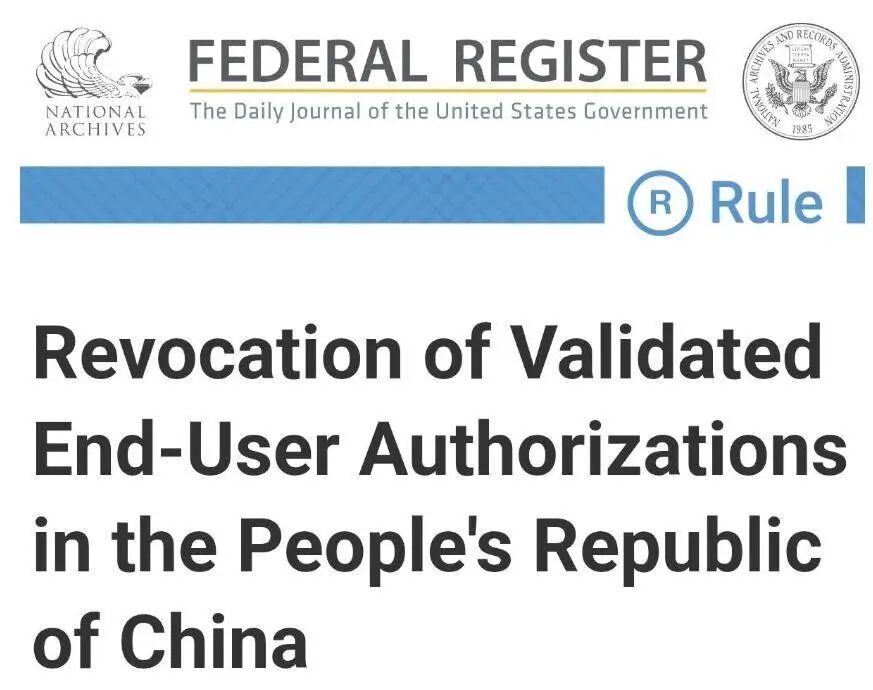
Recently, the U.S. has once again upgraded its layout in the semiconductor field. On August 29, the Department of Commerce’s Bureau of Industry and Security announced a policy adjustment with far-reaching implications: the removal of Samsung, SK Hynix, and Intel from the “Validated End User List.” This means that the previous convenience of shipping equipment containing U.S. technology or manufactured in the U.S. to wafer fabs in China without additional approval will come to an abrupt end. In the future, such equipment shipments to China will face stricter scrutiny and will require a license application to the U.S. side, making it undoubtedly much more difficult to obtain approval given the U.S.’s consistent approval tendencies.
Although this adjustment superficially involves South Korean and American companies, the actual scope of impact has evolved with changes in the industry landscape. Since Intel has already sold its Dalian factory to SK Hynix, the companies that truly need to adjust their supply chains under this policy change are mainly these two South Korean semiconductor giants. Looking back to 2022, the U.S. completely banned the export of advanced semiconductor equipment to China on national security grounds, but at that time, several companies, including Samsung and SK Hynix, received temporary waivers. The revocation of these waivers is very clear in intent: to further delay the development of China’s high-end semiconductor industry by cutting off technology input channels.
From a technical perspective, Samsung and SK Hynix primarily produce memory chips at their factories in China. Although these are not the most cutting-edge AI acceleration chips, the U.S. still chose to take action, reflecting its determination to adopt a “zero tolerance” attitude towards China’s technological upgrades. This strategy of “better to mistakenly kill than to leave future troubles” exposes the U.S.’s firm intention to construct a technological blockade chain in the semiconductor field.
For China’s semiconductor industry, this policy adjustment will undoubtedly bring real shocks. In recent years, domestic companies such as Yangtze Memory Technologies and ChangXin Memory have made breakthrough progress in the memory chip field and have initially built a competitive domestic replacement system. However, the advanced production capacity of foreign companies in China remains an indispensable key link in the entire industry chain. Those who believe that the industry can immediately achieve comprehensive replacement clearly underestimate the complexity of technological iteration and the deep stickiness of the industrial ecosystem.

It is worth noting that this policy adjustment is not a “one-size-fits-all” approach, as it allows for a 120-day transition period and does not completely prohibit equipment from entering China. The U.S. explanation for this is to allow companies time to adjust their supply chains; however, the deeper logic is worth scrutinizing. Based on past U.S. operational patterns, equipment imports necessary for maintaining existing factory operations may still be approved. What will truly be “stuck” are the equipment necessary for new capacity construction and technological upgrades. This means that factories in China can still maintain operations in the short term, but their long-term development will inevitably be restricted.
This strategy of “limited blockade” is reminiscent of the U.S. ban on EDA (Electronic Design Automation) software several months ago. At that time, the U.S. suddenly required the three major EDA companies to cut off services to China, but after subsequent U.S.-China trade negotiations, supplies were quickly restored. A review of the incident shows that it was related to the Trump administration’s attempt to use negotiation leverage to gain access to China’s rare earth supplies. The establishment of this 120-day transition period likely continues the same logic: on the surface, it is to allow companies to adjust their supply chains, but in reality, it provides the U.S. with operational space in negotiations with China.
Rare earths, as a strategic resource, have once again highlighted their importance in this round of negotiations. As a special resource that can be applied in both civilian fields and as core materials for military equipment, rare earths have always been an important bargaining chip in U.S.-China negotiations. The U.S. hopes to break the existing agreement’s restrictions and expand the use of Chinese rare earths from civilian to military applications, while China firmly maintains a clear bottom line: rare earth exports must not be used for the manufacture of missiles, radars, and other military equipment.
Currently, the international landscape has undergone profound changes, and the unilateral hegemony pursued by the U.S. is facing unprecedented challenges. For example, Brazil is willing to bear high tariffs to monitor former President Bolsonaro, and India continues to purchase Russian energy despite U.S. pressure. These cases reflect the international community’s backlash against U.S. hegemonic behavior.

As the world’s second-largest economy and a technological powerhouse, China’s response strategy in the semiconductor field demonstrates a deeper strategic resolve. In the face of U.S. technological blockades and negotiation pressures, China maintains a clear understanding—that the upgrade of the semiconductor industry cannot be achieved overnight; and also shows a firm stance—that any negotiations must be based on mutual respect. On key issues such as rare earth supply, China consistently adheres to its principled bottom line. This attitude stems from the enhancement of comprehensive national strength and the maintenance of international rules and order. When the U.S. attempts to create negotiation leverage through technological blockades, China is participating in this game with a more composed posture, neither avoiding issues nor compromising on its bottom line.