Running marathons, boxing, playing football………
Since the beginning of this year, various humanoid robot competitions have emerged at an unprecedented speed in the public eye.
During the Spring Festival, humanoid robots became popular for their handkerchief tricks; in April, the world’s first humanoid robot half marathon was launched in Beijing’s Yizhuang; in May, the world’s first fighting competition featuring humanoid robots took place in Hangzhou; and in June, the football competition known as “RoBoLeague” became a hot topic.
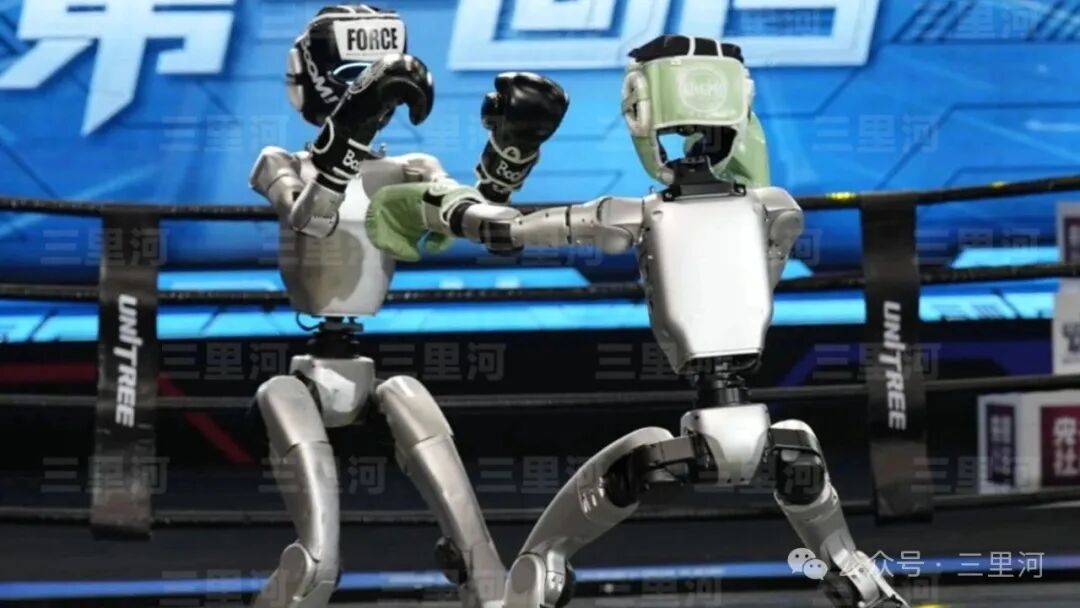
Scene of the CMG World Robot Competition Series Mecha Fighting Arena.
Some believe that robot companies in northern China tend to participate in sports that highlight leg technology, such as marathons and football, while companies in southern China prefer sports that showcase upper limb technology.
In this sense, the competitions of humanoid robots in China somewhat reflect the traditional martial arts concept of “Southern Fist, Northern Kicks”.
In fact, humanoid robot sports typically require full-body coordination; boxing requires excellent footwork, and playing football also necessitates hand coordination. Regardless of the sport or competition the robots participate in, it is a continuous evolution of robot motion control algorithms and hardware performance.
Taking “RoBoLeague” as an example, although the related technology still has significant room for improvement and the robots’ movements can be somewhat comical, with some netizens joking that “the stretcher is the busiest in robot football matches,” it is evident that Chinese robot technology is steadily advancing.
Unlike previous robot competitions, the robots participating in this football match are no longer remotely controlled by humans in real-time; instead, they autonomously observe the situation on the field through cameras and make decisions based on pre-written AI strategies.
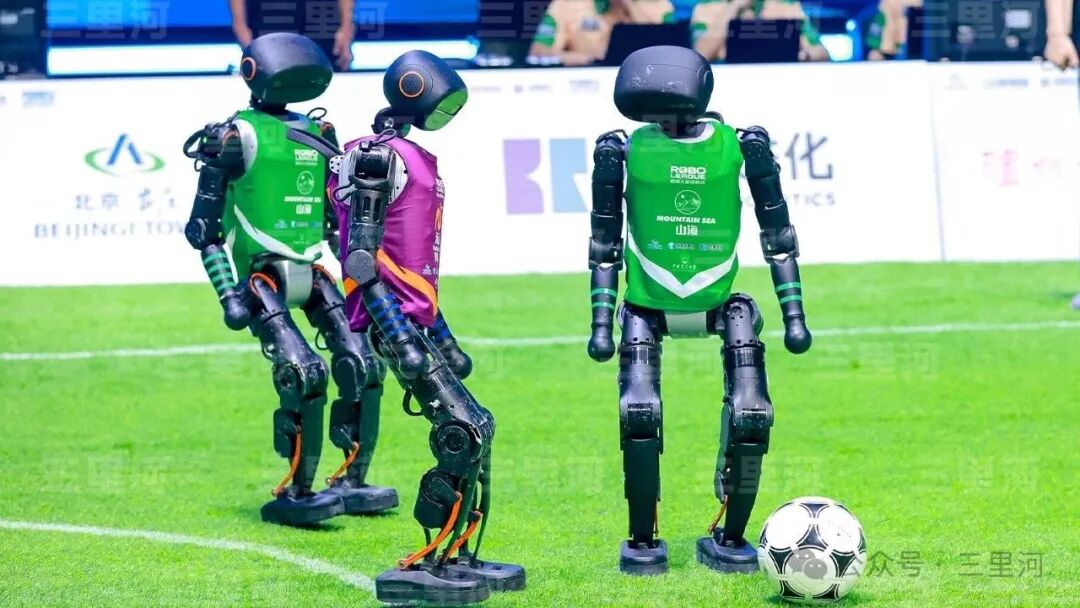
Finals of the RoBoLeague Robot Football League。
Cheng Hao, Executive Director of the competition organizing committee and founder of Accelerated Evolution Company, stated to Sanlihe that compared to movements requiring remote control or pre-programming, AI autonomous decision-making, equipped with visual sensors and multimodal algorithms, makes robot football the best competitive project that can generalize to household applications.
In the foreseeable future, robots will participate in more competitive events. This August, the World Humanoid Robot Games will be held in Beijing, featuring 19 main events including 100 meters, football, standing long jump, and free gymnastics.
Cheng Hao believes that competitive events are the best training ground, rapidly promoting the iteration of algorithms and hardware technology while making technological development transparent and visible. The event economy will be a significant driving force for humanoid robot technology development in the next decade.
This viewpoint has gained consensus within the industry. From a temporal perspective, what people refer to today as “Southern Fist, Northern Kicks” is merely a stage in the “evolution” process of robots.
Wang Xingxing, founder of Yushu Technology, once stated that whether it is dancing, fighting, or serving tea, washing clothes, or cooking, all are part of full-body movements. “Different competitive events will promote robots to master various movements, thereby driving the development of robot technology.”
Humanoid robots are a high ground for new productive forces and a “culmination” of technological cross-integration.
This year, the Chinese government work report mentioned for the first time “embodied intelligence” and “intelligent robots,” proposing to vigorously develop intelligent robots. Industry reports predict that by 2031, the market size of embodied intelligence in China is expected to exceed one trillion yuan.
With China’s strong innovation capabilities and a complete industrial system, the Chinese robot industry firmly stands in the global first tier:
Effective patents related to robots have exceeded 190,000, accounting for about two-thirds of the global total;
China has been the world’s largest industrial robot market for 11 consecutive years;
Among the top 100 humanoid robot companies globally, Chinese companies account for more than one-third.
“Humanoid robots have entered the era of sports, but being athletic is definitely not the endpoint for humanoid robots,” said Wang He, founder and CTO of Beijing Galaxy General Robotics.
In Wang He’s view, leading body control with vision to achieve autonomous work and generalized operations will truly make humanoid robots human assistants. Humanoid robots are entering the most exciting era—an era of productivity.
“Sanlihe” Studio
▎Previous Recommendations
China is promoting a major transformation
Flying around the Earth 14 times, in exchange for a threatening letter
Gambling! Musk bets on Tesla
Surpassing Beijing and Shanghai, China’s first airport is about to change hands
China gathers “three pearls”