Follow+Star PublicAccount to not miss exciting content
Author | strongerHuang
WeChat Official Account | strongerHuang
There are hundreds of RTOS available globally, but only about 10 are commonly used in the market.First, let me ask everyone, which RTOS do you use most frequently?Today, I will summarize some characteristics of commonly seen RTOS in the market.1.FreeRTOSOfficial website:
https://www.freertos.org/
Source code address:
https://github.com/FreeRTOS
1. Open source and free
The FreeRTOS kernel and other component libraries are licensed under the MIT open-source license.
The official also provides two commercially licensed versions based on the FreeRTOS kernel: OpenRTOS and SafeRTOS.
For more details, please refer to:
https://www.freertos.org/Documentation/02-Kernel/01-About-the-FreeRTOS-kernel/04-Licensing
2. Lightweight
FreeRTOS supports trimming (through the FreeRTOSConfig.h configuration file) to use minimal RAM and Flash resources.
3. Abundant learning resources
FreeRTOS currently has the highest market share among RTOS globally, so there are a large number of learning materials and video tutorials available, both official and online.
Additionally, the official website provides a Chinese version, greatly facilitating learning for those who are not proficient in English.
2.RT-ThreadOfficial website:
https://www.rt-thread.org/
Source code address:
https://github.com/RT-Thread/rt-thread
https://gitee.com/rtthread/rt-thread
1. Open source and free
RT-Thread follows the Apache-2.0 open-source license.
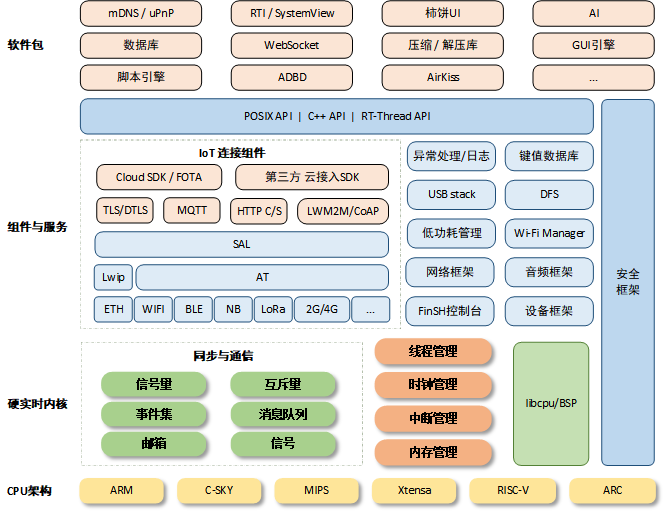
2. Rich components
RT-Thread provides commonly used components in the market, as well as a set of IoT connection components.
 3. Abundant learning resources
RT-Thread is one of the earliest RTOS in China, and it has developed rapidly over the years. The official provides a wealth of professional learning materials, especially in Chinese, making it particularly suitable for domestic learners.
https://www.rt-thread.org/document/site/#/
3.μCOSWhy μCOS? Because the generation born between 1970 and 1990 witnessed the glory of μCOS. Many people born after 1995 or 2000 may not have heard of μCOS.Official website:
https://www.silabs.com/developers/micrium
(Original: http://micrium.com)
Maintenance website:
www.weston-embedded.com
(This website requires a VPN to access)
Source code address:
https://github.com/weston-embedded
1. Open source and free
The μCOS kernel and other component libraries are licensed under the Apache-2.0 open-source license.
https://weston-embedded.com/micrium-licensing
The early μCOS was open-sourced by Micrium but was commercially paid. After being acquired by Silicon Labs in 2016, it was soon made free for commercial use.2. Well-structured source code with clear comments
μCOS is the most standardized RTOS kernel source code I have seen. Even beginners with a solid foundation in C can relatively easily understand its kernel source code.
Students who want to deeply understand the underlying mechanisms of RTOS can try reading the μCOS kernel source code.
3. Lightweight
μCOS supports the vast majority of MCUs on the market, including many resource-constrained 8-bit MCUs (such as the early 51 microcontroller).
The configuration files of μCOS are clearly categorized, and the descriptions are very clear, making system trimming very convenient.
4.ThreadXThreadX has undergone several “changes”. Back in 2019, Microsoft acquired ThreadX and renamed it Azure RTOS. Then, in 2023, it was announced that it would be hosted by the Eclipse Foundation and renamed Eclipse ThreadX.Official website:
https://threadx.io/
Source code address:
https://github.com/eclipse-threadx
1. Open source and freeAs of 2025, ThreadX follows a relatively permissive MIT open-source license.See:
https://threadx.io/faq/
Before being hosted by the Eclipse Foundation, ThreadX followed a “simple protocol” from Microsoft.2. Security certificationThreadX has many hard-to-obtain information security and safety certifications, and obtaining ThreadX security licensing agreements requires additional fees.3. Rapid developmentAfter Microsoft’s acquisition in 2019, Microsoft has invested heavily in ThreadX, and its components are rapidly expanding.Hosting it under the Eclipse Foundation and launching the ThreadX Alliance are visible signs of ThreadX’s rapid development.5.ZephyrZephyr is a relatively young RTOS, but it has been developing rapidly in recent years, especially with significant movements in the last two years.The recently released V4.1 even went head-to-head with the established FreeRTOS:Performance comparison between Zephyr and FreeRTOS.Official website:
https://zephyrproject.org/
Source code address:
https://github.com/zephyrproject-rtos
1. Open source and freeZephyr follows the Apache-2.0 open-source license.2. Abundant resources
If you have been following Zephyr, you will find that its development speed in recent years has been very fast. One reason is the abundance of resources available.
https://docs.zephyrproject.org/latest/introduction/index.html
3.Supports multiple architectures
Zephyr not only supports platform development but also supports various processor architectures.
-
ARCv2 (EM and HS) and ARCv3 (HS6X)
-
ARMv6-M, ARMv7-M, and ARMv8-M (Cortex-M)
-
ARMv7-A and ARMv8-A (Cortex-A, 32- and 64-bit)
-
ARMv7-R, ARMv8-R (Cortex-R, 32- and 64-bit)
-
Intel x86 (32- and 64-bit)
-
MIPS (MIPS32 Release 1 specification)
-
Renesas RX
-
RISC-V (32- and 64-bit)
-
SPARC V8
-
Tensilica Xtensa
6. NuttXIf you have been involved in Xiaomi IoT-related development, you should know NuttX. I learned about this system back in 2018 when I was working on a drone project.Official website:
https://nuttx.apache.org/
Source code address:
https://github.com/apache/nuttx
1. Open source and freeNuttX follows the Apache-2.0 open-source license.2. Standard APINuttX manages standards based on POSIX and ANSI standards, and also adopts additional standard APIs from Unix and other common RTOS.3.Rich platform supportNuttX is compatible with various processor architectures, covering most processors on the market.You can refer to:
https://nuttx.apache.org/docs/latest/platforms/index.html
Due to time constraints, I will stop sharing here.Which RTOS do you use most frequently? Feel free to discuss in the comments.———— END ————
● Column “Embedded Tools”
● Column “Embedded Development”
● Column “Keil Tutorials”
● Selected Tutorials in Embedded Column
Follow the public accountReply “Join Group” to join the technical exchange group according to the rules, reply “1024” to see more content.
Click “Read the original text” to see more shares.