Translation | Ren Mingshuo (任铭硕)The College of Law of The Australian National University
When the right holder discovers infringing content or acts accompanied by advertising during the process of rights protection and evidence collection, they should further investigate the advertising placement situation of the infringer. If it can be proved that the advertising placement is closely related to the specific infringing content and act, an application should be made to the court to obtain relevant evidence, and the advertising income of the infringer should be regarded as its “illegal gains”, and a more accurate claim should be made, or even used as a reasonable base for applying for punitive damages, so as to effectively crack down on and sanction the infringing act.
Advertising income is an important source of income for traditional radio and television institutions as well as various Internet services such as the constantly emerging portal websites, vertical platforms, and social media. Especially for Internet services, splash screens, signboards, patches, buffers, floating windows… Advertising forms are constantly innovating, and marketing income has repeatedly reached new highs. Then, if radio and television institutions and Internet platforms are determined to have infringed upon others’ copyrights, is their advertising income considered “illegal income”? Which advertising incomes should be regarded as the “illegal gains” of the infringer?
1. Due to the complex relationships with infringement, advertising income should not all be regarded as “illegal gains”
In the judicial practice of copyright, the content and acts of infringement are diverse, and the forms of advertising and sources of income related to infringement also vary greatly. It can be roughly divided into two major categories: “Advertising income corresponding to the infringement claimed by the right holder” and “advertising income not corresponding to the infringement claimed by the right holder”.
In cases where “advertising income corresponds to the infringement claimed by the right holder”, the advertising income of the infringer is closely related to the alleged infringement. For instance, the developers of WeChat mini-programs only offer one novel, one film or TV drama, one game, or even one album or one single in their mini-programs, and they make profits by attaching advertisements to the mini-programs. If the overall content provided by the mini-program developer is not permitted by the rights holder, then the advertising income obtained by the developer through the mini-program has a direct causal relationship with its infringement. The aforementioned advertising income may come from a single advertisement placed by one company or from different advertisements placed by multiple companies. It might be a single type of signboard advertisement, or there could also be other types of advertisements such as patches, buffers, and floating windows. Regardless of whether the advertising income is diverse or not, all of its advertising placements are closely related to the infringement claimed by the rights holder.
The situation where “advertising income cannot correspond to the rights holder’s claim of infringement” is more complex and common. The advertising income of the infringer is usually not closely related to the alleged infringement. For instance, an infringer operates a game and makes profits by placing advertisements within the game. If the game is not a complete copy or minor modification of others’ prior works, but is adapted from novels or film and television works without permission; or for large-scale online game software, if only individual modules such as communication, battles, and maps are copied from others’ works, or if a certain character image, background music, or art set has not been permitted by the rights holder, it is difficult to determine that all the advertising income in the operation of the game is closely related to the infringement. A song on a variety show was not granted permission for use, an article published on a portal website was found to be plagiarized, a movie provided by a video APP had authorization flaws, and social media was held liable for contributory infringement for delaying the handling of user-posted infringing content after receiving a notice from the rights holder… In the aforementioned circumstances, the income from title sponsorship advertisements of variety shows, the income from homepage board advertisements of portal websites, the income from splash screen advertisements of video apps, and the income from link advertisements pushed to users by algorithms on social media clearly cannot be ruled out as being related to the possible existence of legal content or other infringing content. Furthermore, it cannot be determined that there is a direct causal relationship between the aforementioned advertising income and the infringement claims made by the right holder against an article or a film.
2. Advertising income closely related to the infringement should be regarded as “illegal gains”
Given the complex relationship between advertising income and the infringement claimed by the right holder as mentioned above, not all advertising income owned by the infringer can be compensated to the right holder as “illegal gains”. Only advertising income closely related to the infringement claimed by the right holder can and should be regarded as “illegal gains”.
For instance, an account on a social media platform secretly posts others’ articles and enables the installation of advertisements for profit. Although the advertising resources are randomly matched by the platform, the advertising income brought by the unauthorized posting of articles to this account is clear and specific, and there is a unique pointing relationship between the unauthorized posting of articles and the advertising income (as shown in Figure 1). Under the previous circumstances, the advertising income generated by this account due to the unauthorized posting of articles should have been recognized as “illegal gains”. There may be controversy over whether the advertising income added to the platform by illegally posting articles and retained by the platform should be recognized as “illegal gains”. However, if the platform fails to handle the matter after the rights holder issues a deletion notice to the platform, all the additional advertising income (including the portion allocated to the account) resulting from the unauthorized posting of articles should be regarded as “illegal gains”.

Figure 1: Details of Advertising income Attached to articles on a certain platform’s official account.
If the entire or main content of a certain column, section, series report, or live-streaming event is determined to be infringing, then the advertising income from types such as title sponsorship advertisements and special advertisements placed for targeted recruitment should be recognized as “illegal gains”. For instance, in a case where a well-known sports vertical platform was sued for publishing a large number of GIF format videos of the European Cup football matches without permission, both its “Match Update” and “European Cup Match Report” special topics had title sponsors and dedicated banner advertisements, and each piece of information under the special topics contained infringing videos (as shown in Figures 2 and 3). If the evidence collected by the rights holder shows that the platform has specifically conducted advertising recruitment and actual advertising placement for the infringing content, the rights holder can apply to the court to obtain the detailed income obtained by the platform from this advertising recruitment and claim compensation as “illegal gains” closely related to the platform’s infringement.
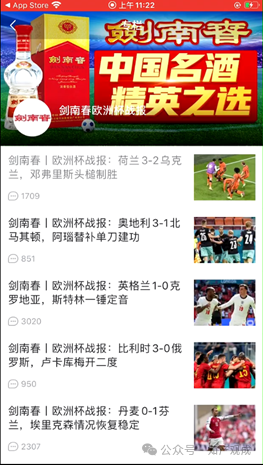
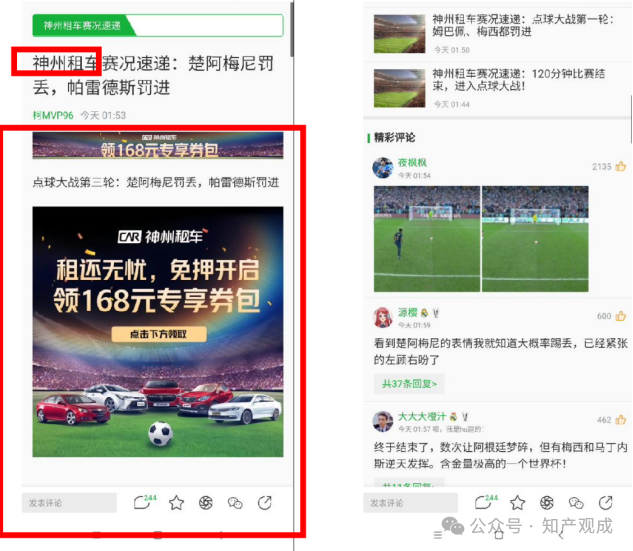
Figure 2
Figure 3
For the regular advertisements placed by radio and television institutions during their advertising slots and the general advertisements placed by Internet platforms using their inherent spatial resources, it is usually difficult to determine that there is a direct causal relationship between them and the specific infringing content or acts. Under the current technological conditions, even platforms that adopt intelligent algorithms and recommend personalized advertisements usually push based on users’ preferences and habits. They lack the ability to identify specific content (especially infringing content) and target advertisements accordingly. For instance, the splash screen ads of apps and the video ads that pop up during continuous viewing of short videos are still difficult to be closely associated with specific infringing content or acts, and usually cannot be recognized as the “illegal gains” of the infringer.
In conclusion, in order to give priority to applying the standards of “actual losses” or “illegal gains” in the judgment of damages for copyright infringement, enhance the refinement of compensation judgments, and reduce the application of statutory damages, when the right holder discovers the infringing content or the infringing behavior accompanied by advertising placement during the process of rights protection and evidence collection, they should further investigate the advertising placement situation of the infringer. If it can be proved that the advertising placement is closely related to the specific infringing content and act, an application should be made to the court to obtain relevant evidence, and the advertising income of the infringer should be regarded as its “illegal gains”, and a more accurate claim should be made. Even it should be used as a reasonable base for applying for punitive damages, so as to effectively crack down on and sanction the infringing act.
Original Chinese Text
Can Advertising Income Be Considered “Illegal Gains”?
Written by | Zhu Xiaoyu, Pi Qiaoqian
When the right holder discovers infringing content or acts accompanied by advertising during the process of rights protection and evidence collection, they should further investigate the advertising placement situation of the infringer. If it can be proved that the advertising placement is closely related to the specific infringing content and act, an application should be made to the court to obtain relevant evidence, and the advertising income of the infringer should be regarded as its “illegal gains”, and a more accurate claim should be made, or even used as a reasonable base for applying for punitive damages, so as to effectively crack down on and sanction the infringing act.
Advertising income is an important source of income for traditional radio and television institutions as well as various Internet services such as the constantly emerging portal websites, vertical platforms, and social media. Especially for Internet services, splash screens, signboards, patches, buffers, floating windows… Advertising forms are constantly innovating, and marketing income has repeatedly reached new highs. Then, if radio and television institutions and Internet platforms are determined to have infringed upon others’ copyrights, is their advertising income considered “illegal income”? Which advertising incomes should be regarded as the “illegal gains” of the infringer?
1. The relationship between advertising income and infringement is complex and diverse, and should not all be regarded as “illegal gains”
In judicial practice of copyright, the content and acts of infringement are diverse, and the forms of advertising and sources of income related to infringement also vary greatly. It can be roughly divided into two major categories: “Advertising income corresponding to the infringement claimed by the right holder” and “advertising income not corresponding to the infringement claimed by the right holder”.
In cases where “advertising income corresponds to the infringement claimed by the right holder”, the advertising income of the infringer is closely related to the alleged infringement. For instance, the developers of WeChat mini-programs only offer one novel, one film or TV drama, one game, or even one album or one single in their mini-programs, and they make profits by attaching advertisements to the mini-programs. If the overall content provided by the mini-program developer is not permitted by the rights holder, then the advertising income obtained by the developer through the mini-program has a direct causal relationship with its infringement. The aforementioned advertising income may come from a single advertisement placed by one company or from different advertisements placed by multiple companies. It might be a single type of signboard advertisement, or there could also be other types of advertisements such as patches, buffers, and floating windows. Regardless of whether the advertising income is diverse or not, all of its advertising placements are closely related to the infringement claimed by the rights holder.
The situation where “advertising income cannot correspond to the rights holder’s claim of infringement” is more complex and common. The advertising income of the infringer is usually not closely related to the alleged infringement. For instance, an infringer operates a game and makes profits by placing advertisements within the game. If the game is not a complete copy or minor modification of others’ prior works, but is adapted from novels or film and television works without permission; or for large-scale online game software, if only individual modules such as communication, battles, and maps are copied from others’ works, or if a certain character image, background music, or art set has not been permitted by the rights holder, it is difficult to determine that all the advertising income in the operation of the game is closely related to the infringement. A song on a variety show was not granted permission for use, an article published on a portal website was found to be plagiarized, a movie provided by a video APP had authorization flaws, and social media was held liable for contributory infringement for delaying the handling of user-posted infringing content after receiving a notice from the rights holder… In the aforementioned circumstances, the income from title sponsorship advertisements of variety shows, the income from homepage board advertisements of portal websites, the income from splash screen advertisements of video apps, and the income from link advertisements pushed to users by algorithms on social media clearly cannot be ruled out as being related to the possible existence of legal content or other infringing content. Furthermore, it cannot be determined that there is a direct causal relationship between the aforementioned advertising income and the infringement claims made by the right holder against an article or a film.
2. Advertising income closely related to the infringement should be regarded as “illegal gains”
Given the complex relationship between advertising income and the infringement claimed by the right holder as mentioned above, not all advertising income owned by the infringer can be compensated to the right holder as “illegal gains”. Only advertising income closely related to the infringement claimed by the right holder can and should be regarded as “illegal gains”.
For instance, an account on a social media platform secretly posts others’ articles and enables the installation of advertisements for profit. Although the advertising resources are randomly matched by the platform, the advertising income brought by the unauthorized posting of articles to this account is clear and specific, and there is a unique pointing relationship between the unauthorized posting of articles and the advertising income (as shown in Figure 1). Under the previous circumstances, the advertising income generated by this account due to the unauthorized posting of articles should have been recognized as “illegal gains”. There may be controversy over whether the advertising income added to the platform by illegally posting articles and retained by the platform should be recognized as “illegal gains”. However, if the platform fails to handle the matter after the rights holder issues a deletion notice to the platform, all the additional advertising income (including the portion allocated to the account) resulting from the unauthorized posting of articles should be regarded as “illegal gains”.

Figure 1: Details of Advertising income Attached to articles on a certain platform’s official account.
If the entire or main content of a certain column, section, series report, or live-streaming event is determined to be infringing, then the advertising income from types such as title sponsorship advertisements and special advertisements placed for targeted recruitment should be recognized as “illegal gains”. For instance, in a case where a well-known sports vertical platform was sued for publishing a large number of GIF format videos of the European Cup football matches without permission, both its “Match Update” and “European Cup Match Report” special topics had title sponsors and dedicated banner advertisements, and each piece of information under the special topics contained infringing videos (as shown in Figures 2 and 3). If the evidence collected by the rights holder shows that the platform has specifically conducted advertising recruitment and actual advertising placement for the infringing content, the rights holder can apply to the court to obtain the detailed income obtained by the platform from this advertising recruitment and claim compensation as “illegal gains” closely related to the platform’s infringement.
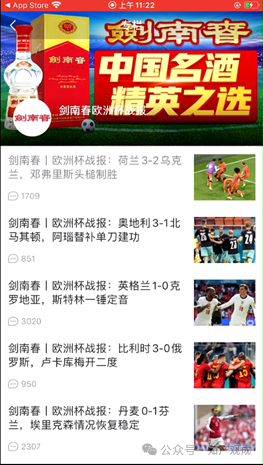
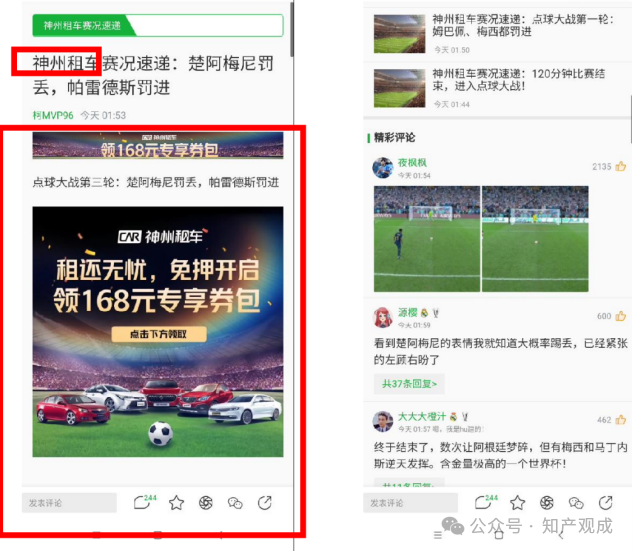
Figure 2
Figure 3
For the regular advertisements placed by radio and television institutions during their advertising slots and the general advertisements placed by Internet platforms using their inherent spatial resources, it is usually difficult to determine that there is a direct causal relationship between them and the specific infringing content or acts. Under the current technological conditions, even platforms that adopt intelligent algorithms and recommend personalized advertisements usually push based on users’ preferences and habits. They lack the ability to identify specific content (especially infringing content) and target advertisements accordingly. For instance, the splash screen ads of apps and the video ads that pop up during continuous viewing of short videos are still difficult to be closely associated with specific infringing content or acts, and usually cannot be recognized as the “illegal gains” of the infringer.
In conclusion, in order to give priority to applying the standards of “actual losses” or “illegal gains” in the judgment of damages for copyright infringement, enhance the refinement of compensation judgments, and reduce the application of statutory damages, when the right holder discovers the infringing content or the infringing behavior accompanied by advertising placement during the process of rights protection and evidence collection, they should further investigate the advertising placement situation of the infringer. If it can be proved that the advertising placement is closely related to the specific infringing content and act, an application should be made to the court to obtain relevant evidence, and the advertising income of the infringer should be regarded as its “illegal gains”, and a more accurate claim should be made. Even it should be used as a reasonable base for applying for punitive damages, so as to effectively crack down on and sanction the infringing act.
[1] China Central Television International Network Co., Ltd. v. Beijing Duoge Technology Co., Ltd. Dispute over the infringement of the right of information network dissemination of works: First instance: (2023) Jing 0491 Minchu 5818; Second instance: (2024) Jing 73 Minzhong 904.
Special Note:This article is for academic and practical discussion purposes only and represents the author’s personal views, and should not be regarded as legal opinions and/or advice issued by the author and the institution where they practice.