Source:Chip Knowledge
Original Author:Future Chip
This article mainly discusses what a MEMS catalytic combustion gas sensor is.
MEMS catalytic combustion sensors are miniaturized devices used to detect combustible gases, utilizing MEMS technology to miniaturize and integrate traditional catalytic combustion sensors. The core principle of the MEMS catalytic combustion sensor is “flame-free catalytic combustion”. The sensor typically contains two key components: the sensing element and the compensation element. The sensing element is coated with a catalyst, while the compensation element is usually either uncoated or has an inactive catalyst, used for environmental compensation. When combustible gases, such as methane or hydrogen, come into contact with the catalyst on the sensing element’s surface, a catalytic oxidation reaction occurs at conditions far below their ignition temperature. This process generates heat, causing a temperature change in the sensing element, which in turn leads to a change in its resistance. These two elements typically form a Wheatstone bridge, and the change in resistance of the sensing element disrupts the balance of the bridge, outputting an electrical signal proportional to the gas concentration, thus enabling quantitative detection of combustible gases.
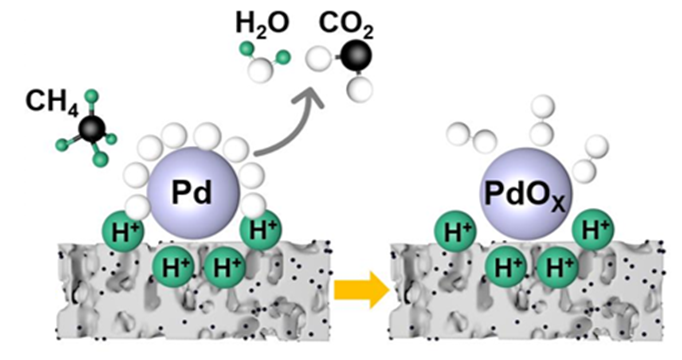
Figure: Working principle of the catalytic combustion gas sensor
A typical MEMS catalytic combustion sensor includes a micro-heating plate and a catalytic layer. The micro-heating plate is fabricated based on silicon-based MEMS technology, containing an insulating layer, a platinum micro-heating electrode, and a back cavity structure to provide good thermal insulation, reduce heat loss, and lower power consumption. The catalytic layer is the “olfactory” core of the sensor, precisely depositing high surface area carriers, such as porous ceramics or mesoporous alumina films, along with noble metal catalysts like platinum Pt, palladium Pd or their alloy nanoparticles, onto the micro-heating plate using techniques such as screen printing, magnetron sputtering, or spin coating. The sensing and reference elements are typically symmetrically designed, with the reference element containing only the carrier material.
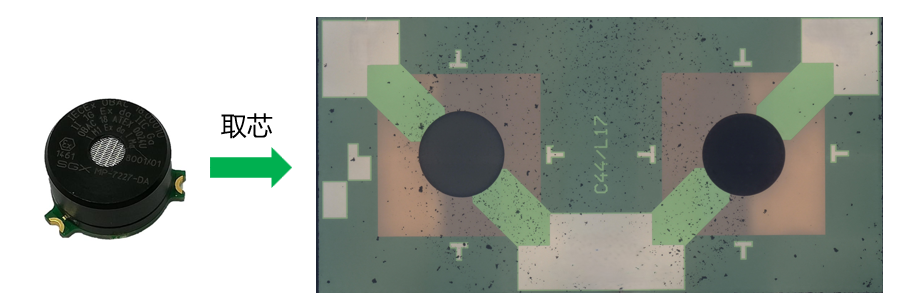
Figure: SGX Sensortech MP7227 MEMS chip
One of the more mature products on the market is the SGX Sensortech MP7227, which is a micro MEMS sensor for methane detection, featuring low power consumption and anti-poisoning characteristics, suitable for battery-powered portable detectors. The MP7227 is manufactured using silicon-based MEMS technology, with two silicon cavities created on the back of the MEMS chip through wet etching. This structure aids in thermal insulation, reducing heat loss and thus lowering power consumption. The front of the chip forms two suspended membranes corresponding to the detection and compensation areas, with sensitive materials (such as catalysts) deposited in these areas using methods like screen printing. To ensure reliability and safety in industrial environments, the MP7227 features an explosion-proof metal casing, and also includes a metal sintered mesh for flame resistance, mechanical protection, and resistance to airflow interference, along with desiccant structures.
END
The reproduced content only represents the author’s views
and does not represent the position of the Semiconductor Institute of the Chinese Academy of Sciences
Editor: Xiaoshuai
Responsible Editor: Yuzu Lu
Submission Email: [email protected]
Previous Recommendations
1. Understanding the applications and challenges of 2.5D and 3D packaging
2. Metal materials in MEMS: Aluminum
3. Thinning technology based on TSV
4. Thermal evaluation of 2.5D and 3D integration technology based on bridge chips
5. Chip manufacturing: Thin film deposition
6. What are the hazards of hydrogen evolution reactions on wafer plating?