01Basic Understanding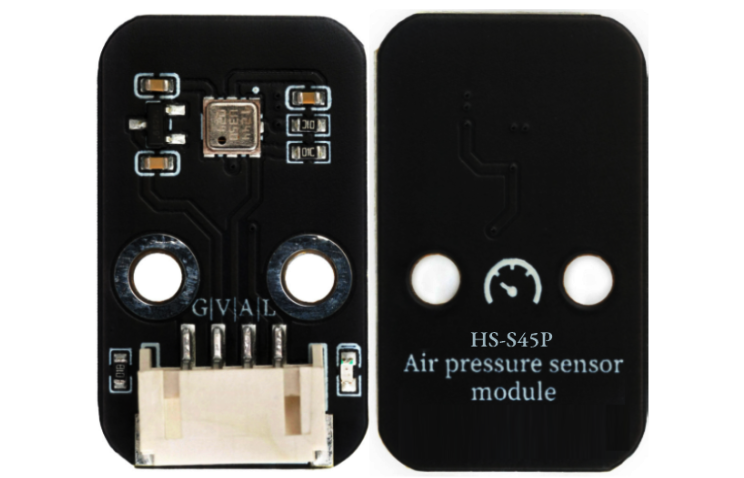 Model:HS-S45PName:Barometric Pressure SensorSeries:SensorDescription:This is a high-precision digital sensor that integrates barometric pressure and altitude measurement functions. It uses MEMS (Micro-Electro-Mechanical Systems) technology and an I2C communication interface to convert atmospheric pressure changes into readable digital signals. It can also calculate altitude based on pressure values, featuring high measurement accuracy, low power consumption, and rapid response. It is a core component for meteorological monitoring, altitude control, and environmental perception.Usage Scenarios:Meteorological station setup (real-time monitoring of pressure changes, weather prediction); drone altitude control (stabilizing flight altitude through pressure values); mountaineering equipment (measuring altitude, assisting navigation); smart home (pressure changes trigger ventilation systems to improve indoor environment); educational experiments (verifying physical formulas through the relationship between pressure and altitude); industrial storage (monitoring pressure in sealed environments to ensure the safety of hazardous materials). This aligns with the “Guidelines for Artificial Intelligence General Education in Primary and Secondary Schools (2025 Edition)” by helping students understand the physical relationship between gas pressure and altitude through building “pressure alarm devices” and “altitude recorders.”Disciplinary Integration:Physics, Mathematics, Geography, Labor, Information TechnologyEthical Education:If pressure data is combined with location information, it may leak user activity trajectories (e.g., climbing routes), requiring clear boundaries for data collection; high-precision pressure sensors used for military or sensitive area monitoring must comply with relevant regulations; the accuracy of device calibration data may affect weather predictions, necessitating a rigorous scientific attitude; the recycling of MEMS chips in electronic waste must consider environmental responsibilities; over-reliance on sensor data may reduce natural observation skills (e.g., judging weather through cloud patterns), requiring a balance between technological tools and experiential knowledge.
02Technical Parameters
Working Principle::
The module contains a MEMS pressure-sensitive element, which experiences slight deformation due to changes in atmospheric pressure. This deformation is converted into an electrical signal through a Wheatstone bridge, and after analog-to-digital conversion (ADC) and data processing, a digital pressure value is generated. Data is transmitted to the microcontroller via the I2C communication protocol, and a built-in temperature compensation circuit reduces the impact of environmental temperature on measurement accuracy. Altitude is calculated using the standard pressure formula (based on a standard sea-level pressure of 1013.25 hPa).
Parameter Analysis:
G(GND): Power input negative/ground
V(VCC): Power input positive/positive
A(SDA):I2C data transmission interfaceL(SCL):I2C clock synchronization interfaceMeasurement range: 300-1100 hPa (covering sea level to 8000 meters altitude)Pressure accuracy: ±0.5 hPa (at 25°C environment)Altitude accuracy: ±1 meter (relative measurement)Response time: ≤8 ms (delay from pressure change to data output)Operating temperature: -40°C to 85°CCommunication protocol: I2C (default address 0x77, can be modified via pins)Power consumption: ≤1.5 mA (operating state), ≤0.1 μA (standby state)03Code Example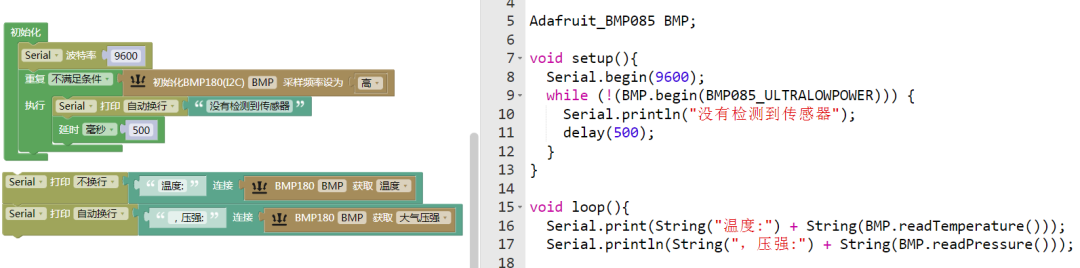
Note: Students should pay attention to library installation.
04Safety Measures
1.Power must be turned off before wiring, and confirm the polarity of VCC and GND; reversing connections may burn the I2C communication circuit;
2. Avoid severe impacts or vibrations to the module; MEMS elements are precision and fragile, which may cause measurement drift;
3. Do not use in corrosive gas environments (e.g., sulfur dioxide, chlorine) as they may corrode sensitive elements;
4. If the operating temperature exceeds the range of -40°C to 85°C, usage must be stopped to prevent component damage;
5. When soldering, the soldering iron temperature should not exceed 300°C, and soldering time should be ≤3 seconds to avoid high-temperature damage to the chip;
6. When not in use for a long time, it should be stored in a sealed dry environment to prevent pin oxidation;
7. During debugging, ensure that the I2C address (default 0x77) does not conflict with other devices to avoid communication failure.
05Extensions
Students can try the following:
1. Create a “Meteorological Monitoring Station”: Combine with the HS-S26A temperature and humidity sensor to record pressure, temperature, and humidity simultaneously, and plot the change curves on an OLED display;2. Build a “Drone Altitude Control System”: Link with a motor drive module to automatically adjust the speed based on pressure values, maintaining stable flight altitude;3. Design an “Altitude Recorder”: Connect to an SD card module to record altitude changes during climbing, generating altitude-time graphs;4. Develop an “Indoor Ventilation Controller”: Automatically start a fan to balance pressure when the pressure difference exceeds a threshold (e.g., indoor-outdoor pressure difference of 5 hPa). Arduino Sensors: HS-S01A Infrared SensorArduino Sensors: HS-S02P Infrared Sensor (Obstacle Avoidance)Arduino Sensors: HS-S03P Ultraviolet SensorArduino Sensors: HS-S05P Sound SensorArduino Sensors: HS-F07P Active BuzzerArduino Sensors: HS-S08P Flame SensorArduino Sensors: HS-S09LB Raindrop SensorArduino Sensors: HS-S09PC Soil Moisture Sensor
Arduino Sensors: HS-S10P Mist Sensor
Arduino Sensors: HS-S11-L Gas Sensor
Arduino Sensors: HS-S20P Ambient Light Sensor
Arduino Sensors: HS-S21P Tilt SensorArduino Sensors: HS-S22P Grayscale SensorArduino Sensors: HS-S23P Infrared Receiver ModuleArduino Sensors: HS-S24P Digital Temperature SensorArduino Sensors: HS-S26A Temperature and Humidity SensorArduino Sensors: HS-S28P Potentiometer
Arduino Sensors: HS-S29P Infrared Transmitter Module
Arduino Sensors: HS-S30P Clock Module
Arduino Sensors: HS-S31P Touch Sensor
Arduino Sensors: HS-S32L Rotary Encoder Module
Arduino Sensors: HS-S34P Dual-axis Joystick Module
Arduino Sensors: HS-S37PS Water Level Sensor
Arduino Sensors: HS-S38P Human Sensor
Arduino Sensors: HS-S40P Hall Magnetic Sensor

— Previous Recommendations —