01Basic Understanding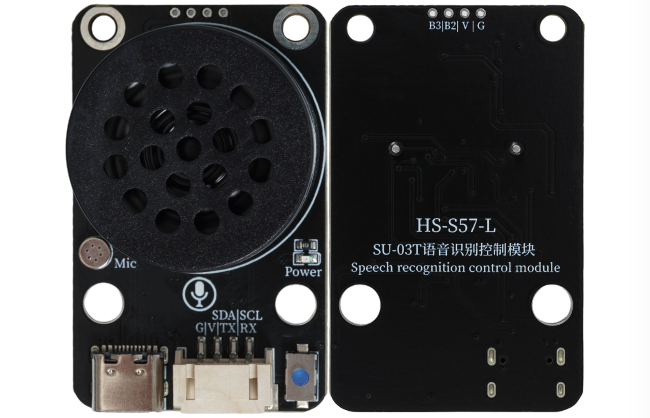 Model:HS-S57-LName:SU-03T Voice Recognition Control ModuleSeries:Voice Interaction ModuleDescription:This is an intelligent module that integrates voice collection, recognition, and command output functions. It features a built-in microphone array and offline voice recognition chip, supports customizable wake words and control commands, and can convert voice commands into recognizable electrical signals (serial / IO output). It enables direct control of “voice → action” without the need for internet connectivity, making it a core component for human-machine voice interaction, suitable for scenarios requiring responsiveness and privacy.Usage Scenarios:This is an intelligent module that integrates voice collection, recognition, and command output functions. It features a built-in microphone array and offline voice recognition chip, supports customizable wake words and control commands, and can convert voice commands into recognizable electrical signals (serial / IO output). It enables direct control of “voice → action” without the need for internet connectivity, making it a core component for human-machine voice interaction, suitable for scenarios requiring responsiveness and privacy.Interdisciplinary Integration:Physics, Mathematics, Linguistics, Information TechnologyEthical Education:Voice commands may be mimicked by others (e.g., children imitating parents’ voices to control devices), necessitating a discussion on the need for “voiceprint encryption”; recognition failures may lead to misoperations (e.g., accidentally turning off important devices), requiring a redundant confirmation mechanism; the voice feature data stored in the module may involve privacy, necessitating clear boundaries for local data storage; differences in recognition rates due to dialects or accents require attention to inclusive design; over-reliance on voice control may reduce manual operation skills, necessitating a balance between technological convenience and basic skill development.
02Technical Parameters
Operating Principle:The module collects voice signals through the microphone, processes them (noise reduction, filtering), extracts acoustic features, and matches them with the built-in command feature library. When the similarity exceeds a threshold, it is determined to be a valid command, outputting command codes via serial or triggering corresponding IO port level changes (high/low level). It supports offline operation (no network required) and allows customization of wake words (e.g., “Xiao An Tong Xue”) and control commands (up to 50 commands), with a recognition response time of ≤1 second.
Parameter Analysis:
G(GND): Power input negative/ground
V(VCC): Power input positive/voltage
TX: Serial transmission end (outputs recognition results)RX: Serial receiving end (configures module parameters)Recognition distance: 0.5-5 meters (unobstructed environment)Supported commands: ≤50 (customizable)Wake word length: 2-4 characters (e.g., “Smart Butler”)Response time: ≤1000ms (from voice input to command output)Operating temperature: -10℃~60℃03Code Example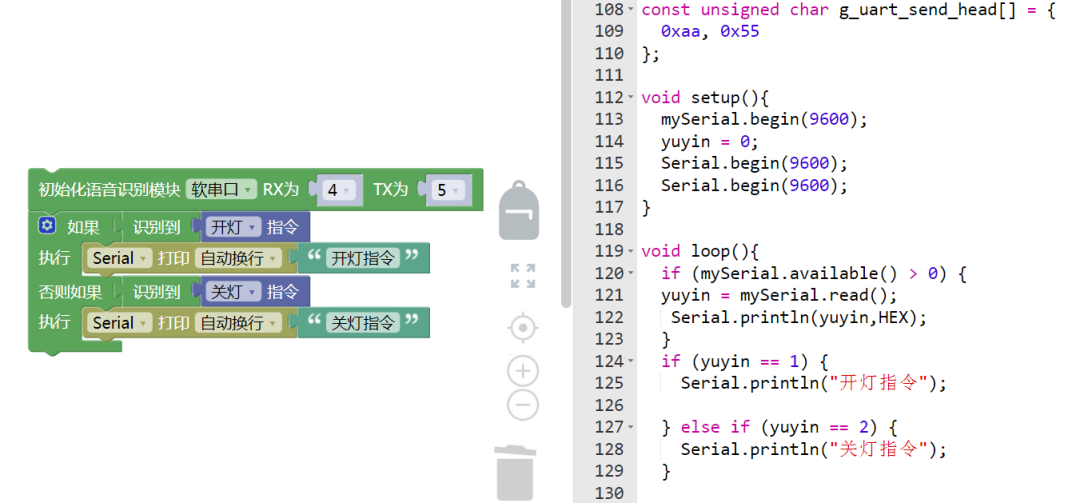
Connect the pins as follows: RX:D4 TX:D5.
Note: The library file can be obtained by leaving a message in the comments section.
04Safety Measures
1. Power off before wiring, and confirm VCC (3.3V-5V) and GND polarity; reversing connections may burn the recognition chip;
2. Avoid using in high noise environments (e.g., above 85 decibels), as this will significantly reduce recognition rates;
3. Do not block or cover the microphone hole (small hole on the module surface), as this will affect sound reception;
4. Do not touch the microphone or chip with sharp objects to prevent physical damage;
5. Use in humid environments requires adding a moisture-proof shell, as moisture can reduce microphone sensitivity;
6. If recognition is unstable during debugging, check if the power supply is stable (recommended 3.3V power supply to reduce ripple interference);
7. When not in use for a long time, power off and store to avoid microphone aging.
05Extensions
Students can try the following:
1. Create a “voice-controlled car”: Combine with the L298N motor driver module to control the car’s movement with commands like “forward”, “backward”, “turn left”, “turn right”;
2. Build a “smart bedroom system”: Connect relay modules to control lights, fans, and curtains with voice commands, achieving “one-stop” voice interaction;
3. Design a “voice interactive toy”: Link with the HS-S49A-PL MP3 module to play corresponding sound effects upon recognizing commands (e.g., saying “tell a story” plays a fairy tale audio);
4. Develop a “voice alarm device”: In conjunction with the HS-S38P human sensor, report “a stranger has entered” through the voice module when an anomaly is detected.
 Arduino Sensor: HS-S01A Infrared SensorArduino Sensor: HS-S02P Infrared Sensor (Obstacle Avoidance)Arduino Sensor: HS-S03P Ultraviolet SensorArduino Sensor: HS-S05P Sound SensorArduino Sensor: HS-F07P Active BuzzerArduino Sensor: HS-S08P Flame SensorArduino Sensor: HS-S09LB Raindrop SensorArduino Sensor: HS-S09PC Soil Moisture Sensor
Arduino Sensor: HS-S10P Mist Sensor
Arduino Sensor: HS-S11-L Gas Sensor
Arduino Sensor: HS-S20P Ambient Light Sensor
Arduino Sensor: HS-S21P Tilt SensorArduino Sensor: HS-S22P Grayscale SensorArduino Sensor: HS-S23P Infrared Receiver ModuleArduino Sensor: HS-S24P Digital Temperature SensorArduino Sensor: HS-S26A Temperature and Humidity SensorArduino Sensor: HS-S28P Potentiometer
Arduino Sensor: HS-S29P Infrared Transmitter Module
Arduino Sensor: HS-S30P Clock Module
Arduino Sensor: HS-S31P Touch Sensor
Arduino Sensor: HS-S32L Rotary Encoder Module
Arduino Sensor: HS-S34P Dual-axis Joystick Module
Arduino Sensor: HS-S37PS Water Level Sensor
Arduino Sensor: HS-S38P Human Sensor
Arduino Sensor: HS-S40P Hall Magnetic Sensor
Arduino Sensor: HS-S45P Pressure Sensor
Arduino Sensor: HS-S46P Weight Sensor
Arduino Sensor: HS-S48P Gyroscope Module
Arduino Sensor: HS-S49A-PL Voice Broadcast Module

— Previous Recommendations —