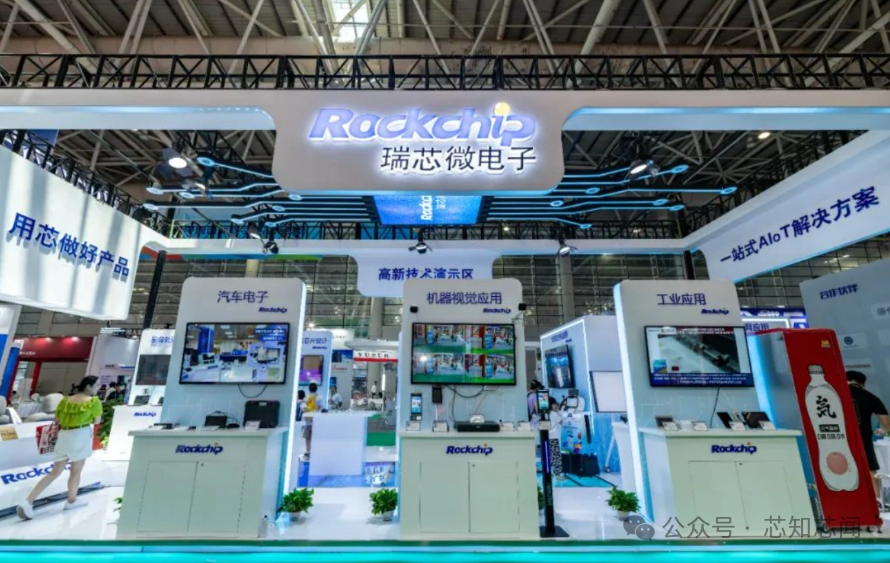
Rockchip (603893.SH) significantly exceeded expectations in its performance for the first half of 2025, with strong growth driven by the synergistic effects of multiple factors:
1.Explosion of the AIoT Market and Surge in Edge AI Demand
High Industry Prosperity Driven: In the first half of 2025, the AIoT (Artificial Intelligence of Things) market continued its rapid growth trend from 2024, with AI technology accelerating its penetration into edge computing, driving smart automotive electronics, industrial automation, machine vision, and service robots to become core growth engines. The deep expansion of AIoT application scenarios in China (such as smart manufacturing and smart cities) has provided Rockchip with vast market space.
Surge in Edge Computing Power Demand: Open-source large models represented by Deepseek have lowered the development threshold for edge AI, leading to a surge in demand for real-time response and low-power computing capabilities in edge devices. Rockchip’s SoC chips, with their low power consumption and high computing power characteristics, have become core solutions in scenarios such as smart cockpits and industrial robots.
2.Product Matrix Advantages and Technological Innovations
Flagship Chip Volume Production: The main product, RK3588 (high-end SoC), has achieved large-scale applications in automotive electronics (smart cockpits), machine vision, and robotics, driving growth across the RK356X and RV11 series of mid-to-low-end product lines. For example:
The smart cockpit chip RK3588M has been mass-produced for over ten vehicle models, with more than 20 designated projects;
The in-vehicle audio processor RK2118M has secured over 20 designated projects.
New Product Iteration and Co-Processor Breakthroughs:
In July 2025, the first edge AI large model co-processor RK1820/RK1828 will be launched, supporting power stacking and specifically designed for edge large models, addressing the contradiction between slow iteration of traditional SoCs and the surge in computing power demand.
The development of the new generation flagship chip RK3688 and co-processor RK1860 constructs a “SoC + co-processor” dual-track platform, enhancing technical barriers.
3.Product Structure Optimization and Financial Leverage Effects
Gross Margin Continues to Improve: The increase in the proportion of high-end products has driven the gross margin from 33.44% in Q1 2023 to 40.95% in Q1 2025, with a net profit margin exceeding 25% in Q2. The main reasons include:
The volume production of high-margin chips like RK3588 in the automotive and robotics sectors;
Optimization of cost control and release of scale effects.
Expense Control Efficiency: Rapid revenue growth (Q2 2025 single-quarter revenue of 1.16 billion yuan, a year-on-year increase of 64%) has been accompanied by relatively stable sales, management, and R&D expenses, resulting in significant financial leverage effects, with the net profit margin jumping from -5.58% in Q1 2023 to over 25% in Q2 2025.
4.Deepening Strategic Layout and Ecological Synergy
Full-Stack Solution Capability: Covering high-growth tracks such as automotive electronics and robotics with a “chip + algorithm + scenario” model. For example:
In the robotics field: RK3588 supports motion control and environmental perception for humanoid robots, already implemented in various scenarios including industrial, service, and humanoid robots.
The economical vision chip RV1103B/C equipped with AI-ISP technology is capturing the cost-effective camera market.
Continuous R&D Investment: In 2024, R&D expenses reached 564 million yuan (20% of revenue), supporting the IP chipization and systematization technology path, ensuring rapid product iteration.
5.Future Growth Momentum and Risks
New Market Growth: The co-processor RK1820 series and RK3688 chip are expected to enter mass production in the second half of 2025, likely further opening up the edge computing market; the automotive electronics business (revenue year-on-year increase of over 70%) and designated projects in the robotics field are gradually being realized.
Potential Risks: Tight wafer production capacity and rising raw material prices may affect delivery; increasing industry competition and slower-than-expected new product introductions need to be monitored.
Conclusion
Rockchip’s performance explosion is essentially the result of “technological positioning + demand resonance + operational efficiency improvement“: its high-end SoC precisely matches the edge AI computing power upgrade demand, co-processor innovations address industry pain points, and the surge in orders from high-prosperity tracks such as automotive and robotics ultimately leads to a stepwise increase in revenue and profit. In the short term, the ramp-up of new products and optimization of gross margins will continue to support high growth; in the medium to long term, it is necessary to track the increase in AIoT penetration and the deepening process of domestic substitution.